Remote LED Driver Benefits: 2026 Centralized Power Guide
Explore remote LED driver benefits, including lower heat, HVAC savings, longer driver life, simpler maintenance, and GMP-ready washdown. Learn more.
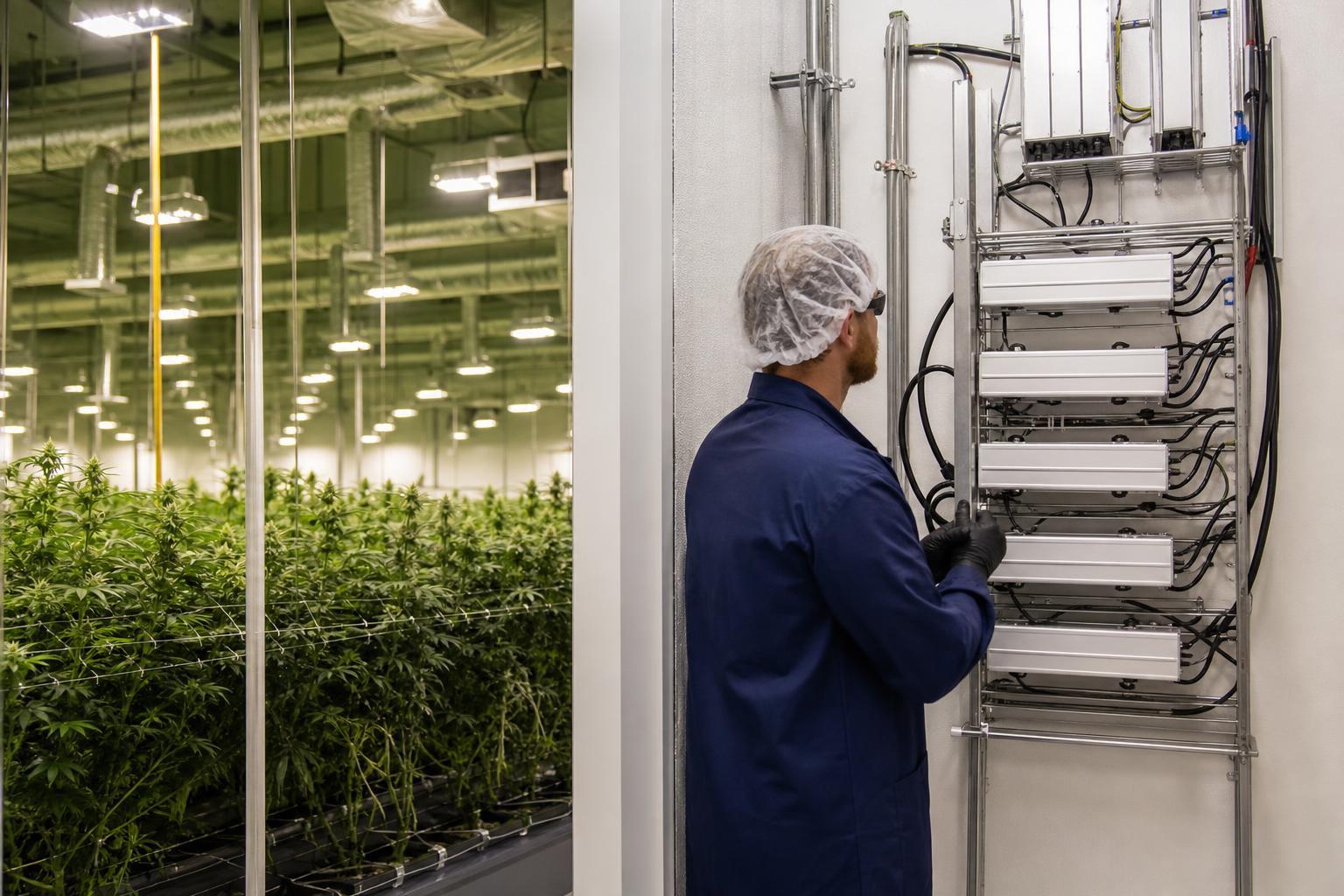
TL;DR: A remote LED driver relocates the power conversion component away from the light fixture, typically to an electrical room or equipment rack. The benefits include meaningful heat reduction in the grow space, dramatically extended driver lifespan through cooler operating temperatures, up to 35-40% savings on installation costs, simplified maintenance, and improved biosecurity for GMP-compliant facilities. For large commercial operations, this infrastructure decision pays dividends across every stage of the facility’s life.
What Is a Remote LED Driver?
Every LED fixture needs a driver. This is the component that converts AC mains power (the electricity from your wall) into the regulated DC current that LEDs actually use. It is a switched-mode power supply, not a simple transformer, and it contains sensitive electronic components that generate heat and eventually wear out.
In a traditional LED grow light, the driver is built into or bolted onto the fixture housing. It sits right there in the grow room, above or beside the canopy, exposed to the same heat and humidity as your plants.
A remote LED driver changes this arrangement. The power conversion step moves physically away from the fixture, either to a nearby wall, an adjacent hallway, or (in fully centralized architectures) to an electrical room or equipment rack that serves dozens or hundreds of fixtures at once. The fixture itself becomes lighter, simpler, and essentially “driverless,” receiving only low-voltage DC power through a cable.
You may see this concept described as centralized power distribution, driverless fixtures, or external driver architecture. They all refer to the same core idea: separate the electronics from the light.
Explore OptiDrive centralized power to see how this works in practice for commercial grow facilities.
The spectrum of remote driver setups ranges from a single driver mounted on a wall a few feet from its fixture (something even home growers do) to fully centralized systems where one rack powers an entire room. The benefits scale accordingly.
Heat Reduction and HVAC Savings
This is the benefit most people encounter first, and it is real, though often overstated by marketing copy. Being precise about the numbers matters.
LED drivers are typically between 89% and 95% efficient. That means only 5-11% of a fixture’s total power draw is lost as heat from the driver itself. On a standard 1000W LED fixture producing roughly 3,400 BTUs of heat, the driver contributes about 272 BTUs, or approximately 8%.
That sounds modest for a single fixture. At commercial scale, it is not.
Consider a facility running 500 fixtures at 1000W each. The drivers alone produce 50W of waste heat per unit, totaling 25,000 watts, or about 85,000 BTUs per hour, of heat that must be removed from the grow space. A 1,500-driver installation pushes past 75,000 watts and 255,000 BTUs per hour. That is a substantial HVAC load.
Here’s the nuance that honest engineering demands: relocating those drivers does not eliminate the heat. The energy still exists and still needs to be managed. However, HVAC systems operate significantly more efficiently in a dry, temperature-controlled electrical room than in a humid grow environment. Industry analysis from VoltServer estimates this efficiency difference translates to a 3-4% reduction in total energy use when drivers are centralized.
Three to four percent may not sound dramatic, but in a facility spending $200,000 or more annually on electricity, that is $6,000-$8,000 in real savings, year after year. And the energy math is only part of the story.
For multi-tier and vertical farming operations, the heat benefit becomes even more pronounced. In tight inter-shelf spaces, every watt of heat above the canopy directly raises leaf temperature and complicates climate control. Removing driver heat from those constrained spaces makes environmental management substantially easier.
For a deeper look at how heat loads affect cooling system sizing, the guide on HVAC requirements for LED lights walks through the calculations in detail. Understanding the difference between latent and sensible heat also helps explain why the location of a heat source matters as much as its magnitude.
The Insurance Angle Nobody Talks About
Here’s a remote LED driver benefit that almost no one in the lighting industry discusses: risk reduction from an insurance perspective. Cannabis insurance underwriters have specifically flagged driver heat as a fire risk factor. One insurance practice leader, quoted in industry reporting on cannabis facility risks, noted that after 10-12 hours of operation in a vegetative room, “those drivers are really hot. The lights themselves are not, but the drivers are.” His team observed that remote driver systems were “completely removing the risk of the lights’ heat profiles and placing less strain on ventilation systems.”
For facility operators carrying expensive crop insurance or navigating the still-difficult cannabis insurance market, reducing documented fire risk factors can influence both coverage availability and premiums. This is a concrete, financial remote LED driver benefit that goes beyond energy savings.
Extended Driver Lifespan: The 10°C Rule
If heat reduction is the most discussed benefit, extended lifespan is the most underappreciated. The engineering principle behind it is straightforward and well-established, but rarely explained clearly in horticultural lighting contexts.
Driver failure accounts for roughly 90% of LED system failures. The fixture, the LEDs themselves, the wiring, these components are comparatively bulletproof. The driver is where things break.
The weak point is the electrolytic capacitor inside the driver. These capacitors contain a liquid electrolyte that slowly evaporates over the component’s life. Heat accelerates this evaporation dramatically.
The governing principle comes from the Arrhenius equation applied to power electronics: for every 10°C increase in operating temperature, the lifespan of an electrolytic capacitor roughly halves. The inverse is equally powerful. Drop the operating temperature by 10°C, and you double the expected life.
This is where the remote driver concept transforms from “nice to have” into a serious reliability strategy. Consider what actually happens inside a traditional integrated fixture mounted at ceiling height in a grow room:
- The ambient grow room temperature might be 80°F (27°C).
- Heat rises, so the air at ceiling level is warmer still.
- The driver sits inside a sealed enclosure alongside other heat-producing circuitry (roughly 10% of total fixture power becomes driver heat).
- The capacitor’s actual operating temperature is significantly higher than room ambient, often 20-30°C above it.
By relocating the driver to a climate-controlled electrical room running at 68°F (20°C), the capacitor temperature drops substantially. A 20°C reduction in operating temperature could mean a four-fold increase in expected driver life, based on the 10°C rule. A driver rated for 50,000 hours in a hot grow room might last 200,000 hours in a cool electrical room.
For commercial facilities running hundreds of fixtures, this translates directly into fewer replacements, less maintenance labor, and fewer crop disruptions caused by mid-cycle fixture failures. The article on LED reliability covers additional factors that affect fixture longevity. For those interested in the deeper engineering data, the technical whitepapers section provides further reading.
Lower Installation Costs and Simpler Wiring
The upfront cost savings from remote LED driver architecture are substantial enough to change project economics.
Start with the fixtures themselves. Without an integrated driver, each fixture can be up to 10 pounds lighter. That matters more than you might think. Lighter fixtures require less structural support, simpler mounting hardware, and fewer labor hours to install. When you are hanging hundreds of lights from greenhouse trusses or rack-mounted shelving, cumulative weight reduction affects structural engineering requirements.
Then consider the wiring. In a traditional setup, each fixture needs its own AC power connection plus a separate two-wire 0-10V dimming connection for intensity control and synchronization. That means running two sets of wires to every single fixture, terminated, tested, and tied down.
A centralized remote driver system eliminates fixture-to-fixture dimming wiring entirely. Control signals go to the central driver, which then distributes the correct power levels to each driverless fixture. In some low-voltage architectures, the distribution wiring itself can run without conduit, further reducing material and labor costs.
The numbers from industry analyses are significant. Advanced Energy research documents up to 35% savings on initial costs compared to individual driver systems. VoltServer’s analysis claims centralized LED drivers can reduce combined electrical, control, and LED system costs by up to 40%.
For facility planners running cost comparisons, the guide on greenhouse lighting installation costs provides additional context on how electrical infrastructure decisions affect total project budgets.
Easier Maintenance and Faster Diagnostics
When something fails in a commercial grow facility, speed of diagnosis matters as much as speed of repair. Every hour of downtime above a flowering canopy is lost photons and lost revenue.
With integrated drivers, troubleshooting a dead fixture means getting ceiling access (often in a room full of plants), pulling the fixture down, testing components, and determining whether the problem is the driver, the LED board, or a wiring connection. In a multi-tier setup, access can be even more constrained.
Remote drivers simplify this dramatically. When a circuit fails, the fault is either in the driver, the low-voltage wiring to the fixture, or the LED board itself. A voltage test at the driver output, performed in the electrical room with no ceiling access required, immediately identifies whether the driver has failed. Diagnostic time before any physical intervention drops substantially.
Request a free consultation to discuss how centralized power architecture can simplify maintenance for your specific facility layout.
Hot-swappable driver modules take this further. A failed module can be pulled and replaced in minutes without entering the grow room at all, eliminating crop exposure to outside contaminants and avoiding the disruption of opening a sealed environment mid-cycle. Routine service happens on the operator’s schedule, not in crisis mode.
Practitioners on grower forums confirm these benefits even at small scale. One home grower on the ILGM Forum explained their reasoning for remote-mounting a single 260W driver: “My driver is very hot to the touch. As hot weather is approaching where I live I am planning ahead in case I have to remote mount my driver.” If the heat and access benefits matter for a single fixture in a tent, they compound enormously across a 500-fixture commercial operation.
Biosecurity, Washdown, and GMP Compliance
This is arguably the most overlooked remote LED driver benefit, and it is growing in importance as cannabis regulations tighten and vertical farms increasingly serve food-safety-regulated markets.
LED drivers are not washable. They are sealed electronic components that cannot be sprayed down, submerged, or sanitized the way you would clean a stainless steel surface. In a grow room, they sit in housings that collect dust, harbor moisture, and create crevices where pathogens can establish populations.
Pathogen management in indoor farms depends on thorough, regular washdown of every surface in the grow space. If any component cannot be properly cleaned, it becomes a reservoir for harmful microorganisms that will recolonize cleaned surfaces between cycles. Drivers, control boxes, dimming wire runs, and their associated mounting hardware all create surfaces that are difficult or impossible to sanitize adequately.
Removing drivers from the grow space eliminates these harborage points. Fixtures become simpler enclosures (often IP-rated for wet environments) that can be wiped or sprayed down along with every other surface. The electrical room, which is dry and separately ventilated, handles the electronics in an environment where pathogen pressure is minimal.
For cannabis operations pursuing GMP compliance, this is not a marginal improvement. It is the difference between a room that can be fully sanitized and one that cannot. As regulatory frameworks mature (and as food-safety standards apply to leafy-greens vertical farms), the ability to perform a true washdown becomes a baseline expectation, not a luxury. The guide on reducing operating expenses in cultivation facilities explores how operational decisions like this affect long-term costs.
Practical Considerations and Tradeoffs
Remote LED driver architecture is not without engineering considerations. Understanding these tradeoffs is part of making a good infrastructure decision.
Voltage drop over distance. When power travels from a centralized driver to a distant fixture, some energy is lost in the cable as heat. Lower-current, higher-voltage designs reduce this loss but may require more expensive insulation. Cable sizing, run length, and voltage architecture all need to be engineered correctly. This is not a reason to avoid remote drivers, but it is a reason to work with experienced lighting designers rather than treating it as a simple DIY project.
New builds vs. retrofits. Centralized power architecture is simplest to implement in new construction, where the electrical room, cable pathways, and fixture mounting can all be designed as an integrated system. Retrofitting an existing facility, particularly a traditional greenhouse, involves more technical challenges. It is absolutely possible, but the cost-benefit math depends on the specific building, the existing electrical infrastructure, and the scale of the deployment.
Not all architectures are equal. Remote driver systems range from high-voltage DC distribution (best for large new builds) to low-voltage approaches designed for easier retrofit and enhanced electrical safety. The right choice depends on facility size, regulatory requirements, and budget constraints.
Scale matters. The benefits of remote drivers compound with scale. A facility with 50 fixtures will see real advantages in heat management and maintenance. A facility with 500 or 1,500 fixtures will see transformative improvements in installation cost, reliability, and operational simplicity. For very small operations, the infrastructure overhead of centralized power may not justify the investment, though even mounting a single driver on a cooler wall extends its life.
When Remote LED Drivers Make the Most Sense
The remote LED driver benefits outlined above apply broadly, but they are most compelling in specific scenarios:
- Large-scale deployments with hundreds or thousands of fixtures, where installation cost savings and reduced failure rates have the greatest financial impact.
- Multi-tier and vertical farming environments where inter-shelf space is tight and every watt of heat above the canopy matters.
- Facilities requiring GMP compliance or regular washdown, including cannabis operations under state or federal regulatory frameworks and food-production vertical farms.
- Operations prioritizing long-term reliability and low total cost of ownership over lowest upfront fixture price.
- Humid grow environments where driver electronics face accelerated degradation from both heat and moisture.
For cultivation teams evaluating this infrastructure decision, the math generally favors centralized power once you cross the threshold of roughly 100+ fixtures, particularly in new construction where the electrical design can be optimized from the start.
Talk to a lighting expert about whether centralized power architecture fits your facility plan.
Frequently Asked Questions
What exactly does an LED driver do?
An LED driver is a switched-mode power supply that converts AC mains electricity into the regulated DC current that LEDs require to operate. It controls voltage and current to ensure the LEDs receive stable, appropriate power. Without a driver, LEDs cannot function from standard electrical circuits.
How much heat do LED drivers actually produce?
LED drivers are typically 89-95% efficient, meaning 5-11% of input power is lost as heat. On a 1000W fixture, the driver contributes roughly 272 BTUs of heat, about 8% of the fixture’s total thermal output. At scale (500+ fixtures), this adds up to tens of thousands of watts that must be removed by HVAC systems.
Will remote-mounting my LED drivers save a lot on energy costs?
The direct HVAC energy savings from relocating drivers is typically 3-4%, not the dramatic reduction some marketing materials imply. The real value proposition is the combination of that energy savings with installation cost reductions (up to 35-40%), dramatically extended driver life, simpler maintenance, and improved biosecurity. Energy savings alone rarely justify the switch; the total package does.
What is the 10°C rule for LED drivers?
Based on the Arrhenius equation, every 10°C increase in operating temperature roughly halves the lifespan of the electrolytic capacitors inside LED drivers. Conversely, every 10°C decrease doubles their life. Since drivers account for about 90% of LED system failures, relocating them to a cooler environment is the single most effective way to extend the useful life of your entire lighting system.
Can I retrofit remote drivers into an existing facility?
Yes, though it is more straightforward in some buildings than others. New construction allows the cleanest integration because electrical rooms, cable pathways, and fixture mounting points can be designed together. Existing facilities, especially traditional greenhouses, may face additional challenges with cable routing and space allocation. Low-voltage distribution architectures tend to be more retrofit-friendly than high-voltage DC systems.
Are remote LED drivers worth it for small grows?
For very small operations (under 20-30 fixtures), the infrastructure overhead of a fully centralized system may not justify the cost. However, even remote-mounting individual drivers on a cooler wall or in an adjacent space provides meaningful heat and lifespan benefits. The cost savings from simplified wiring and lighter fixtures scale proportionally, so the sweet spot for centralized architectures is typically 100+ fixtures.
How do remote drivers improve biosecurity?
Drivers cannot be washed or sanitized. When mounted inside fixtures in the grow room, they and their associated wiring create surfaces where pathogens can harbor and grow between cleaning cycles. Removing all driver electronics from the grow space allows for thorough, uncompromised washdown of every surface, which is critical for GMP compliance and pathogen management in both cannabis and food-production environments.
What should I consider when choosing between remote driver architectures?
The main variables are facility scale, new build vs. retrofit, electrical safety requirements, and budget. High-voltage DC systems offer the highest efficiency and are ideal for large new builds. Low-voltage distribution systems prioritize easier installation and enhanced safety, making them better suited for retrofits and projects where conduit elimination is a priority. Working with an experienced lighting design team ensures the architecture matches your specific operational needs.