Greenhouse Lighting Installation Cost: 2026 Complete Guide
Greenhouse Lighting Installation Cost in 2026: See $8–$30+ per sq ft, 18–24 mo payback, and rebate tips for LED vs HPS. Get your custom estimate.
TL;DR
Greenhouse lighting installation cost covers far more than fixtures. The total project cost, including electrical infrastructure, HVAC adjustments, controls, and labor, typically runs 2 to 5 times what growers budget for lights alone. Expect $3 to $25+ per square foot depending on technology choice, facility size, and regional factors. LED systems cost more upfront but pay back within 18 to 24 months through energy savings, and utility rebates can offset 30% to 70% of fixture costs when handled correctly.
Quick Answer: Greenhouse Lighting Installation Cost
For most commercial greenhouses, total installed lighting costs range from $8 to $30+ per square foot, depending on fixture type, electrical upgrades, labor, controls, and HVAC requirements.
Greenhouse Size | Typical Installed Cost |
|---|---|
500 sq ft | $4,000–$15,000 |
1,000 sq ft | $8,000–$30,000 |
5,000 sq ft | $45,000–$140,000 |
10,000 sq ft | $90,000–$280,000+ |
50,000 sq ft | $400,000–$1M+ |
Most commercial growers underestimate installation costs because lighting fixtures often represent only 25–50% of the total project budget. Electrical work, HVAC upgrades, permitting, controls, engineering, and commissioning make up the remaining costs.
Key takeaway: Budget for the complete lighting system—not just the fixtures.
What Is Greenhouse Lighting Installation Cost?
Greenhouse lighting installation cost is the total capital expenditure required to deploy supplemental or sole-source lighting in a greenhouse. It includes everything from the fixtures themselves to the electrical infrastructure that powers them, the labor to install them, the controls that run them, and the HVAC modifications needed to manage the heat they produce.
Most growers think of this cost as “the price of the lights.” That thinking leads to bad budgets. The fixture is often less than half the total installed cost, and sometimes less than a quarter. A realistic project budget must account for five distinct cost layers, each with its own variables and surprises.
This matters whether you’re planning a new greenhouse build or retrofitting an existing HPS setup. In both cases, the gap between what growers expect to spend and what they actually spend is where projects stall, budgets blow up, and ROI calculations fall apart.
Get a project-specific cost estimate from a lighting expert →
The Five Layers of Greenhouse Lighting Installation Cost
Every greenhouse lighting project is really five projects stacked on top of each other. Here’s what each one involves and what it costs.
1. Fixture Hardware
This is the line item everyone focuses on, and it’s the most straightforward to price.
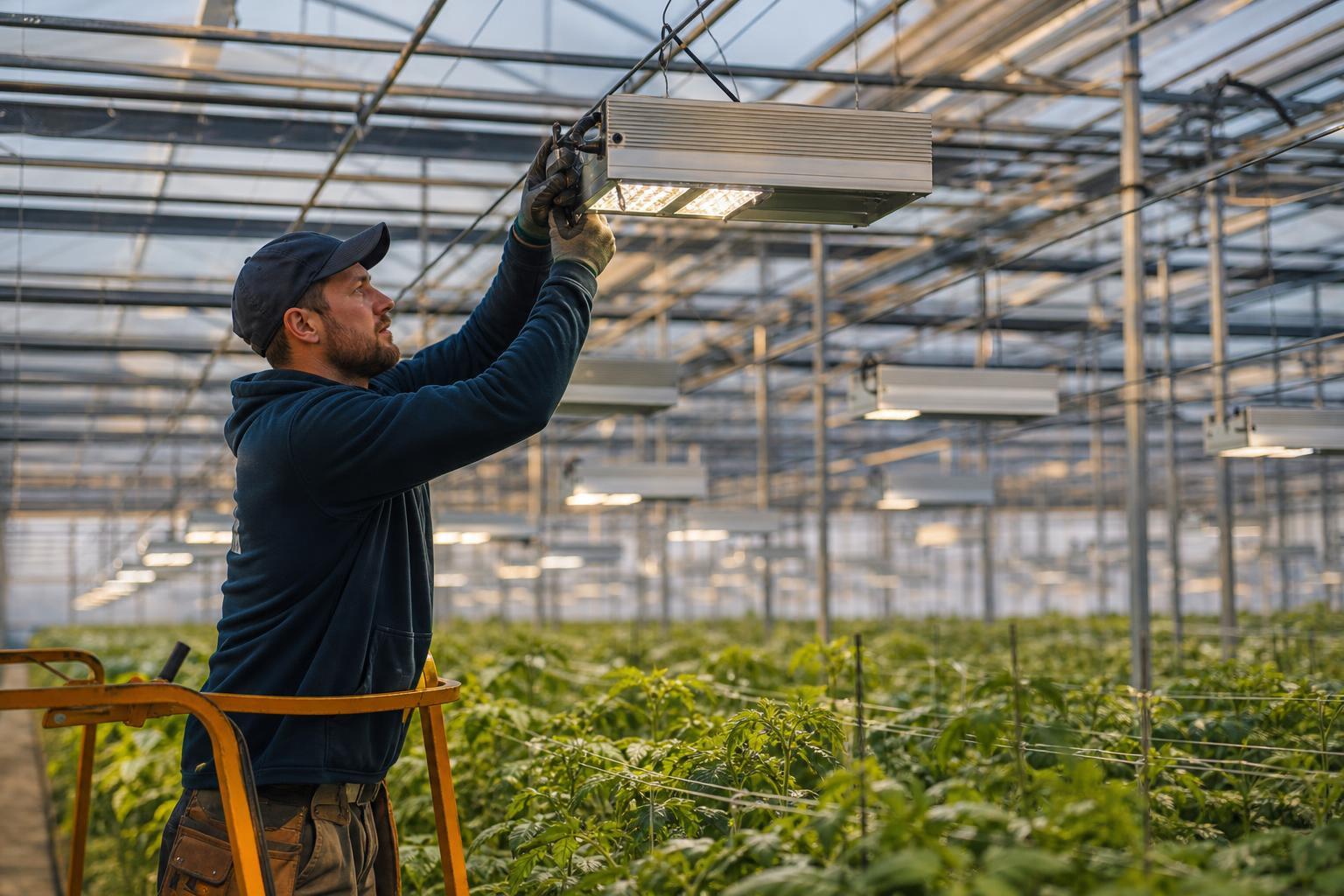
HPS systems run $200 to $400 per 1,000W unit (lamp, ballast, and reflector included). For a 1,000-square-foot greenhouse, a full HPS installation typically costs $8,000 to $12,000 in fixture hardware.
LED systems cost more per fixture: $600 to $1,500 for a 1,000W-equivalent unit, or roughly $15,000 to $25,000 per 1,000 square feet. Smaller supplemental LED fixtures for hobby or small commercial operations fall in the $100 to $300 range per unit.
On a per-square-foot basis, lighting hardware alone adds roughly $2 to $5 per square foot for basic supplemental setups, and $10 or more for high-intensity sole-source applications. For a closer look at how LED and HPS options compare across the full cost picture, this LED vs. HPS greenhouse lighting comparison is worth reading.
2. Electrical Infrastructure (the Biggest Hidden Cost)
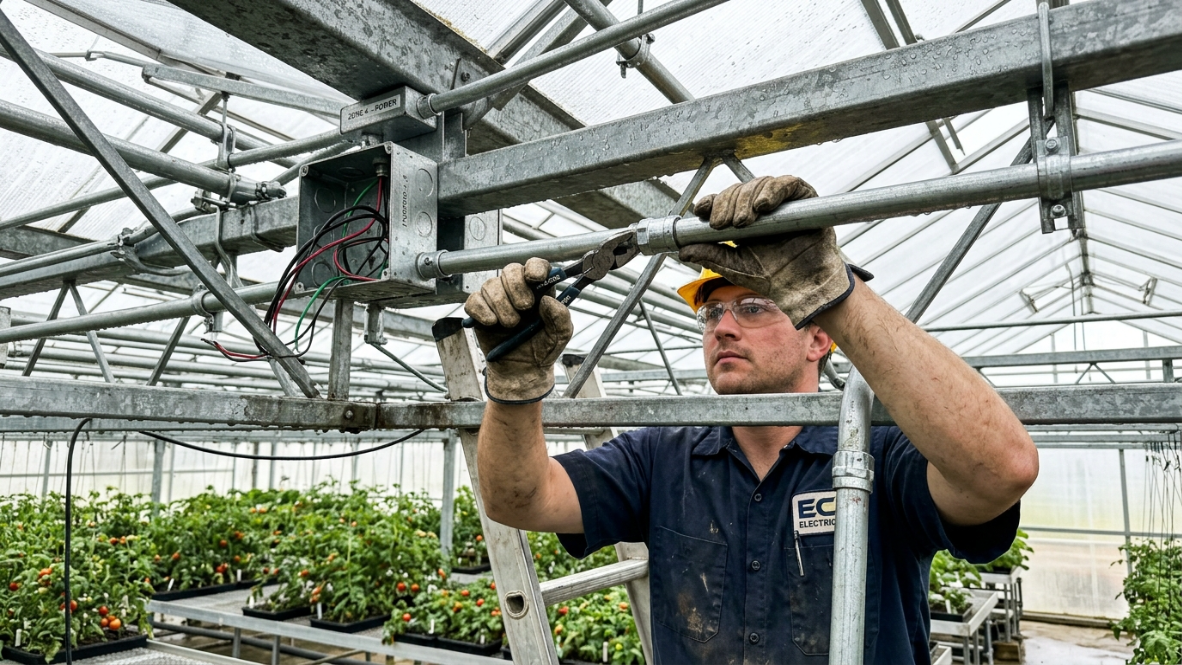
This is where budgets explode. Wiring, conduit, electrical panels, transformers, and switchgear can easily exceed the cost of the fixtures themselves.
Greenhouses are classified as wet, high-dust environments. The National Electrical Code requires all wiring to be run in conduit, typically Electrical Metallic Tubing (EMT) with galvanized and organic-coated interiors for corrosion resistance. Practitioners on electrician forums confirm that greenhouse installs demand specialized cable choices because of heat, humidity, and UV exposure. SWA cable and IP-rated components are standard.
The scale of this work is staggering. Even a medium-sized grow facility requires thousands of feet of conduit, all managed by a certified electrician. According to a detailed analysis from Cannabis Equipment News, conduit installation accounts for roughly 85% of the total labor involved in distributing power to LED fixtures.
Electrician rates for greenhouse work range from $50 to $120 per hour, and a large install can require hundreds of hours. Panel upgrades add another significant chunk. In the cannabis sector, one contractor noted that utilities sometimes charge $50,000 upfront for service upgrades to facilities requiring 2,400-amp capacity, because the utility bears the risk if the operation goes under.
An electrical engineer interviewed by Marijuana Venture put it bluntly: having an engineer who has designed grow facilities before matters more than having the right electrician. If the engineering is done correctly, any licensed electrician can follow the plans.
3. HVAC Adjustments
Lighting technology directly affects your cooling load. HPS fixtures convert a large portion of their energy input into heat, requiring substantial HVAC capacity to maintain canopy temperatures. LEDs run significantly cooler.
Switching to LED systems typically reduces peak cooling demand by about 5%, and in some cases up to ~15% depending on the facility design and controls. That can still mean smaller HVAC equipment in a new build or reduced run-time in a retrofit. Annual cooling cost reductions from LEDs can also be meaningful, but should be calculated case-by-case.
This works in both directions, though. If you’re moving from HPS to LED, your greenhouse may need additional heating capacity in winter because you’ve lost all that radiant heat from the old fixtures. The HVAC adjustment is a real cost (or savings) that belongs in your installation budget. For deeper detail on this calculation, see this guide on HVAC sizing for LED grow lights.
4. Controls and Automation
A bare-bones installation might just wire fixtures to manual switches. Commercial operations rarely stop there. Dimming, scheduling, zone control, and daylight integration systems add cost but pay for themselves quickly.
When ambient sunlight is sufficient to meet your daily light integral (DLI) targets, automated controls can dim or shut off supplemental lights entirely. This strategy compounds on top of any efficiency gains from the fixtures themselves. Control systems range from simple timers and 0-10V dimmers (a few hundred dollars) to fully integrated environmental control platforms (several thousand dollars or more, depending on the number of zones and integration requirements).
5. Labor and Project Management
Beyond the electrician’s hourly rate, factor in lighting design, engineering, project management, and commissioning. A professional lighting plan ensures uniform PPFD across the canopy and right-sizes the system for your crop’s DLI requirements. Skipping this step is a common and costly mistake.
Summary: Greenhouse Lighting Installation Cost Per Square Foot
Cost Layer | Approximate Range (per sq ft) |
|---|---|
Fixture hardware (LED) | $8 – $25 |
Fixture hardware (HPS) | $5 – $12 |
Electrical infrastructure | $3 – $15+ |
HVAC adjustments | $0 – $5 (savings possible with LED) |
Controls and automation | $0.50 – $3 |
Labor (design, install, commissioning) | $3 – $10 |
These ranges vary widely based on facility size, location, technology choice, and whether you’re building new or retrofitting. But the key takeaway is clear: fixture cost is only one piece of the total greenhouse lighting installation cost.
Where lighting fits within a broader facility buildout budget matters too, especially for cannabis operations where lighting can be the single largest capital line item.
Greenhouse Lighting Installation Cost by Greenhouse Size
Greenhouse Size | Estimated Project Cost | Typical Fixture Count |
|---|---|---|
500 sq ft | $4,000–$15,000 | 4–8 |
1,000 sq ft | $8,000–$30,000 | 8–20 |
2,500 sq ft | $20,000–$70,000 | 20–45 |
5,000 sq ft | $45,000–$140,000 | 45–90 |
10,000 sq ft | $90,000–$280,000 | 90–180 |
50,000 sq ft | $400,000–$1M+ | 400–900 |
Actual fixture counts vary based on crop type, greenhouse glazing, latitude, desired PPFD, and fixture efficacy.
How to Estimate Your Greenhouse Lighting Budget
Every lighting project follows the same budgeting process:
Step 1
Determine your target Daily Light Integral (DLI).
Step 2
Calculate the required PPFD for your crop.
Step 3
Determine fixture quantity.
Step 4
Estimate electrical upgrades.
Step 5
Include controls and automation.
Step 6
Add HVAC adjustments.
Step 7
Include installation labor.
Step 8
Subtract available utility rebates.
By estimating costs in this order, growers avoid one of the most common budgeting mistakes—pricing fixtures first while ignoring infrastructure costs.
LED vs. HPS: Installation Cost Comparison
The upfront fixture cost gap between LED and HPS has narrowed considerably over the past decade, but LEDs still carry a higher sticker price. That higher price buys you lower total installation cost and dramatically lower operating costs.
Upfront fixture cost: HPS wins. A 1,000W double-ended HPS system can be had for $200 to $400. A comparable LED fixture runs $600 to $1,500.
Electrical infrastructure cost: LED wins. Lower wattage per photon means smaller wire gauges, fewer circuits, and potentially smaller panel capacity. An LED system producing the same photon output as a bank of 1,000W HPS fixtures draws 40% to 50% less power.
Daily operating cost: LED wins decisively. A 1,000W DE HPS fixture costs approximately $1.85 per day to operate, while a comparable LED costs under $1.00. Modern LEDs achieve photon efficacy of 2.5 to 3.0 µmol/J compared to 1.7 to 1.9 µmol/J for HPS.
Maintenance cost: LED wins. LED fixtures last approximately 50,000 hours (roughly 10 years). HPS bulbs degrade and need replacement every 8 to 12 months at $30 to $70 per bulb, plus the labor to swap them. Over five years, a single 1,000W LED system saves $1,800 to $3,600 in electricity alone compared to HID.
Payback period: Most commercial greenhouse growers recover the LED cost premium within 18 to 24 months through energy and maintenance savings. And that’s before accounting for utility rebates.
One critical point that trips up many growers: comparing LEDs to HPS on fixture price alone is the single most common budgeting mistake in greenhouse lighting. Total installed cost, including the electrical and HVAC layers, tells a completely different story.
LED vs HPS Installation Comparison
Feature | LED | HPS |
|---|---|---|
Fixture Cost | Higher | Lower |
Electrical Load | Lower | Higher |
Cooling Requirement | Lower | Higher |
Maintenance | Low | High |
Lamp Replacement | None | Every 8–12 months |
Expected Lifespan | ~50,000 hours | ~10,000 hours |
Utility Rebates | Common | Limited |
Total Cost of Ownership | Lower | Higher |
Typical Cost Breakdown of a Commercial Lighting Project
Project Component | Typical Share of Budget |
|---|---|
Lighting Fixtures | 30–45% |
Electrical Infrastructure | 20–35% |
Labor | 10–20% |
Controls | 3–8% |
HVAC Modifications | 5–15% |
Engineering & Design | 2–5% |
Permits & Inspections | 1–3% |
The exact percentages vary by project size, but most commercial greenhouse lighting installations follow a similar distribution.
How Centralized Power Architecture Cuts Installation Cost
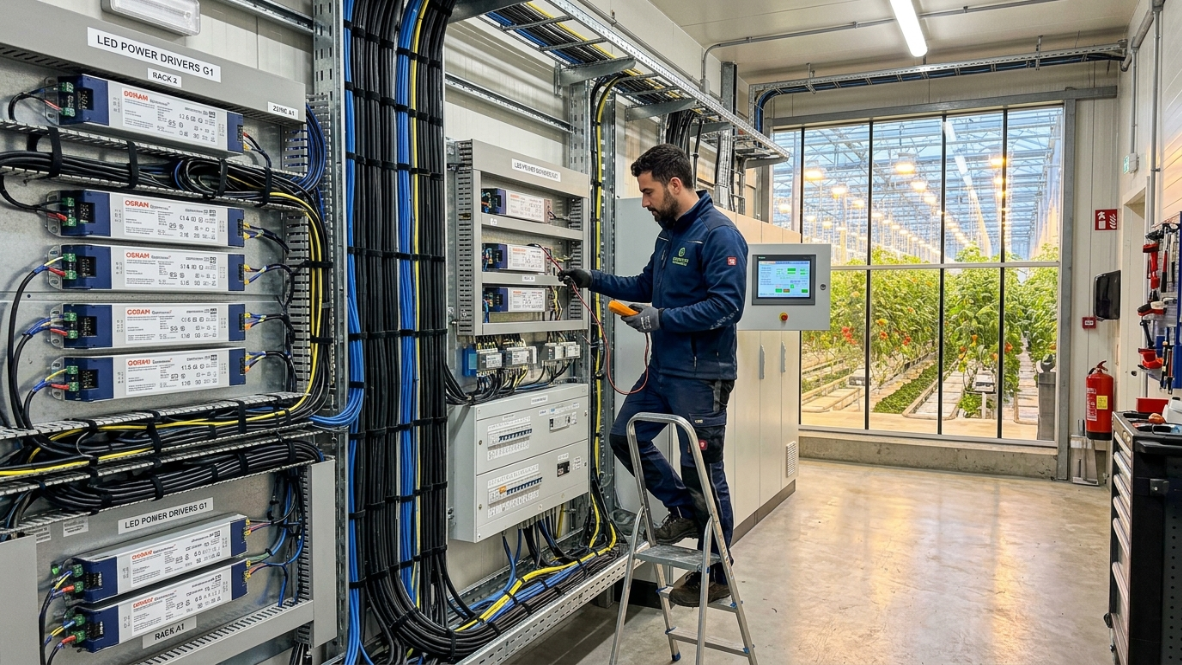
The electrical infrastructure layer, particularly conduit, is the hidden cost bomb in greenhouse lighting projects. A growing number of operations are attacking this problem at its root through centralized power distribution.
Traditional AC-powered LED fixtures each contain their own driver (the component that converts AC power to the DC that LEDs actually need). Every fixture needs its own dedicated home run of conduit and wiring back to an electrical panel. In a 1,000-light greenhouse, that is thousands of feet of conduit, each foot installed by a licensed electrician at $50 to $120 per hour.
Centralized power architecture flips this model. The drivers move out of the fixtures and into a centralized rack, which then distributes power to lighter, simpler fixtures through low-voltage cabling that, depending on the system, can eliminate much of the conduit requirement.
The numbers are striking. Cannabis Equipment News reported that traditional AC systems require 32 times more conduit than centralized alternatives (1,920 feet vs. 60 feet in one case study). That reduction translates to roughly 80% less installation labor and a 32% reduction in the total cost of delivering light to the canopy, approximately $18.28 per square foot of savings.
There’s a fixture cost benefit too. The AC-to-DC driver typically accounts for around 30% of an LED fixture’s retail price. Removing it from each fixture and centralizing it means lighter fixtures, fewer in-room failure points, less heat at the canopy, and lower per-unit hardware cost. Advanced Energy reports that centralized LED lighting drivers deliver up to 35% savings on initial capital costs and approximately 20% annual savings on energy and maintenance.
Thrive Agritech’s OptiDrive remote power platform is built on this principle, available in both DC and DE configurations for new builds and retrofits respectively.
Utility Rebates: The Cost Offset Most Growers Miss
Utility rebates are the most underused tool for reducing greenhouse lighting installation cost. For facilities running 12 to 18 hours of daily photoperiods, transitioning from HPS to LED with modern rebates can offset 30% to 70% of the total fixture cost. In some cases, depending on location and utility provider, growers have received refunds covering up to 100% of the LED fixture cost.
How Rebates Work
Most utility rebate programs require fixtures to be DLC (DesignLights Consortium) certified. DLC certification verifies that a fixture meets minimum photosynthetic photon efficacy (PPE) thresholds, typically 2.3 to 2.7 µmol/J depending on the program and fixture category.
The Pre-Approval Trap
Here’s the mistake that costs growers tens of thousands of dollars: buying fixtures before getting rebate pre-approval. Most utility companies view rebates as an inducement to purchase, not a retroactive reward. If the equipment is already purchased, the incentive disappears.
The correct sequence: apply for the rebate, get written pre-approval, then place the purchase order. This is not optional, and it’s not a formality. It is the single most important step in capturing rebate value.
Check rebate availability for your project →
Greenhouse Lighting Installation Timeline
Project Stage | Typical Time |
|---|---|
Lighting design | 1–2 weeks |
Engineering | 2–4 weeks |
Utility rebate approval | 2–8 weeks |
Equipment ordering | 2–10 weeks |
Electrical installation | 1–4 weeks |
Fixture installation | 2–10 days |
Commissioning | 1–3 days |
Most commercial projects take 6 to 12 weeks from planning to operation.
Factors That Affect Your Total Greenhouse Lighting Installation Cost
No two greenhouse lighting projects cost the same. Here are the variables that create the widest cost swings.
Geographic Location
Location affects greenhouse lighting cost in two ways: sunlight availability and electricity price.
A greenhouse in Kalamazoo, Michigan, needs nearly twice the supplemental lighting of one in Athens, Georgia, simply because of shorter winter days and lower light levels. More lights means more fixtures, more wiring, and higher operating costs.
Electricity rates vary enormously, from as little as $0.07 per kWh in Louisiana to over $0.31 per kWh in Hawaii. A greenhouse in the upper Midwest gets a bigger payback from efficient LED fixtures than one in the South, because more supplemental hours are needed.
Greenhouse Size and Layout
Scale matters, but not always in the direction you’d expect. Larger operations benefit from economies of scale on fixtures and engineering, but the electrical infrastructure cost scales roughly linearly (or worse, if panel upgrades are needed). Layout complexity, ceiling height, and row spacing all affect the number of fixtures and the wiring runs required.
New Build vs. Retrofit
New builds allow you to design electrical infrastructure from scratch, right-sizing panels, conduit runs, and HVAC for the chosen lighting system. Retrofits must work within existing electrical capacity, which often means expensive panel upgrades and creative wiring solutions. On the flip side, retrofits benefit from existing structural mounting and may qualify for larger utility rebates because the baseline (old HPS) establishes a clear energy-reduction calculation.
Crop Type and Target DLI
A lettuce operation targeting 12 to 17 mol/m²/day of DLI needs far less supplemental light than a cannabis flower room targeting 40+ mol/m²/day. Crop requirements directly determine fixture density, which drives every other cost in the stack. Understanding DLI-based sizing is essential before budgeting.
Local Labor Rates and Code Requirements
Electrician rates, permit fees, and inspection requirements vary by municipality. Some jurisdictions require stamped engineering drawings; others don’t. These differences can swing installation labor costs by 30% or more between regions.
Common Mistakes That Inflate Greenhouse Lighting Installation Cost
Budgeting for Fixtures Only
The most pervasive mistake. Fixture hardware is often 25% to 50% of total installed cost. Growers who budget $50,000 for lights and then discover they need $80,000 in electrical work are not unusual. They’re typical.
Under-Sizing Electrical Panels
Adding supplemental lighting to an existing greenhouse frequently pushes the electrical system past its capacity. A panel upgrade midway through a project adds cost, delays, and utility coordination headaches. Size the panel for the full lighting load (plus a growth margin) from the start.
Skipping Professional Lighting Design
A proper lighting plan maps PPFD uniformity across the canopy, identifies fixture placement, calculates DLI delivery, and specifies electrical loads per circuit. Without it, growers end up with hot spots, dead zones, oversized systems, or (worst case) all three. The cost of a professional design is a fraction of the cost of fixing a bad installation. To avoid the most common facility buildout errors, review these indoor agriculture pitfalls.
Buying Before Rebate Pre-Approval
Worth repeating: ordering fixtures before written rebate approval is the single most expensive administrative mistake a grower can make. Thousands of dollars, sometimes tens of thousands, vanish because someone jumped the gun.
Ignoring the Operating Cost Equation
Electricity costs for supplemental lighting can consume up to 30% of total greenhouse operating costs. A typical 300-light glasshouse running 12 hours of supplemental light will see electricity bills exceeding $200,000 per year. Choosing a slightly cheaper fixture with lower efficacy costs far more over its lifetime than the initial savings. The real metric is total cost of ownership, not purchase price. For strategies on cutting those ongoing expenses, this guide on reducing operating costs in grow facilities provides practical next steps.
Questions to Ask Before Requesting Quotes
Before comparing proposals, ask installers:
Does the quote include electrical infrastructure?
Are permits included?
Is engineering included?
Does it include commissioning?
Are utility rebate applications handled?
Are HVAC impacts evaluated?
Is PPFD mapping included?
Are fixture mounting systems included?
Are controls programmed?
Are future expansion circuits included?
These questions make comparing competing proposals much easier.
Frequently Asked Questions
How much does greenhouse lighting installation cost per square foot?
Total installed cost ranges from roughly $8 to $30+ per square foot for commercial LED installations, depending on fixture density, electrical infrastructure complexity, and whether you’re building new or retrofitting. Fixture hardware alone adds $2 to $25 per square foot, but electrical work, HVAC, controls, and labor can easily double or triple that figure.
Is LED or HPS cheaper to install in a greenhouse?
HPS is cheaper upfront ($8,000 to $12,000 per 1,000 sq ft vs. $15,000 to $25,000 for LED). But LED systems draw less power, which means smaller wire gauges, fewer circuits, and potentially lower electrical infrastructure costs. When you include the electrical layer, the gap narrows significantly. Over 18 to 24 months, energy savings typically eliminate it entirely.
What is the biggest hidden cost in greenhouse lighting installation?
Electrical infrastructure, specifically conduit and wiring. Running NEC-compliant conduit through a wet, high-dust greenhouse environment accounts for up to 85% of installation labor. Many growers underestimate this cost by 50% or more.
How can I reduce greenhouse lighting installation cost?
Four primary strategies: choose high-efficacy LED fixtures to reduce total fixture count, explore centralized power architecture to slash conduit and wiring costs, capture utility rebates (30% to 70% of fixture cost), and invest in proper engineering upfront to avoid costly rework.
Do utility rebates really cover LED grow light costs?
Yes, and substantially. Depending on your utility provider and location, rebates can offset 30% to 70% of LED fixture costs, with some programs covering up to 100%. The critical requirement is DLC certification on the fixtures and written pre-approval from the utility before purchasing.
How long does it take for LED greenhouse lighting to pay for itself?
Most commercial growers recover the LED investment premium within 18 to 24 months through electricity and maintenance savings. Operations with high daily photoperiods (12+ hours), expensive electricity, or significant rebate offsets may reach payback even sooner.
Does switching from HPS to LED affect HVAC costs?
Yes. Switching from HPS to LED typically reduces peak cooling demand by around 5%, and in some cases up to ~15% depending on the facility design and controls. Cooling cost savings can still be meaningful, but should be calculated case-by-case. However, in cold climates, you may need to compensate for the loss of radiant heat that HPS fixtures provided, potentially increasing heating costs in winter.
Should I hire a lighting designer or just buy fixtures?
Hire a designer. A professional lighting plan ensures uniform PPFD, right-sizes the system for your crop’s DLI needs, and specifies the electrical load per circuit. The cost of design is a small fraction of total installation cost and prevents expensive corrections later. An experienced electrical engineer who understands grow facilities is more valuable than finding the cheapest electrician.
Greenhouse lighting installation cost is a complex, multi-layered number that rewards careful planning and punishes shortcuts. The growers who budget accurately, capture rebates, and choose the right power architecture end up with systems that pay for themselves within two years. Those who wing it end up paying two to five times what they expected.
If you’re planning a greenhouse lighting project and want a realistic cost estimate tailored to your facility, crop, and location, schedule a free consultation with a Thrive Agritech lighting expert.