Grow Light Wiring Requirements: 2026 NEC Code Guide
Understand grow light wiring requirements, NEC 410.184, GFCI rules, wire sizing, and UL 8800 standards. Plan a compliant installation.
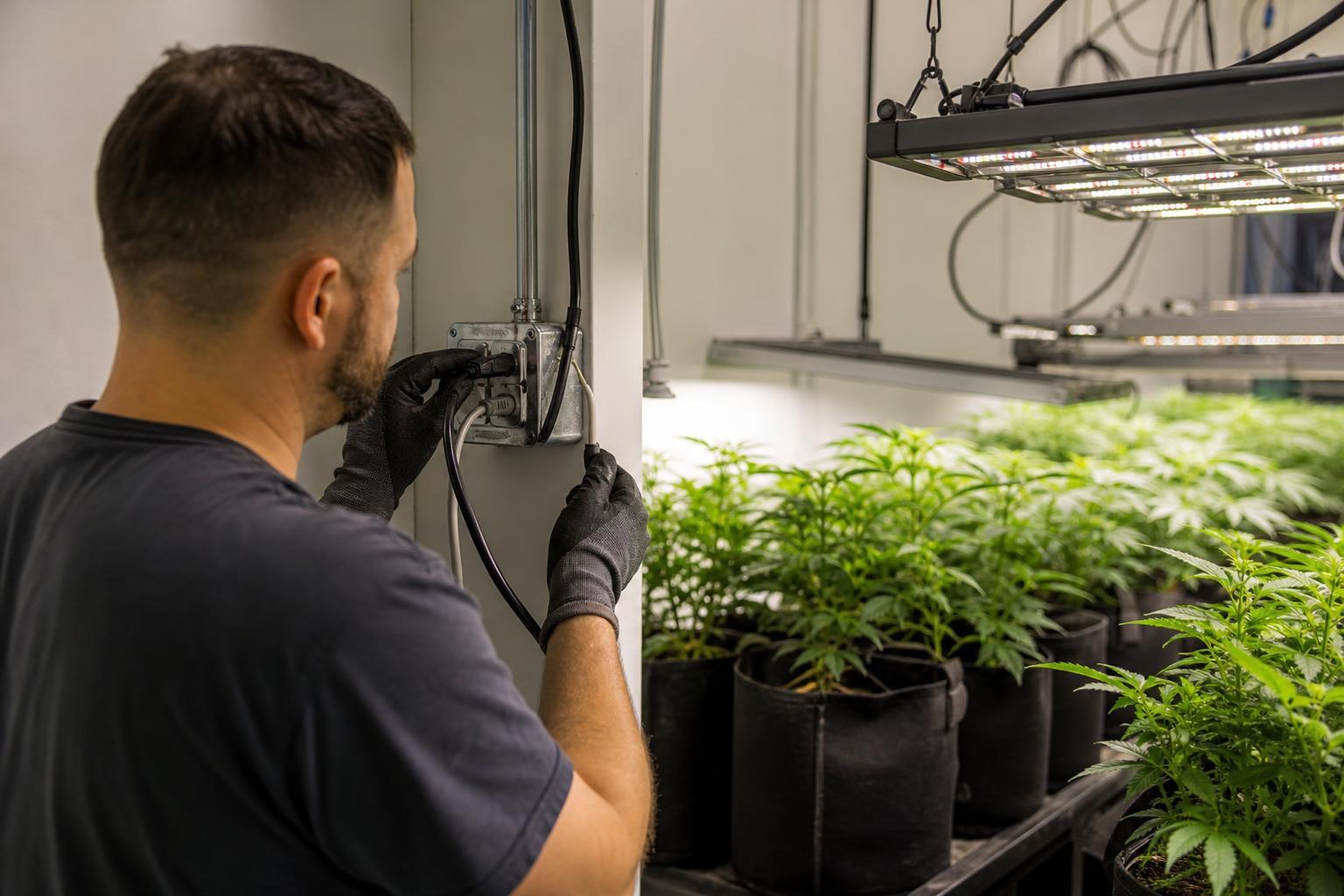
TL;DR: Grow light wiring requirements are governed primarily by the National Electrical Code (NEC), with Article 410 Part XVI specifically addressing horticultural lighting since 2020. Key rules include GFCI or SPGFCI protection for cord-connected fixtures (NEC 410.184), sizing conductors and breakers at 125% for continuous loads, selecting the right wire gauge for your operating voltage and run length, and using only UL 8800-listed fixtures. Hardwired installations are exempt from GFCI requirements, which is the single most important distinction for commercial facility design.
Commercial grow light installations sit at the intersection of electrical code, facility economics, and crop safety. Get the wiring wrong and you face tripped breakers during a critical photoperiod, failed inspections, voided insurance, or worse. Get it right and the electrical system disappears into the background, doing its job quietly for years.
This guide covers every wiring requirement, code reference, and practical term that a cultivation manager or facility operator needs to understand before breaking ground or retrofitting a grow room. It is written for the person who needs to speak intelligently with an electrician or engineer, not replace one.
For greenhouse-specific electrical terms, see the companion greenhouse electrical design glossary.
Talk to a lighting expert about your project
Codes and Standards That Govern Grow Light Wiring
NEC (National Electrical Code) / NFPA 70
The NEC is the baseline electrical safety code adopted (in various editions) across the United States. Every grow light wiring requirement traces back to it. The relevant articles span a wide range: Article 100 for definitions, 110 for general requirements, 210 for branch circuits, 220 for load calculations, 410 for luminaires, 310 for conductor ampacity, 250 for grounding, and 300.5 for underground runs. For agricultural buildings, Article 547 may also apply.
Why growers care: your local Authority Having Jurisdiction (AHJ) enforces a specific NEC edition, and that edition determines which rules apply. Some jurisdictions still enforce the 2017 NEC, while others have adopted 2020 or 2023. Always confirm which edition your AHJ uses before designing your electrical system.
NEC Article 410, Part XVI: Horticultural Lighting
The 2020 NEC introduced Part XVI of Article 410, which was a landmark change. Before it existed, electricians and inspectors had to piece together requirements from unrelated code sections, guessing at how they applied to grow lights. Part XVI brought purpose-built rules for horticultural lighting equipment.
Section 410.174 mandates that lighting equipment identified for horticultural use must be installed according to the manufacturer’s instructions and the markings on the equipment as required by its listing. This sounds basic, but it gives inspectors a clear enforcement mechanism: if the manufacturer says “hardwire only” and you plug it in, you’re in violation.
NEC Section 410.184: GFCI and SPGFCI Protection
This is the single most discussed, most misunderstood, and most frustrating grow light wiring requirement in the industry. It gets its own detailed section below.
ANSI/CAN/UL 8800: Horticultural Lighting Safety Standard
Published in August 2019, UL 8800 is the first North American safety standard built specifically for horticultural lighting equipment. Unlike general luminaire standards, UL 8800 addresses the unique hazards of grow environments: damp and wet locations, exposure to excessive dust and water, photobiological safety, and the specific supply wiring methods used in CEA facilities.
UL 8800 requires horticultural luminaires to include provisions for fixed wiring connections (outlet box), cord connections, or proprietary wiring systems. It also establishes the IP rating and environmental marking requirements that determine where a fixture can legally be installed.
The practical consequence is stark: operating non-listed fixtures violates NEC mandates and almost always forfeits property and casualty insurance coverage in the event of a fire or other loss. Every fixture in a commercial operation should carry UL 8800 listing.
DLC Horticultural Qualified Products List
DLC (DesignLights Consortium) listing is not a wiring requirement. But it connects directly to wiring compliance because DLC expects listed horticultural fixtures to carry appropriate safety certification, and UL 8800 is the key standard for that equipment category. Since April 18, 2025, DLC horticultural listing requires a minimum photosynthetic photon efficacy of 2.5 µmol/J. More importantly for facility operators, DLC listing is the gate that most North American utility rebate programs use to decide which fixtures earn an incentive.
For a deeper explanation of what DLC listing means and why it matters, read this guide on DLC-listed LED grow lights. To check your rebate eligibility, visit the rebate resource page.
Authority Having Jurisdiction (AHJ)
The AHJ is the local entity (building department, fire marshal, or state agency) that enforces electrical code in your area. Two things matter here. First, AHJs adopt specific NEC editions, and yours may be one or two cycles behind the current release. Second, AHJs have the authority to interpret code and add local amendments. An electrician on the Mike Holt forums noted that in Oklahoma, the state fire marshal now requires a licensed electrician to certify annually that every grow facility’s electrical installation meets applicable codes. This trend toward annual inspections is spreading.
Always confirm your AHJ’s adopted NEC edition and any local amendments before finalizing your electrical design.
Circuit Design Terms Every Grower Should Know
Continuous Load and the 125% Rule
A continuous load is any load expected to run for three hours or more. Grow lights run 12 to 18 hours per day. They always qualify.
NEC 210.19(A)(1) and 215.2(A)(1) require that conductors and overcurrent protection devices feeding continuous loads be sized at 125% of the actual load current. The practical way to think about it: keep your continuous grow light load at or below 80% of the breaker rating. On a 20A breaker, that means a maximum continuous lighting load of 16A.
This is not optional. An experienced electrical contractor on the Mike Holt forums pointed out that you must use the input VA of the drivers (not just the fixture wattage) for load calculations per NEC 220.18(B), and that this value can be significantly higher than expected when accounting for power factor and inrush.
Branch Circuit vs. Feeder
A branch circuit is the final wiring run from the last overcurrent device (breaker) to the fixtures. A feeder is the wiring between the service equipment and the branch circuit panel. Both have separate sizing and voltage drop requirements. When electricians discuss grow light wiring requirements, they are usually talking about branch circuits, but feeder sizing matters just as much in large facilities where panels may be hundreds of feet from the main service.
Wire Gauge (AWG) Sizing
Standard pairings for branch circuits:
| Breaker Rating | Minimum Wire Gauge | Typical Use Case |
|---|---|---|
| 15A | 14 AWG | Small residential or hobby setups |
| 20A | 12 AWG | Standard commercial branch circuits |
| 30A | 10 AWG | Higher-draw circuits, longer runs |
| 40A–50A | 8–6 AWG | Large bay circuits in commercial grows |
For commercial grow operations, LED grow light banks typically use #10 to #6 AWG copper for common bay circuits, with larger conductors needed when voltage drop risk is high on 100 to 180 foot runs.
Practitioner content consistently emphasizes one point: for any setup drawing 12A or more, use fixed wiring on a dedicated 20A or 240V circuit installed by a licensed electrician. Fixed wiring inside walls is not a grower’s job.
Voltage Drop
The NEC recommends limiting voltage drop to about 3% on branch circuits and 5% total (feeder plus branch combined). These are informational notes rather than hard requirements, but most AHJs and engineers treat them as design standards.
Voltage drop matters enormously in large facilities. A greenhouse with 150-foot wire runs at 120V will lose significantly more voltage than the same run at 277V, because higher voltage means lower current for the same wattage, and lower current means less voltage drop.
Operating Voltage Selection
This is where grow light wiring requirements intersect directly with facility economics. Higher operating voltage reduces current draw per fixture, which means smaller wire gauges, less voltage drop, and more fixtures per circuit.
| Operating Voltage | Advantages | Considerations |
|---|---|---|
| 120V | Readily available, familiar | High current draw, limited fixtures per circuit, significant voltage drop on long runs |
| 208V | Common in commercial 3-phase panels | Better than 120V but still relatively high current |
| 240V | Good balance for mid-size grows | Widely available in single-phase and 3-phase |
| 277V | Standard commercial lighting voltage | Excellent for large facilities, lowest branch circuit current among common options |
| 480V | Used at the feeder/distribution level | Requires step-down transformers for most fixtures |
One electrician on the Mike Holt forums explained the math clearly: with 277V fixtures, you can run four 1,000W lights per 20A circuit. Using multi-wire branch circuits (MWBCs), that number jumps to twelve per full circuit. The same principle applies to LED. Higher voltage means lower amperage per fixture, smaller conductors, and fewer home runs to the panel.
For a detailed look at how electrical infrastructure affects total project cost, see this guide on greenhouse lighting installation costs.
Multi-Wire Branch Circuit (MWBC)
An MWBC shares a neutral conductor between two or more ungrounded conductors fed from different phases. In a 3-phase panel, three hot conductors can share one neutral, tripling the number of circuits per conduit run. This reduces conduit, wire, and labor costs significantly in large grow facilities. MWBCs require simultaneous disconnect (handle-tied or multi-pole breakers) per NEC 210.4(B).
Overcurrent Protection
Breakers and fuses protect conductors from overheating. The breaker rating must match the conductor ampacity, and for continuous loads (all grow lights), the load must not exceed 80% of the breaker rating. An undersized breaker will trip during normal operation. An oversized breaker will not protect the wire, creating a fire hazard.
Connection Methods and Protection
This section addresses the single biggest source of confusion in commercial grow light wiring requirements: the relationship between how you connect a fixture and what protection the code demands.
Hardwired vs. Cord-and-Plug
This distinction drives everything downstream.
A hardwired fixture connects directly to the building wiring through conduit, MC cable, or a junction box. There is no plug, no separable connector, nothing you can disconnect by hand.
A cord-and-plug (or cord-connected) fixture uses a flexible cord with an attachment plug or separable connector to receive power.
The NEC treats these two methods very differently when it comes to GFCI protection. Understanding this difference is the most important practical takeaway in this entire guide.
GFCI (Ground-Fault Circuit Interrupter)
A GFCI monitors the balance of current between the hot and neutral conductors. If it detects a difference of 6mA (Class A), it trips the circuit in milliseconds, preventing electrocution. Standard GFCI protection has been required in wet locations for decades.
Under NEC Section 410.184, GFCI protection is required for outlets supplying horticultural lighting equipment that uses a flexible cord with one or more conductors, meaning any cord-connected or separable-connector fixture.
Hardwired fixtures do not require GFCI protection. This is the critical distinction.
SPGFCI (Special Purpose Ground-Fault Circuit Interrupter)
For circuits exceeding 150 volts to ground (common with 277V and 480V systems), a standard GFCI is impractical. The NEC requires Special Purpose GFCI protection instead. SPGFCI devices use a Class C trip threshold of 20mA, compared to the 6mA of a standard Class A GFCI. The higher threshold reduces nuisance tripping while still providing ground-fault protection.
This matters because many commercial grow facilities operate at 277V or higher. If those fixtures use separable connectors, they need SPGFCI protection.
The GFCI Problem in Practice
Practitioners on the Mike Holt forums report that the GFCI requirement causes significant frustration in real-world installations. The most common challenge is not disagreement about the need for protection, but unexpected circuit tripping that interrupts photoperiods and damages crops. Inrush current from LED drivers, capacitive leakage from long wire runs, and the humid environment of grow rooms all contribute to nuisance trips.
One forum moderator confirmed the reality plainly: if you do not want to deal with GFCIs or SPGFCIs, the only option is to hardwire. The rule requires this type of protection wherever any type of separable connection is used, not just a traditional cord and plug.
The practical workaround: use MC cable or conduit to hardwire fixtures, eliminating the GFCI requirement entirely.
2026 NEC Update to Section 410.184
The 2026 NEC reorganizes and expands Section 410.184 into a clearer list structure with expanded provisions. This reformatting is designed to improve clarity for installers, designers, and enforcement officials. While the fundamental requirements remain the same (cord-connected fixtures need GFCI/SPGFCI, hardwired fixtures do not), the improved organization should reduce misinterpretation.
Almost no grower-facing content covers this update yet. If your AHJ adopts the 2026 NEC, expect inspectors to reference the reorganized section.
MC Cable and Conduit
MC (Metal-Clad) cable and conduit are the two primary methods for hardwired fixture connections. Both provide physical protection for the conductors and ground path continuity. Using either method makes the installation “hardwired” under the NEC, which exempts the circuit from GFCI/SPGFCI requirements for horticultural lighting.
Conduit also allows future wire pulls and upgrades. MC cable is faster to install but less flexible for changes. The choice often comes down to local AHJ preferences, labor costs, and facility layout.
Separable Connector
A separable connector is any plug-type connection that can be disconnected without tools. Under the NEC, the presence of a separable connector on a horticultural fixture triggers the GFCI/SPGFCI requirement, just like a standard cord and plug. This catches some installers off guard. Even if the fixture is otherwise mounted permanently, a separable connector in the power path means the circuit needs ground-fault protection.
Environmental and Safety Ratings
Wet, Damp, and Dry Locations
Grow environments are frequently wet due to irrigation, misting, and high humidity. They may sit on grade-level concrete slabs, providing a direct path to ground. The NEC requires fixtures and wiring methods to be rated for the actual conditions of their installed location.
Only use lights and plugs rated for damp or wet locations in any grow space where water or condensation is present. Most commercial horticultural fixtures carry at least a damp location rating. Greenhouse installations, particularly in open or semi-enclosed structures, typically require wet location ratings.
IP Rating (Ingress Protection)
IP codes indicate how well a fixture resists dust and water. The two-digit code works as follows: the first digit rates solid particle protection (0–6), the second rates liquid protection (0–9). A fixture rated IP54 resists dust ingress and water splashing from any direction. IP65 is dust-tight and resists low-pressure water jets.
UL 8800 allows horticultural luminaires exposed to dust and water to carry IP ratings per IEC 60598-1. For most indoor grows, IP54 is the minimum practical rating. Greenhouses with overhead irrigation should specify IP65 or higher.
Grounding Requirements
NEC Article 250 governs grounding. Every horticultural fixture must have a continuous equipment grounding conductor back to the panel. In wet environments, proper grounding is the last line of defense against electrocution if insulation fails. This is not an area for shortcuts. Loose ground connections and missing bonding jumpers are common inspection failures.
Photobiological Safety
UL 8800 includes photobiological safety assessment, evaluating the risk that a fixture’s light output poses to eyes and skin. Fixtures are classified into risk groups (Exempt, Risk Group 1, Risk Group 2, Risk Group 3). Commercial horticultural LEDs typically fall into Risk Group 1 or 2, requiring appropriate labeling and sometimes workplace safety measures. This is part of the grow light wiring requirements in the broadest sense because UL 8800 ties these markings to the listing that the NEC demands.
For more on fixture reliability and how it connects to long-term safety, see LED reliability essentials.
Control Wiring
0-10V Dimming Wiring
Most commercial LED grow lights use 0-10V analog signals for dimming control. The dimming wires carry a low-voltage signal that tells the driver what output level to maintain. This is classified as Class 2 wiring under the NEC.
Class 1 vs. Class 2 Wiring
Class 1 wiring has no voltage or current limits and is treated like a mains connection. It typically requires conduit. Class 2 wiring is power-limited (generally under 100VA) and can use lighter-duty cables without conduit in many installations.
The critical rule: NEC 725.136 requires that Class 2 wiring be kept separate from Class 1 and line-voltage conductors. Do not run line voltage and low-voltage control wiring in the same conduit, and maintain separation in raceways. Violating this rule can cause interference with control signals, create safety hazards, and will fail inspection.
Digital Protocols (MODBUS, DMX)
Larger facilities increasingly use digital control protocols for lighting management. MODBUS communicates over RS-485 wiring, while DMX uses dedicated shielded cable. Both are low-voltage signals subject to the same Class 2 separation requirements. When planning control wiring runs, factor in the physical separation from power conductors and the maximum cable lengths specified by each protocol.
Power Architecture and Wiring Implications
Traditional Per-Fixture Wiring
In a conventional grow light installation, each fixture contains its own driver (power supply) and connects individually to a branch circuit. This means a dedicated AC power drop at every fixture location, with conduit or MC cable running to each mounting point. For a 500-fixture facility, that is 500 driver enclosures, 500 connection points, and potentially miles of conduit.
The biggest hidden cost in greenhouse and indoor grow lighting installation is this electrical infrastructure: conduit and wiring. Total installed cost is typically two to five times the cost of the fixtures alone.
Centralized and Remote Power Distribution
Centralized power architecture moves drivers outside the grow space into a dedicated rack or enclosure. The drivers convert AC power to the appropriate DC voltage, and lower-gauge DC cabling distributes power to simplified fixture modules. This fundamentally changes the wiring topology: fewer AC power drops in the grow room, less in-room conduit, fewer failure points above the canopy, and reduced heat load where plants are growing.
Explore OptiDrive centralized power to see how this architecture applies in practice.
The wiring implications are significant. Centralized power can reduce conduit runs by consolidating AC connections at the rack location rather than distributing them across the entire grow area. It can also simplify compliance with grow light wiring requirements by reducing the number of in-room connection points that might trigger GFCI/SPGFCI requirements.
Higher voltage distribution at the feeder level, combined with centralized conversion, further reduces total installation cost through smaller wire sizes and fewer circuits. For facilities where HVAC load from LED lights is a concern, moving heat-generating drivers out of the grow space also reduces cooling demand.
Low-Voltage Distribution
Some centralized systems distribute power at low voltage (under 60V DC) from the central unit to the fixtures. Low-voltage distribution can eliminate the NEC requirement for conduit entirely, depending on the voltage level and the AHJ’s interpretation. This dramatically reduces installation labor and material costs. The trade-off is higher current at low voltage, which requires appropriately sized conductors to manage voltage drop.
What Grow Light Wiring Requirements Cost in Practice
Electrical installation is not where you save money. A grow facility manager documented roughly $6,800 in wasted budget from electrical mistakes over several years, and that figure is modest compared to what a full commercial buildout can cost when done incorrectly.
Commercial grow room electrical and wiring costs range from $4,000 to $40,000 or more depending on scale, voltage, and complexity. Strategies to reduce this cost include choosing high-efficacy LED fixtures (fewer watts per square foot means fewer circuits), exploring centralized power architecture, capturing utility rebates, and investing in proper engineering upfront.
For context on how lighting fits into broader facility budgets, see this breakdown of cannabis startup costs.
Schedule a free consultation to plan your electrical design
Frequently Asked Questions
Do all grow lights need GFCI protection?
No. Under NEC 410.184, only cord-connected or separable-connector horticultural fixtures require GFCI protection (Class A, 6mA trip for circuits at or below 150V to ground) or SPGFCI protection (Class C, 20mA trip for circuits above 150V to ground). Hardwired fixtures connected via conduit or MC cable are exempt. This exemption is the primary reason many commercial facilities choose hardwired installations.
What wire gauge do I need for grow lights?
It depends on the breaker size, conductor length, and operating voltage. Standard residential circuits use 14 AWG on 15A breakers or 12 AWG on 20A breakers. Commercial grow operations typically use #10 to #6 AWG copper for bay circuits, especially on runs exceeding 100 feet where voltage drop becomes a factor. Always size conductors at 125% of the continuous load current per NEC 210.19(A)(1).
Can I daisy-chain grow lights?
Some fixtures allow daisy-chaining within the limits specified by the manufacturer and the circuit’s ampacity. The total load on the daisy chain must not exceed 80% of the breaker rating (the continuous load rule), and each connection point must comply with the manufacturer’s wiring instructions. Check the fixture’s UL 8800 listing and installation manual for maximum daisy-chain limits before connecting multiple units.
Do I need a licensed electrician for grow light installation?
For any commercial operation, yes. Fixed wiring inside walls, conduit installation, panel work, and circuit additions all require a licensed electrician in virtually every jurisdiction. Even for cord-and-plug fixtures, the branch circuit feeding them must be properly sized and protected by a qualified professional. Beyond code compliance, many AHJs now require annual electrical inspections of grow facilities by a licensed electrician.
What happens if I fail an electrical inspection?
A failed inspection means your facility cannot legally operate until the deficiencies are corrected and the installation passes reinspection. More critically, operating with known electrical violations can void your property and casualty insurance. If a fire or injury occurs in a facility with unpermitted or non-compliant wiring, the insurance carrier has grounds to deny the claim entirely.
Does operating voltage affect my grow light wiring requirements?
Significantly. Higher operating voltage (240V, 277V) reduces current draw per fixture, which allows smaller wire gauges, longer runs with acceptable voltage drop, and more fixtures per circuit. For large facilities, voltage selection is one of the most impactful decisions for controlling electrical installation costs. Most modern commercial LED fixtures accept a range of input voltages (often 208 to 480V), giving designers flexibility to match the facility’s existing electrical service.
What is the difference between UL listing and DLC listing?
UL listing (specifically UL 8800 for horticultural equipment) is a safety certification required by the NEC. It means the fixture has been tested and found to meet minimum safety standards for electrical, fire, and photobiological hazards. DLC listing is an efficiency and performance qualification used by utility companies to determine rebate eligibility. A fixture needs UL listing to operate legally. It needs DLC listing to qualify for most utility incentive programs. Both matter, but they serve different purposes.
Getting grow light wiring requirements right protects your people, your crop, your insurance coverage, and your bottom line. The code exists for good reasons, and the distinctions between hardwired and cord-connected installations, between GFCI and SPGFCI, and between voltage levels all have direct consequences for safety and cost. Work with qualified engineers and electricians, confirm your local AHJ’s adopted NEC edition, and choose UL 8800-listed fixtures.
Browse Thrive Agritech’s UL-listed fixtures or request a free consultation to discuss your facility’s electrical design.