7 Best Fluence Alternatives for Commercial Growers (2026)
Discover 7 Fluence alternatives for 2026: Thrive, Gavita, Sollum, FOHSE, Faven, Philips, HLG. Compare costs, controls, and yields.
TL;DR
Fluence makes solid commercial LED grow lights, but the total cost of ownership (fixtures, controllers, installation, HVAC) pushes many growers to explore alternatives. This guide covers seven credible Fluence alternatives for commercial operations: Thrive Agritech (best overall, with a unique centralized power architecture), Gavita (best large-scale cannabis control ecosystem), Sollum Technologies (best dynamic spectrum for greenhouses), FOHSE (best max-output indoor cannabis), Faven Lighting (best under-canopy specialist), Philips GreenPower (best enterprise greenhouse), and HLG (best budget-commercial crossover). Each entry includes specs, honest limitations, and practitioner perspectives.
If you're looking for the best Fluence alternative for a commercial grow, the right choice depends on your facility rather than the highest efficacy rating.
- Thrive Agritech is best for reducing total ownership costs through centralized power architecture.
- Gavita is ideal for large cannabis facilities needing centralized lighting control.
- Sollum Technologies excels in greenhouses requiring dynamic spectrum adjustment.
- FOHSE produces the highest light output for indoor cannabis.
- Faven specializes in under-canopy lighting.
- Philips GreenPower remains the enterprise greenhouse standard.
- HLG offers the best value for smaller commercial operations.
Instead of comparing fixture efficacy alone, evaluate installation costs, HVAC impact, power architecture, warranty coverage, control software, and long-term operating expenses.
Why Commercial Growers Look Beyond Fluence
Fluence earned its reputation. Backed by Signify (the OSRAM parent company), the SPYDR and VYPR lines are well-engineered fixtures with strong efficacy numbers, up to 3.06 µmol/J on the SPYDR 3. Nearly 80% of commercial growers now use LEDs in flower, and Fluence has been a go-to recommendation for years.
But a recommendation isn’t a commitment. When growers start pricing out full deployments, the picture gets complicated. A single SPYDR 2i runs $1,200 to $1,600 before controllers or installation. The Field IQ control system adds roughly $100 per month for a 50-fixture setup. Installation labor can run $150 per hour for three hours per fixture.
Then there are the surprises. One grower reported that Fluence’s WAGO connectors, standard in Europe, didn’t match their US electrician’s stock, forcing them to source matching connectors after the fact. Another planned to use a generic 0-10V dimmer and discovered they needed PWM-compatible converter boxes at $80 each, an unexpected $4,000 across the facility.
If you’re transitioning from HPS or evaluating your first major LED investment, the right question isn’t “Is Fluence good?” It’s whether Fluence delivers the best total value for your specific facility, crop, and operating budget. For many growers, the answer leads them to explore Fluence alternatives.
A grower on the THCFarmer forum put it plainly: “LED lighting buzz marketing is one of the biggest smoke and mirrors sham out there. There is no ‘best,’ ‘better’ etc. Purchase what’s going to work for you. Just because it’s more money, doesn’t mean jack shit in many cases.” That practitioner skepticism is healthy. Specs have converged across top-tier brands. The real differentiators now are total cost of ownership, infrastructure fit, and the systems around the fixtures.
Quick Comparison: Fluence Alternatives at a Glance
Brand | Best For | Top Efficacy | Remote Power | Warranty | Control System | Under-Canopy |
|---|---|---|---|---|---|---|
Thrive Agritech | Full-facility (fixtures + power infra) | Quote-based specs | OptiDrive DC + DE | 5-year full | MODBUS / 0-10V | Boost XE |
Gavita | Large cannabis ops (10+ fixtures) | 3.2 µmol/J (RS 2400e) | No | 5-year | Master Controller EL3 | 150W UCL |
Sollum | Multi-crop greenhouse | Dynamic (varies) | No | Not published | SUNaaS cloud | None |
FOHSE | Max-output indoor cannabis | 2.91 µmol/J (A3i) | No | 3-5 year | Smart control | Available |
Faven | Under-canopy supplemental | 2.9 µmol/J | No | 5-year | 0-10V compatible | Core business |
Philips | Enterprise greenhouse produce | Recipe-dependent | No | Varies | GrowWise | Interlighting |
HLG | Budget-commercial crossover | 2.8 µmol/J (650R) | No | Varies | None | No |
Fluence (baseline) | Multi-tier cannabis + CEA | 3.06 µmol/J (SPYDR 3) | No | 5-yr fixture / 3-yr driver | Field IQ ($100/mo) | VYNE series |
How We Chose the Best Fluence Alternatives
To compare commercial lighting systems fairly, we evaluated every manufacturer using the same criteria rather than relying on marketing claims.
Evaluation Criteria
Factor | Why It Matters |
|---|---|
Fixture efficacy | Determines energy efficiency |
PPF output | Indicates usable light production |
Warranty | Reduces long-term replacement costs |
Driver architecture | Impacts HVAC, maintenance, reliability |
Control ecosystem | Determines scalability |
Under-canopy options | Increases lower-canopy production |
Commercial installations | Demonstrates real-world proof |
Utility rebate eligibility | Improves ROI |
Dealer network | Affects support and replacement speed |
Total ownership cost | More important than fixture price |
What to Evaluate in Any Fluence Alternative
Before comparing individual brands, establish your evaluation criteria. Fixture specs alone won’t tell you what a lighting system will actually cost to own and operate.
Total Cost of Ownership
The fixture price is the most visible cost and often the least important one. Add the controller, wiring, connectors, installation labor, energy consumption over five years, HVAC load from in-room heat, and maintenance. A $1,400 fixture that adds $300 per year in cooling costs looks different from a $1,200 fixture that doesn’t. The greenhouse lighting installation cost guide breaks down how these hidden expenses stack up across commercial deployments.
Efficacy at Operating Temperature
Datasheet efficacy is measured at 25°C. Grow rooms run warmer. Ask vendors for performance data at realistic operating temperatures, not just lab maximums.
Warranty Scope
A “5-year warranty” means different things from different manufacturers. Some cover the entire fixture. Others warranty the LED board separately from the driver. When drivers live inside the fixture above a hot, humid canopy, that distinction matters. Understanding LED reliability factors can save you from expensive surprises down the road.
Control System Lock-In and Subscription Costs
Fluence’s Field IQ system runs about $100 per month for a 50-fixture facility. Some alternatives require their own proprietary controllers. Others work with standard 0-10V or MODBUS protocols, letting you choose your own control infrastructure. Monthly software subscriptions compound over time.
Power Architecture and Installation Complexity
This is the category most buyers overlook. Traditional LED fixtures pack drivers inside each unit, which means hundreds of heat-generating, failure-prone components above your canopy. Centralized driver architectures relocate that hardware outside the grow space, fundamentally changing the heat, wiring, and reliability equation. Only one brand in this comparison offers that option.
Under-Canopy Strategy
Top-light-only solutions leave lower-canopy production on the table. Growers adding light below the canopy have documented 20 to 30% yield gains. Whether a brand offers a purpose-built under-canopy system, and how well it integrates with their top lights, is worth asking early.
Comparison by Growing Environment
Growing Environment | Recommended Brand |
|---|---|
Indoor cannabis | Thrive Agritech |
Multi-tier cultivation | Thrive Agritech |
Greenhouse vegetables | Sollum |
Greenhouse flowers | Philips |
High-output flower rooms | FOHSE |
Under-canopy retrofit | Faven |
Small commercial grow | HLG |
7 Best Fluence Alternatives
1. Thrive Agritech
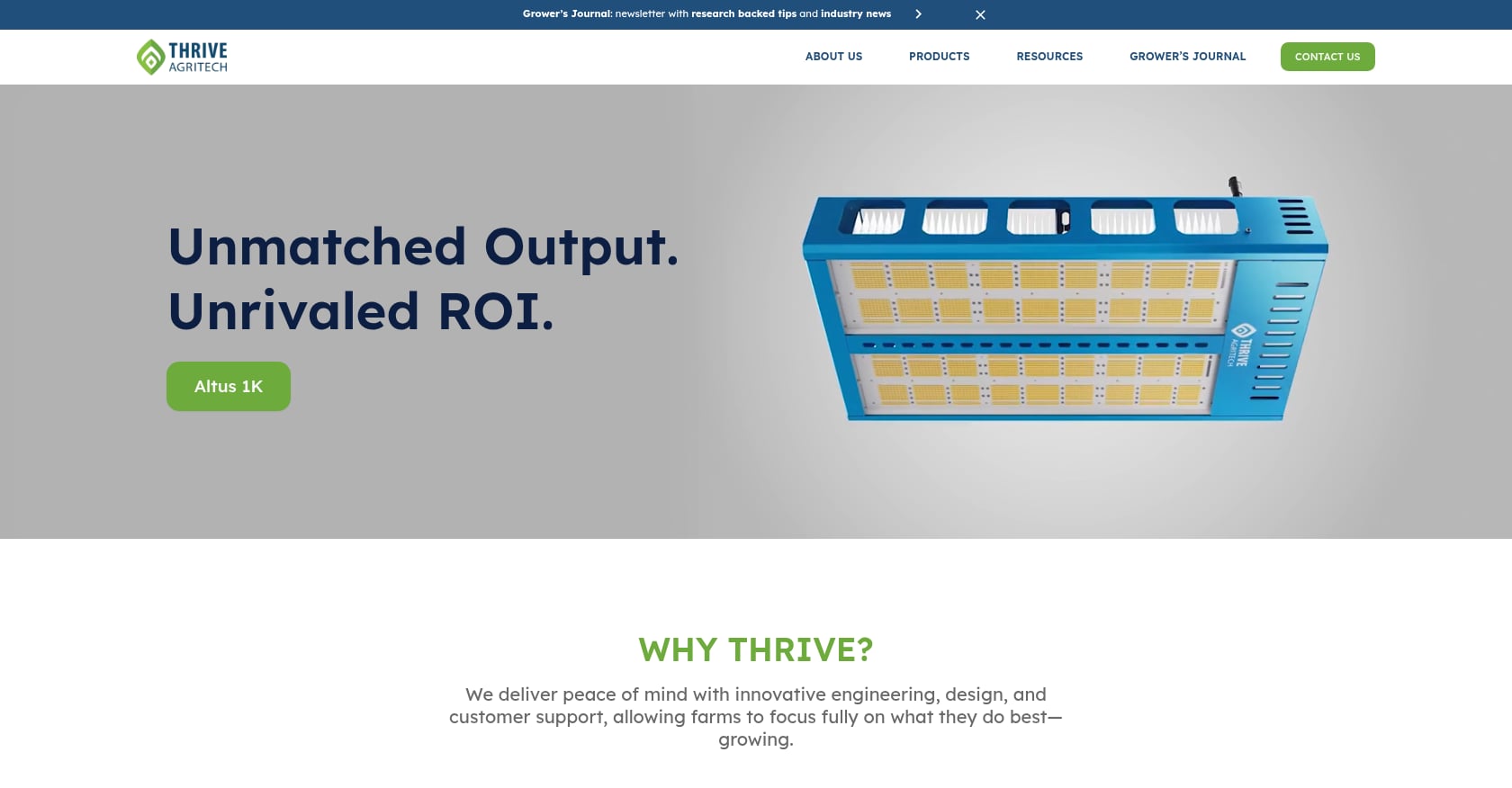
Best for: Commercial operations that want a complete lighting and power architecture system, not just fixtures.
Thrive Agritech is the only brand on this list that addresses the infrastructure problem most fixture manufacturers ignore entirely. While other Fluence alternatives compete on efficacy numbers and spectrum options, Thrive competes on total system design, which is why it earns the top spot.
Key products:
Altus 1K (1050W top light for cannabis and greenhouse supplemental lighting)
Pinnacle Series (300W, 600W, and 840W)
Boost XE (120W under-canopy bar, patent-pending)
Strata and Strata HP (vertical farm and multi-tier)
OptiDrive DC and OptiDrive DE (centralized power platforms)
What sets it apart from Fluence:
The marquee differentiator is OptiDrive, a remote power architecture that moves LED drivers out of the grow space entirely. OptiDrive DC delivers 12,000 watts per shelf through three 4,000-watt modules at up to 95% efficiency. OptiDrive DE puts out 3,000 watts per transmitter across seven output channels. Both accept a wide voltage range and meet UL/CE/CSA requirements.
This isn’t an incremental improvement. Removing drivers from above the canopy cuts in-room heat (reducing HVAC load), simplifies wiring, eliminates hundreds of potential failure points per facility, and makes fixtures lighter and easier to install. Fluence has no equivalent. Neither does any other brand in this comparison. For a deeper look at how this changes facility economics, the remote driver architecture guide explains the HVAC and installation math.
Reliability and proof:
Sub-1% fixture failure rate over the 5-year warranty period
95% repeat-order rate
±5% design-to-install PPFD variance
40,000-hour fixture lifetime
Named installations include Vertical Harvest (52,000 sq ft), Strawberry Fields (two acres of greenhouse, doubled winter yields), Weber Greenhouse, and Summit Colorado. The company is Y Combinator backed and earned the Xcel Energy Efficiency Partner Award.
Under-canopy lighting:
The Boost XE is a patent-pending 120W under-canopy fixture with documented yield gains of 20 to 30%. Thrive’s position is clear: the experiment on under-canopy lighting is over. The data supports it.
Limitations:
Quote-based pricing with no instant online purchasing. This is a consultative, B2B process.
Less brand recognition among hobby growers (irrelevant for commercial buyers, but it means fewer Reddit threads).
The full-spectrum white light philosophy, built on patented phosphor chemistry, trades the last bit of red-heavy flower weight optimization for a better work environment and full-spectrum plant response.
Pricing: Project-specific. Thrive offers a free 15-minute expert consultation to scope your facility and provide a custom lighting design, including rebate assistance.
2. Gavita
Best for: Large cannabis operations (10+ fixtures) that need centralized control of hundreds of fixtures through a proven ecosystem.
Gavita has been in horticultural lighting for over 40 years. The Dutch brand built its reputation on HPS and has transitioned to LED with fixtures that compete directly with Fluence on specs.
Key products:
Pro RS 2400e LED: 3.2 µmol/J efficiency with broad white light
1700e: 645W, 1700 µmol/s, 2.6 µmol/J
Under Canopy 150W LED: 450 µmol/s for sub-canopy lighting
What sets it apart from Fluence:
The Master Controller EL3 scales to 512 fixtures with auto-protection features, giving facility managers centralized dimming, sunrise/sunset simulation, and emergency shutdowns from a single interface. Fluence doesn’t offer an equivalent centralized control system at this scale.
Pricing: Premium positioning at $1,200 to $1,500 per fixture for most models. The RS 2400e ranges up to approximately $2,024 at retail.
Practitioner perspective:
One independent reviewer noted the 1700e’s light output is great but in line with many other lights on the market now. The fixture stands out because of the Gavita brand name: “growers know what to expect, and there are very few warranty issues and returns.” Another reviewer from Modern Farms made this point directly: the fixtures themselves are competitive but not categorically better than Fluence; “the ecosystem is the differentiator.”
Limitations:
The premium makes operational sense at 10-plus fixture scale where the controller investment compounds across the facility. Smaller operations won’t get the ecosystem benefit.
No remote or centralized power architecture. Drivers live in the fixture, adding heat above the canopy.
Dutch greenhouse heritage means less innovation on the infrastructure layer compared to newer entrants.
5-year warranty, but driver and fixture coverage should be confirmed on your specific model.
3. Sollum Technologies
Best for: Greenhouse produce growers who need fully dynamic, reprogrammable spectrum control across multiple crops.
Sollum takes a fundamentally different approach to LED lighting. Instead of fixed-spectrum fixtures, the Montréal-based company sells the SF-INFINITE fixture paired with the SUNaaS (Sun as a Service) cloud platform, enabling growers to change their light recipe without changing their hardware.
Key product:
SF-INFINITE fixture powered by SUNaaS cloud platform
What sets it apart from Fluence:
Fluence offers a handful of PhysioSpec spectrum options that lean into specific red ratios. Sollum’s fixtures are completely reprogrammable. A grower can switch crops, adjust DLI targets, or simulate specific geographic sunlight patterns through software alone. The company claims 40 to 60% energy savings versus HPS with a 2 to 4 year payback, plus an additional 16.8% efficiency boost compared to standard LED systems.
Sollum also publishes a 19.5% tomato yield boost from dynamic lighting, which is a strong data point for greenhouse vegetable producers.
Practitioner perspective:
A Grozine review found that the SUNaaS platform helped achieve consistent growth in conditions where manual adjustments had failed: “broccoli that had previously failed to develop proper florets finally flourished under optimal light conditions” after the system increased DLI automatically.
Limitations:
Software-dependent. The system requires a SUNaaS subscription and edge computing hardware to function. Without the platform, the fixtures lose their primary value proposition.
Primarily greenhouse-focused. Not a strong fit for indoor cannabis flower rooms or vertical farming.
Montréal-based with a thinner US dealer network than Fluence, Gavita, or Thrive Agritech.
No published under-canopy system. Growers wanting sub-canopy supplemental light will need to pair Sollum with another brand’s fixtures.
4. FOHSE
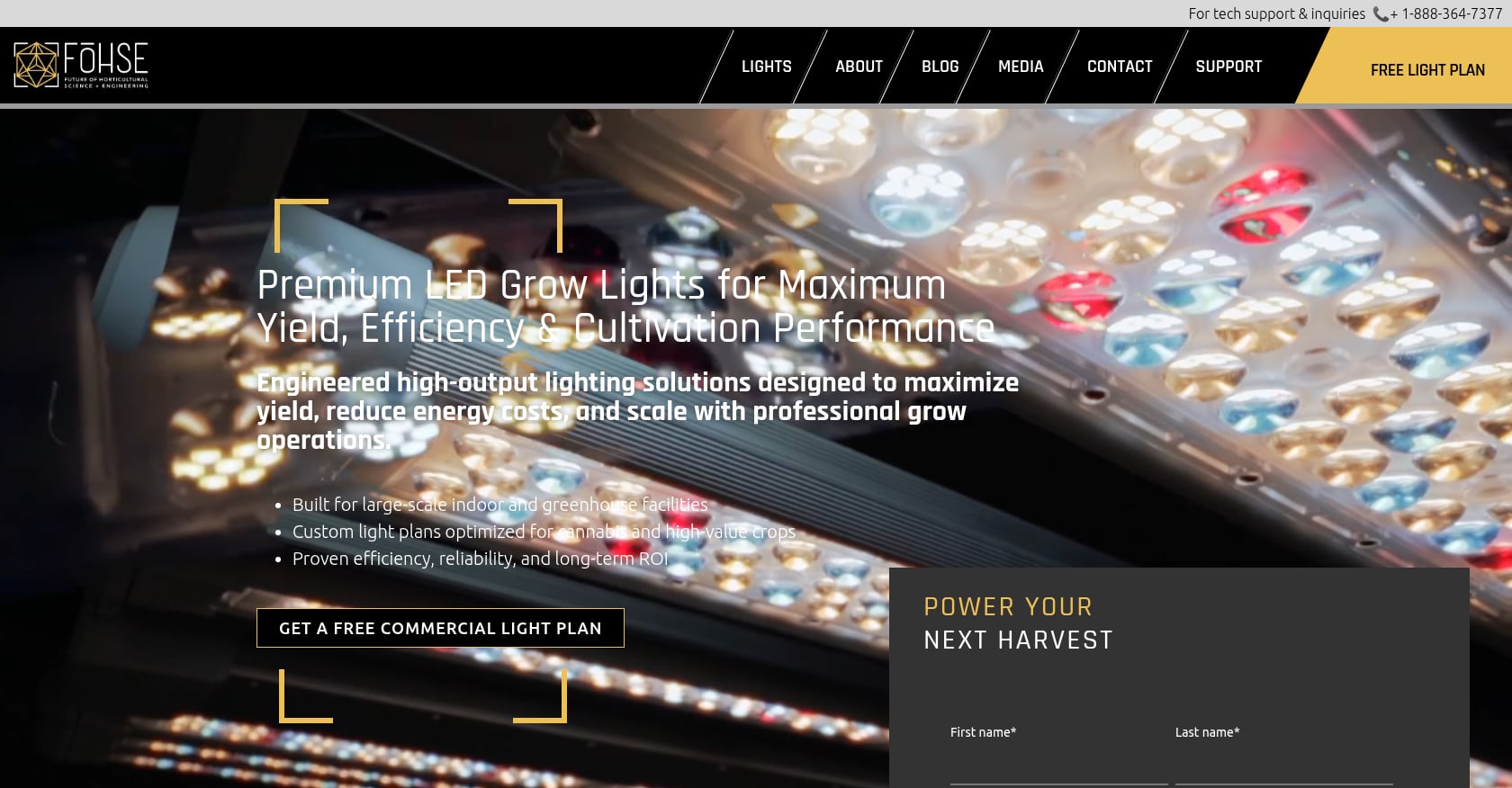
Best for: Single-tier indoor cannabis operations that want maximum photon density per fixture.
FOHSE makes some of the highest-output LED fixtures on the market. The Las Vegas-based manufacturer targets cannabis cultivators who want to push light intensity to the limit.
Key products:
A3i: 1,500W, up to 4,359 µmol/s PPF at 2.91 µmol/J
121: 850W direct HPS replacement
Aries: 640W for boutique commercial
PRO Series: seven adjustable spectrum channels (UVA, Green, Far Red, Blue, Cool White, Warm White, Red)
What sets it apart from Fluence:
Raw output. The A3i pushes nearly double the photons of most commercial fixtures. FOHSE publishes a case study with The Grove, a cannabis operation that saw a 65% increase in dry yield harvest weights while using 16% less energy after switching from HPS.
The PRO Series offers seven-channel spectrum tuning, which gives growers more spectral control than Fluence’s fixed PhysioSpec options.
Limitations:
1,500 watts is a lot of heat, even from LEDs. The A3i requires serious HVAC and electrical infrastructure. Understanding how to calculate HVAC needs for LED lights is essential before committing to fixtures this powerful.
Cannabis-focused. Not designed for greenhouse produce or vertical farming.
Las Vegas-based niche manufacturer with less ecosystem compatibility than larger brands.
Premium pricing: A3i fixtures have historically priced north of $2,000.
3 to 5 year warranty, shorter than the standard 5-year full coverage some competitors offer.
No centralized power architecture. Every watt runs through in-fixture drivers above the canopy.
5. Faven Lighting
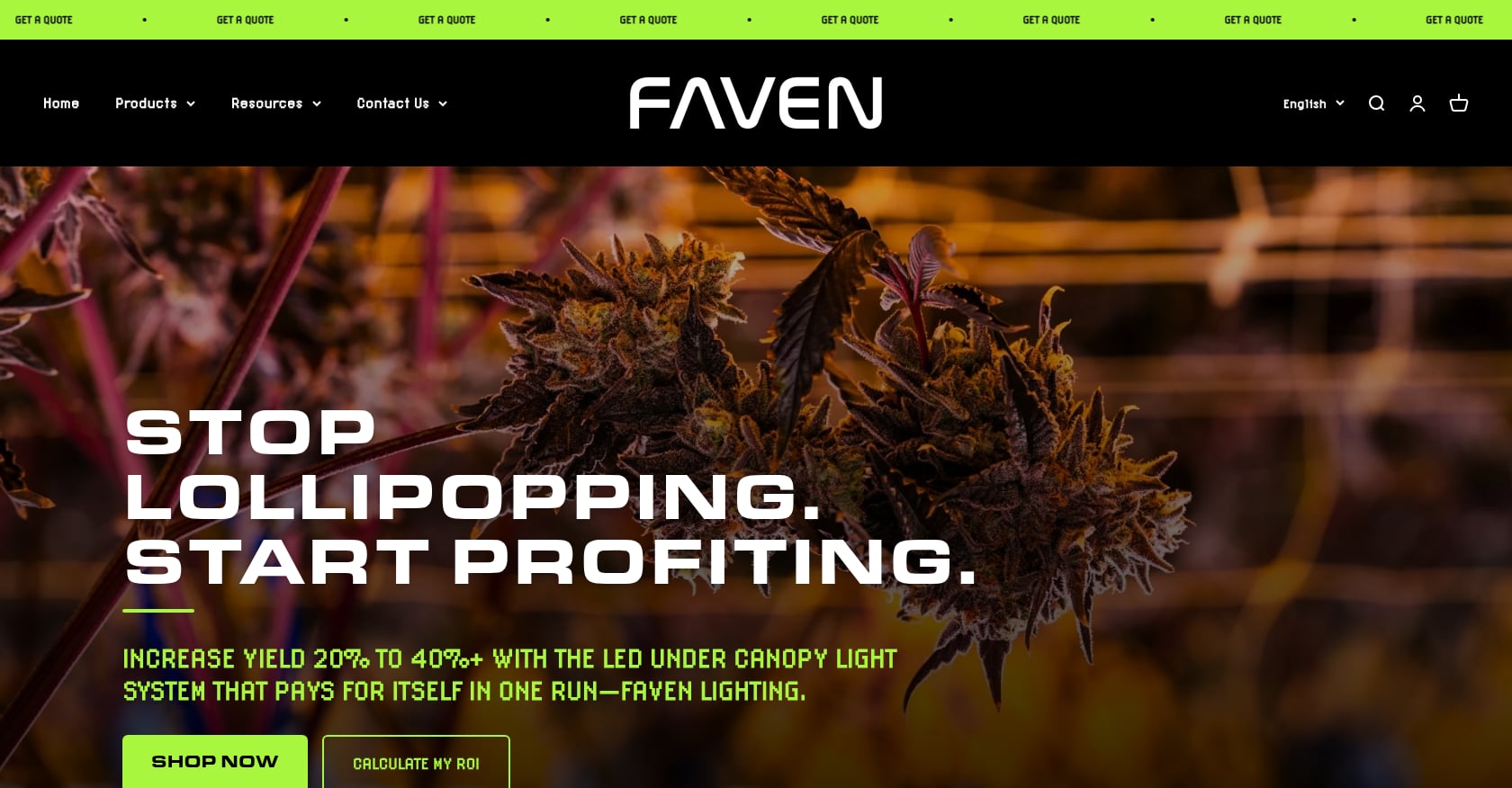
Best for: Cannabis cultivators specifically seeking under-canopy supplemental lighting to boost lower-canopy flower quality and reduce trimming labor.
Faven is a specialist. Rather than competing across the full fixture spectrum, the company focuses on under-canopy LED systems with a level of crop-specific engineering that most top-light brands don’t match in their supplemental offerings.
Key products:
R6: under-canopy fixture optimized for HID rooms
R8: under-canopy fixture optimized for LED rooms
Chroma: flagship with tunable spectrum
All lines hit 2.9 µmol/J efficiency
What sets it apart from Fluence:
Faven’s unique insight is that HID and LED top lights produce different spectra, so the under-canopy supplement should be different too. The R6 is specifically engineered to balance HPS-heavy rooms, while the R8 complements LED top lights. This spectrum-matching philosophy is genuinely unique among Fluence alternatives.
Practitioner perspective:
Hydrobuilder positions Faven as delivering “commercial-grade fixture performance without paying the brand premium” for growers evaluating quality under-canopy options. Faven reports that over 85% of customers achieve a 1-run return on investment, with a typical 20% yield increase paying for the lights within one harvest cycle.
Limitations:
Under-canopy only. This is not a full-facility lighting solution. You’ll need another brand’s top lights.
Primarily cannabis-focused. Limited utility for greenhouse produce or vertical farming.
Newer brand with less track record than established players.
The Chroma offers tunable spectrum, but the R6 and R8 are fixed-spectrum designs.
For growers considering under-canopy supplemental lighting, it’s worth comparing Faven against Thrive Agritech’s Boost XE, which takes a different approach with full-spectrum white light and a patent-pending configuration documented at 20 to 30% yield gains.
6. Philips GreenPower LED
Best for: Enterprise-scale greenhouse vegetable and floriculture operations backed by decades of crop research.
Fluence and Gavita may dominate the cannabis conversation, but in large-scale greenhouse produce, Philips remains the benchmark. The brand’s GreenPower LED line benefits from Signify’s massive R&D infrastructure and hundreds of crop trials with university researchers and commercial growers worldwide.
Key products:
GreenPower LED Toplighting Force (TLF): 4-channel control (red, blue, white, far-red) via the GrowWise system
GreenPower LED Gridlighting: dimmable broad-spectrum solution delivering 1700 µmol/s
GreenPower LED Interlighting: designed for year-round high-wire tomato and cucumber production
What sets it apart from Fluence:
Philips is unique in its scientifically validated light recipes supported by hundreds of crop trials. The GrowWise Control System integrates climate and light management in ways no other brand offers, making it the standard for data-driven greenhouse operations at scale.
Limitations:
Enterprise sales channel only. Sold through certified partners with long sales cycles and no direct online ordering.
Cannabis is not a Philips focus market. Growers in that sector will find limited product development and dealer support.
Premium enterprise pricing puts it out of reach for smaller operations.
Less agile than specialist brands. Product cycles move slower.
7. Horticulture Lighting Group (HLG)
Best for: Small-to-mid commercial operations and advanced hobbyists who want commercial-grade efficacy at lower per-fixture cost.
HLG occupies a space between hobbyist and commercial that no other brand on this list targets. For growers who need 5 to 50 fixtures and want DLC-listed efficiency with utility rebate eligibility without the enterprise price tag, HLG is worth considering.
Key products:
650R: 2.8 µmol/J, full-spectrum white light, 1:1 HPS replacement
600Rspec: similar platform at slightly different wattage
Built in the USA and DLC-listed, HLG fixtures qualify for the same utility rebates that Fluence and other premium brands chase.
Limitations:
No Master Controller ecosystem. Each fixture operates independently or through basic 0-10V daisy-chaining.
No dynamic spectrum. Fixed white output only.
No centralized power architecture. Drivers are in-fixture.
Limited greenhouse-specific product range. Primarily designed for indoor grow rooms.
Smaller support infrastructure than Fluence, Gavita, Philips, or Thrive Agritech.
Not positioned for 100+ fixture deployments. The value proposition erodes at scale where ecosystem integration matters.
Pros and Cons Comparison
Brand | Biggest Advantage | Biggest Drawback |
|---|---|---|
Thrive Agritech | Remote power architecture | Quote-only pricing |
Gavita | Excellent controller ecosystem | Premium pricing |
Sollum | Dynamic spectrum | Subscription required |
FOHSE | Massive light output | High HVAC demand |
Faven | Under-canopy specialist | Not a complete solution |
Philips | Research-backed recipes | Enterprise pricing |
HLG | Great value | Limited ecosystem |
Which Fluence Alternative Is Right for You?
Choose Thrive Agritech if...
Installation cost matters
HVAC is expensive
Building a new facility
Expanding existing commercial operations
Interested in centralized power
Choose Gavita if...
Already using Gavita
Need hundreds of fixtures
Want centralized scheduling
Choose Sollum if...
Greenhouse production
Multiple crops
Dynamic lighting recipes
Choose FOHSE if...
Maximum PPFD
Indoor flowering
HVAC capacity is available
Choose Faven if...
Adding under-canopy lighting
Choose Philips if...
Enterprise greenhouse
Choose HLG if...
Small commercial operation
Limited budget
How to Choose the Right Fluence Alternative
The best Fluence alternative depends on three variables: your facility type, your scale, and what you’re growing.
If you’re running a commercial cannabis operation with 50+ fixtures: Thrive Agritech’s OptiDrive architecture will likely save you more on installation, HVAC, and maintenance than any fixture-to-fixture spec comparison. The Gavita Master Controller ecosystem is worth evaluating if centralized dimming and scheduling across hundreds of fixtures is your primary concern.
If you’re a greenhouse produce grower: Sollum’s dynamic spectrum makes sense for multi-crop operations where reprogrammability avoids buying new fixtures every time you change crops. Philips is the safe enterprise choice for operations running hundreds of acres of tomatoes or cucumbers. Thrive Agritech’s Pinnacle and Altus lines, combined with OptiDrive, deserve a look for operations where installation cost and HVAC load drive the economics.
If you need under-canopy supplemental lighting: Faven is the specialist. But Thrive Agritech’s Boost XE offers a competing approach with full-spectrum white light. Compare both against your existing top-light spectrum. The under-canopy lighting ROI guide provides a framework for calculating payback.
If you’re budget-constrained but need commercial quality: HLG gives you strong efficacy at a lower per-fixture price, especially for smaller deployments where you don’t need control ecosystem integration.
If you want maximum photon output and can handle the HVAC implications: FOHSE’s A3i is hard to beat on raw numbers, though the infrastructure demands are significant.
For operations evaluating five- and six-figure lighting investments, the question is whether fixture-only solutions are leaving money on the table compared to integrated systems that address the power architecture, heat management, and installation complexity at the same time.
Talk to a lighting expert for free to get a custom comparison based on your facility’s specific layout and operating requirements.
Estimated Commercial Cost Comparison
Brand | Typical Fixture Cost | Best Scale |
|---|---|---|
Thrive Agritech | Quote | Medium-Large |
Gavita | $$$ | Large |
Sollum | $$$$ | Greenhouse |
FOHSE | $$$$ | Cannabis |
Faven | $$ | Supplemental |
Philips | $$$$ | Enterprise |
HLG | $$ | Small Commercial |
Common Mistakes When Choosing Commercial LED Grow Lights
Many commercial growers focus only on fixture efficiency and overlook factors that often have a larger financial impact.
Common mistakes include:
Comparing efficacy without reviewing PPFD maps
Ignoring HVAC operating costs
Choosing proprietary control systems without considering subscription fees
Forgetting installation labor
Underestimating replacement driver costs
Buying fixtures without checking rebate eligibility
Assuming higher wattage always produces better yields
Frequently Asked Questions
Is Fluence worth the premium over these alternatives?
Fluence makes reliable fixtures with strong efficacy and good build quality. For some operations, particularly those already invested in the Field IQ ecosystem, sticking with Fluence makes sense. But the premium becomes harder to justify when you factor in the full total cost of ownership: controllers ($100/month), installation complexity, WAGO connector sourcing, and the absence of a centralized power architecture. Several alternatives on this list match or exceed Fluence on efficacy while offering better economics at the system level. The right answer depends on your facility size, crop, and how much weight you put on infrastructure costs versus fixture specs alone.
What’s the difference between centralized and in-fixture drivers?
Traditional LED grow lights pack the driver (the power supply that converts AC to the DC current LEDs need) inside each fixture. This is simple for small setups but creates problems at scale: each driver generates heat above the canopy, adds a potential failure point in a humid environment, and requires its own wiring run. Centralized driver architecture, like Thrive Agritech’s OptiDrive system, moves all drivers to a rack outside the grow space. The result is lower canopy heat, fewer in-room failure points, simplified wiring, and reduced HVAC load. The horticulture lighting power distribution guide covers this in more technical detail.
Do Fluence alternatives qualify for utility rebates?
Yes, many do. DLC-listed LED fixtures qualify for utility rebates regardless of brand. HLG, Thrive Agritech, and several others carry DLC listings. Rebates can cover 30 to 50% of fixture cost in some utility territories, which significantly changes the payback math. Check your local utility program and look for brands that offer rebate assistance as part of their sales process.
Can I mix brands for top lighting and under-canopy lighting?
Absolutely. Many commercial operations run one brand’s top lights with another brand’s under-canopy system. The key is spectrum compatibility: make sure the supplemental light complements rather than duplicates your top-light spectrum. Faven specifically engineers different fixtures for HID rooms versus LED rooms for this reason. Thrive Agritech’s Boost XE uses full-spectrum white light designed to integrate with any top-light setup.
How much does installation cost for commercial LED grow lights?
Installation is often the most underestimated line item. Labor can run $150 per hour at three hours per fixture for complex installs. Connector compatibility issues, conduit requirements, and controller wiring add up quickly. One grower discovered they needed $4,000 in PWM converter boxes that weren’t in the original quote. Centralized power architectures reduce installation complexity because they eliminate per-fixture driver wiring and can remove conduit requirements in some configurations. The greenhouse lighting installation cost guide breaks down what to budget.
Should I prioritize efficacy (µmol/J) above all other specs?
Efficacy matters, but it’s converging across top-tier brands. The difference between 2.8 and 3.2 µmol/J is meaningful over thousands of operating hours, but it’s not the whole story. A fixture with slightly lower efficacy that runs cooler, installs faster, or integrates into a centralized power system may deliver better ROI than the highest-efficacy option that requires expensive HVAC upgrades to manage its heat output. Evaluate efficacy alongside total cost of ownership, warranty coverage, and infrastructure compatibility.