8 Philips Greenhouse Lighting Alternatives for 2026
Compare Philips greenhouse lighting alternatives for 2026. See top options like Thrive, Fluence, Gavita, and more with ROI tips and rebate guidance.
TL;DR
Philips/Signify GreenPower is the most visible brand in greenhouse LED toplighting, with fixtures reaching up to 3.9 μmol/J and 2,600 μmol/s. But it is not the only serious option. The best Philips greenhouse lighting alternative depends on your crop, facility, electrical infrastructure, and ROI model. For North American commercial greenhouse and cannabis operations that prioritize installed cost, driver reliability, and long-term project economics, Thrive Agritech is the strongest first call to make. Fluence, Gavita, Sollum, Heliospectra, Verjure Arize, Fohse, and Faven each serve distinct niches worth evaluating.
Quick Answer: Which Philips Greenhouse Lighting Alternative Should You Choose?
If you're comparing Philips GreenPower alternatives, start by matching the lighting system to your operation rather than comparing fixture specifications alone.
- Choose Thrive Agritech if your priority is long-term ROI, remote-driver architecture, commercial greenhouse projects, and cannabis facilities needing high reliability.
- Choose Fluence if you already prefer an established cannabis lighting ecosystem.
- Choose Gavita if you're replacing existing Gavita or HPS fixtures with minimal redesign.
- Choose Sollum if dynamic spectrum control and crop steering are essential.
- Choose Heliospectra for research facilities and high-wire vegetable production.
- Choose Verjure Arize if you want slim greenhouse fixtures through institutional procurement.
- Choose Fohse for very high-output indoor cannabis cultivation.
- Choose Faven only if you're adding under-canopy lighting rather than replacing greenhouse toplighting.
For most commercial greenhouse projects, fixture specifications should be considered only after confirming DLI requirements, electrical infrastructure, installed cost, warranty support, rebate eligibility, and commissioning procedures.
Philips Is the Benchmark. It Is Not the Only Answer.
If you are searching for Philips greenhouse lighting alternatives, you probably are not shopping for a single fixture. You are comparing vendors for a capital project: a new greenhouse build, an HPS retrofit, a cannabis facility expansion, or a supplemental lighting upgrade that needs to pay back within a few years.
Philips has earned its position. The GreenPower LED toplighting compact delivers up to 2,600 μmol/s at 3.9 μmol/J, and the Toplighting Force 2.0 pushes to 5,150 μmol/s at 4.3 μmol/J. Those are strong numbers. But fixture specs alone do not determine whether a lighting project succeeds or fails.
A 2025 survey by Greenhouse Management found that the vast majority of commercial growers use supplemental lighting, most have adopted LEDs, and a significant share plan to upgrade systems within three years. Yet only a small fraction of those who applied for utility rebates actually received them. The market is active, but friction around cost, rebates, and vendor selection persists.
The right alternative to Philips greenhouse lighting depends on five project variables: your target DLI, fixture layout and uniformity, electrical and power architecture, total operating cost, and grower support after the sale. This guide compares the most credible alternatives for commercial greenhouse and cannabis operations.
Request a lighting consultation before finalizing any vendor shortlist.
Philips Greenhouse Lighting Alternatives at a Glance
Alternative | Best For | Pricing | Key Differentiator | Main Tradeoff |
|---|---|---|---|---|
Thrive Agritech | North American commercial greenhouse/cannabis projects focused on ROI and reliability | Quote-based | OptiDrive remote power; under 1% failure rate; ±5% design-to-install PPFD | Not a budget import; consultative sales cycle |
Fluence | Cannabis growers wanting a recognized LED brand | Mostly quote-based | Strong brand recognition; VYPR top-light family | Mixed user reports on driver reliability and RMA process |
Gavita | HPS retrofit buyers in the existing Gavita ecosystem | Some public pricing (~$899 CT 2000e); commercial quote-based | 1:1 HPS retrofit familiarity | Controller/adaptor add-on costs; mixed post-acquisition sentiment |
Sollum | Multi-crop greenhouses needing dynamic spectrum control | Quote-based (platform sale) | Real-time spectrum adjustment and cloud controls | Higher complexity; software dependency |
Heliospectra | High-wire vegetables and research | Quote-based | MITRA X 1500W at 5,700 μmol; modular optics | Less cannabis-community mindshare |
Verjure Arize | Slim greenhouse toplights through institutional channels | Some public pricing (~$1,129 L1000) | Legacy GE/Current lineage; slim form factor | Ownership changes can confuse buyers |
Fohse | Premium high-intensity cannabis | Quote-based / premium | Very high output per fixture | Expensive; polarized grower sentiment |
Faven | Cannabis under-canopy add-on (not a toplight replacement) | Layout/project-based | Under-canopy yield and grade strategy | Adds photons and power; not a toplight substitute |
Decision Tree: Which Alternative Fits Your Greenhouse?
If your priority is... | Best Option |
|---|---|
Lowest long-term maintenance | Thrive Agritech |
Existing HPS retrofit | Gavita |
Premium cannabis brand | Fluence |
Dynamic spectrum | Sollum |
Vegetable greenhouse | Heliospectra |
Institutional purchasing | Verjure Arize |
Highest fixture intensity | Fohse |
Under-canopy lighting | Faven |
What Makes a Good Philips Alternative?
A quality greenhouse lighting system should deliver more than high photon output.
Commercial growers should compare vendors across:
PPE (μmol/J)
PPF
PPFD uniformity
DLI planning
driver design
fixture serviceability
warranty
DLC qualification
electrical infrastructure
commissioning support
rebate assistance
long-term operating cost
Many growers focus on efficacy alone, but a system that is easier to maintain often produces better long-term ROI than one with slightly higher laboratory performance.
How to Evaluate Philips Greenhouse Lighting Alternatives
Comparing alternatives to Philips greenhouse lighting is not a spec-sheet exercise. Here is the framework that separates useful comparisons from misleading ones.
Start with your DLI deficit, not fixture wattage. Virginia Tech Extension emphasizes that supplemental lighting planning begins with your crop’s target daily light integral, average monthly sunlight, and greenhouse transmission loss. The question is not “which fixture has the best PPF?” It is “how many mol per square meter per day are we missing, when, and at what electricity cost?” A detailed greenhouse supplemental lighting guide can help you work through this calculation.
Calculate total installed cost. The fixture price on a distributor website tells you almost nothing about what a project will actually cost. Real project cost includes drivers or power supplies, cabling, controls, mounting hardware, electrical labor, panels and transformers, engineering, commissioning, utility rebate paperwork, downtime during retrofit, and future maintenance. This is where a proper greenhouse lighting ROI model matters more than per-unit price.
Account for heat balance changes. LEDs convert more electricity into photosynthetically active radiation than HPS, but they also shift the greenhouse heat profile. Research published in Biosystems Engineering found that LEDs emit mostly convective heat and operate at lower temperatures, while HPS contributes significant radiant heat. Practitioners on Reddit frequently argue this point: in one greenhouse lighting thread, growers defended HPS specifically because the waste heat was useful during cold-weather supplemental lighting periods. Any serious vendor should model both lighting and climate implications. For more on this tradeoff, see this breakdown of LED HVAC planning.
Verify DLC status and rebate eligibility. DLC Horticultural Lighting Technical Requirements V3.0 set a minimum PPE threshold of 2.30 μmol/J with required reporting for PPF, PPE, and other metrics. DLC listing is often required for utility rebates, and rebate receipt rates remain low in the industry. Ask every vendor for DLC qualification, LM-79 test data, and whether they support rebate paperwork.
Prioritize reliability and serviceability. Grower forums care about this more than any other single topic. Driver failures, RMA turnaround, spare parts, and who pays labor during a warranty claim dominate the real conversation. A single failed fixture during cannabis flower is not just a warranty event. It is lost yield uniformity and risk during a critical growth stage.
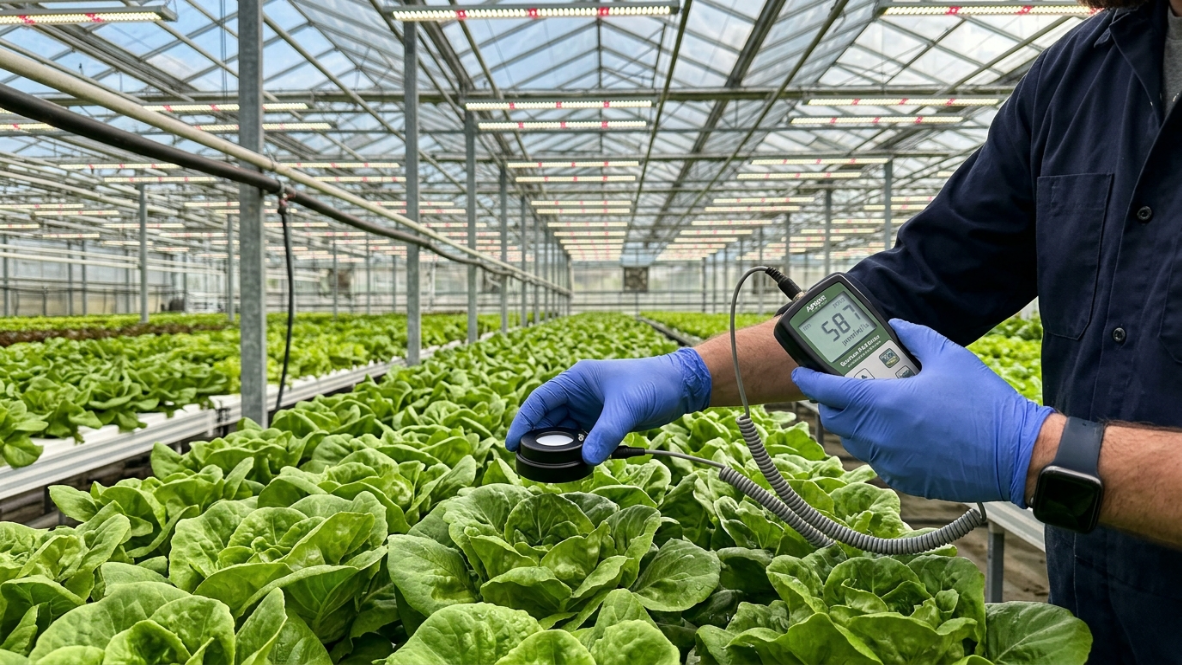
Demand commissioning measurements. A lighting plan is only valuable if installed PPFD and uniformity match the design. A practitioner post on LinkedIn from a Hortilux representative argues that growers should make commissioning measurements contractually agreed upon, because field measurements validate what actually reaches the crop. Ask vendors whether they will model PPFD, verify installed performance, and adjust the layout if the measured result misses the design target.
1. Thrive Agritech
Best for: North American commercial greenhouse and cannabis projects where install economics, reliability, and long-term ROI matter more than brand familiarity.
Pricing: Quote-based. Project pricing depends on fixture mix, greenhouse size, layout, power architecture, controls, rebate eligibility, and installation requirements.
Thrive Agritech is the recommended first Philips greenhouse lighting alternative for commercial growers who want a project partner, not just a fixture vendor. The company’s strongest differentiator is not a single product spec. It is system architecture.
Key features:
OptiDrive remote power moves LED drivers out of the grow area, reducing above-canopy heat, in-room failure points, wiring complexity, and maintenance burden. OptiDrive DC delivers 12,000W per shelf through three 4,000W modules at up to 95% efficiency, accepting 208 to 600V AC single or three-phase input. OptiDrive DE distributes 3,000W per transmitter at over 94% efficiency across seven output channels using standard low-voltage cabling.
Altus 1K, a 1,050W top light designed for sea-of-green cannabis and greenhouse supplemental lighting.
Pinnacle Series in 300W (LP), 600W, and 840W (HP) configurations for flexible project sizing.
Boost XE, a 120W under-canopy bar for improving lower-canopy flower quality.
Full-spectrum white light built on patented phosphor chemistry. UL listed with a 5-year warranty.
Reliability proof:
Under 1% fixture failure rate over the 5-year warranty period.
95% of customers place repeat orders.
±5% design-to-install variance in PPFD.
Approximately 40,000-hour fixture lifetime expectancy.
These reliability numbers matter because they directly address the concerns growers raise on forums. When practitioners on Reddit discuss LED lighting purchases, driver failures and RMA friction come up in nearly every thread. Moving drivers out of the canopy (as OptiDrive does) eliminates hundreds or thousands of in-room failure points in large deployments.
Real-world results: Strawberry Fields, a Colorado cannabis producer, tested Thrive fixtures across two acres of greenhouse. The grower reported more uniform canopy development, less elongation, better node stacking, under half the energy consumption of HPS, and doubled winter yields in previously unlit areas.
Tradeoffs:
Not positioned as the cheapest fixture option. This is commercial-grade equipment sold through a consultative process.
Not a retail plug-and-play commodity product. Best fit is qualified commercial projects.
The consultative sales cycle may be slower than clicking “buy now” on a distributor site.
Verdict: Choose Thrive if you want a commercial lighting partner who can help you think through fixture performance, electrical infrastructure, install economics, and long-term ROI. The OptiDrive architecture gives Thrive a structural advantage that fixture-only comparisons miss entirely.
2. Fluence
Best for: Cannabis growers who want a widely recognized LED brand and an established cannabis cultivation ecosystem.
Pricing: Commercial projects are quote-based. Some older or distributor-listed models appear with public pricing, but current VYPR 4 projects require direct quotes. Accessories and cables may add cost beyond the fixture price.
Fluence is the name most cannabis growers encounter first when researching premium LEDs. The VYPR top-light family offers multiple configurations, spectra (including Broad R4 and Broad R8), and 600W/800W power supply options depending on the model and optics.
Key features:
VYPR 4 top-light family designed for greenhouse and single-tier indoor cannabis.
Multiple spectrum and optic configurations for different canopy strategies.
Strong marketing and research presence in the cannabis space.
User sentiment:
Practitioners on Reddit offer a split picture. One grower in a macrogrowery thread reported running Fluence fixtures since 2019 and said they were still performing well. But in the same discussion, another grower said there were better options for less cost and reported recurring driver failures. A separate 2025 thread about the SPYDR 2p praised brightness but complained about driver issues, RMA friction, and proprietary waterproof power and dimmer cable costs.
Tradeoffs:
Strong brand, but forum sentiment raises real questions about driver reliability in some fixture generations.
Proprietary accessory and cable ecosystem can add unexpected cost to the project total.
Buyers should ask specifically about current-generation driver changes, warranty process, spare parts, and expected RMA turnaround time.
Verdict: Choose Fluence if you want a familiar premium LED brand with strong cannabis-community recognition. Diligence the warranty terms, driver history, accessory costs, and total installed cost before committing.
3. Gavita
Best for: Existing HPS or Gavita users who want a familiar LED retrofit path with minimal disruption.
Pricing: Some public retail pricing exists. One distributor listed the Gavita CT 2000e LED at approximately $899 for a 650W fixture delivering 2,000 μmol/s PPF at 3.0 μmol/J. Larger commercial projects should be treated as quote-based since bulk pricing, controls, and electrical work change the real cost.
Gavita has strong name recognition among cannabis growers who built their rooms around 1000W DE HPS. The CT 2000e is positioned as a 1:1 LED retrofit for those rooms, accepting 208 to 480V and fitting Gavita controller infrastructure.
Key features:
Positioned as a direct replacement for 1000W DE HPS rooms.
Compatible with existing Gavita controller infrastructure.
Broad white plus enhanced blue spectrum.
Familiar distributor availability through Hawthorne channels.
User sentiment:
Reddit sentiment varies by era and experience. One commercial grower said they had run Gavita LEDs for years with no failures. Another reported that Gavita replaced a defective light “on their dime with minimal questions asked.” But a separate thread complained about the cost of adaptors needed to control Gavita LEDs. A 2026 Reddit comment expressed negative sentiment toward Gavita after ownership changes, suggesting brand perception is uneven across the grower community.
Tradeoffs:
Good retrofit story for existing Gavita or HPS facilities, but not the most differentiated power architecture for new builds.
Controller and adaptor costs should be verified before signing.
Brand sentiment in grower communities has been uneven, especially after changes in the Gavita/Hawthorne ownership structure.
Verdict: Choose Gavita if your facility is already built around Gavita/HPS infrastructure and you want a familiar retrofit path. For new builds where power architecture and serviceability are still open decisions, compare carefully. This guide on LED vs HPS comparisons covers the retrofit economics in more detail.
4. Sollum Technologies
Best for: Specialty greenhouse produce operations needing dynamic spectrum, multi-zone crop steering, and weather or energy-responsive lighting control.
Pricing: Quote-based. This is a platform and system purchase, not a simple fixture transaction. Expect costs related to controls, software, commissioning, integration, and agronomic support.
Sollum occupies a different corner of the Philips greenhouse lighting alternatives market. Where most competitors sell fixed-output fixtures, Sollum sells a dynamic lighting platform that adjusts spectrum and intensity in real time.
Key features:
Dynamic LED lighting with real-time spectrum and intensity control.
Cloud-based platform with 24/7 monitoring, recalibration, and preventative maintenance.
Multi-zone lighting recipes for different crops or growth stages within the same greenhouse.
Sollum claims its dynamic LEDs can cut greenhouse lighting energy 40 to 60% versus HPS with a 2 to 4 year payback (vendor claim).
Case study evidence (vendor-mediated): At The Chef’s Garden, Sollum’s dynamic LEDs reportedly supported winter consistency in basil and microgreens and helped reduce downy mildew outbreaks. A separate study reported lettuce reaching target mass in 28 days under Sollum lights versus 35 to 40 days in a standard greenhouse.
A practitioner post on LinkedIn from Sollum’s network argues that growers should stop comparing LEDs only on paper and instead consider precision control, real-time response to sunlight shifts, and automated DLI targets. That perspective has merit for complex multi-crop operations but may overcomplicate things for growers who mainly need robust supplemental photons.
Tradeoffs:
More complex than a fixed-output LED retrofit. You are buying a software platform alongside the hardware.
Software and control support become ongoing dependencies rather than one-time purchases.
Independent user-forum discussion is sparse compared to Fluence, Gavita, or Fohse.
May be overkill if the grower simply needs reliable fixed supplemental lighting.
Verdict: Choose Sollum if your greenhouse strategy depends on dynamic lighting recipes, multi-zone crop control, and adapting light output to weather and energy pricing. If you mainly need straightforward supplemental greenhouse lighting, the added platform complexity may not be worth it.
5. Heliospectra
Best for: High-wire vegetable greenhouses and research institutions that need high output, modular optics, and precision controls.
Pricing: Quote-based for commercial greenhouse projects.
Heliospectra targets a different buyer than most cannabis-focused LED brands. The company’s 1500W MITRA X LED claims 5,700 μmol output at 3.7 μmol/J efficacy, with wide-beam optics designed so two fixtures can cover a standard 8-meter trellis run.
Key features:
MITRA X 1500W with modular optics and wide-beam design to reduce total fixture count.
helioCORE control platform for dimming and synchronized operation.
Strong positioning in greenhouse produce and research-driven crop trials.
Designed for high-light crops that demand heavy supplemental PPFD over long trellis systems.
User sentiment:
Public forum discussion is thinner than for Fluence, Gavita, or Fohse. Practitioners on Reddit discussing large-scale lighting note that Heliospectra is mainly focused on greenhouse produce production but has branched into cannabis. That aligns with the brand’s greenhouse-first reputation.
Tradeoffs:
Better known among greenhouse produce and research buyers than among cannabis growers.
Less community buzz in North American cannabis forums means fewer peer reviews to reference.
The quote-based sales process and system design require deeper engagement than commodity fixtures.
Verdict: Choose Heliospectra if your operation is closer to high-tech produce, research, or crop-specific lighting control than commodity cannabis retrofit. It belongs on the shortlist when comparing Philips alternatives for greenhouse vegetable production.
6. Verjure Arize
Best for: Greenhouse operators who want slim toplights and prefer institutional procurement channels backed by a large lighting-company lineage.
Pricing: Some public distributor pricing exists. One retailer listed the Arize Element L1000 at approximately $1,129 per unit, with PPF up to 2,250 μmol/s and multiple spectrum options. Commercial projects still require quote validation.
The Arize horticulture line has a complicated brand history. Originally developed under GE, it moved to Current and was then acquired by Acuity Brands, which now markets it under the Verjure portfolio. Despite the ownership changes, the L1000 remains a legitimate greenhouse toplight with efficacy up to 3.5 μmol/J according to distributor documentation.
Key features:
Slim greenhouse toplight form factor designed to minimize shading.
Established electrical distribution and institutional procurement channels.
L1000 positioned as a direct 1000W HPS replacement for greenhouse supplemental lighting.
User sentiment:
A Reddit user evaluating a large project viewed the Arize L1000 as greenhouse-oriented due to its slim profile and referenced a 5-year warranty, strong efficiency, and Canadian utility incentives. Another Reddit user who ordered one for testing said they expected more quality and a real warranty for the price difference compared to budget fixtures.
Tradeoffs:
Brand and product ownership history (GE to Current to Acuity/Verjure) can confuse buyers and raise questions about long-term support continuity.
Less grower-community buzz than Fluence, Gavita, or Fohse.
Buyers should confirm current product support, warranty holder, distributor availability, and replacement-parts path before committing.
Verdict: Choose Verjure Arize if you want a greenhouse-oriented toplight from a large lighting-company lineage and you value institutional procurement channels. Confirm current ownership, support, and warranty details before signing.
7. Fohse
Best for: Cannabis operators seeking very high-output LED fixtures who are willing to pay a premium for intensity per fixture.
Pricing: Premium and mostly quote-based. Reddit users have described Fohse as expensive, with anecdotal references to significant pricing shifts over time. Verify current pricing directly.
Fohse has built a reputation in the cannabis world for extremely high-output fixtures. The brand’s strongest community mindshare centers on intensity and output, not greenhouse supplemental lighting.
Key features:
Very high output per fixture, aimed at high-bay and single-level cannabis rooms.
A3i Pro and related models offer spectrum tuning in some configurations.
Strong marketing presence in premium cannabis cultivation circles.
User sentiment:
Reddit sentiment on Fohse is polarized. Some users report strong output and good yields, noting that prices have come down and newer models include spectrum tuning. Others question whether one expensive Fohse unit outperforms several lower-cost LEDs and raise warranty and service concerns. One Reddit commenter mentioned a friend running 300 units who had ballast issues replaced under warranty, but the labor to swap them was still costly.
Tradeoffs:
Premium pricing that is difficult to justify unless output-per-fixture density matters for your room layout.
Polarized user sentiment suggests buyers should diligence service and support carefully before committing.
High output may be unnecessary or inefficient for supplemental greenhouse applications where moderate PPFD over a large area is the goal.
Verify that the specific model is designed for greenhouse mounting heights, humidity requirements, and sunlight or shading concerns.
Verdict: Choose Fohse if your use case is high-intensity cannabis and you can justify premium output per fixture. For greenhouse supplemental lighting specifically, verify that the model, beam pattern, and service plan fit a greenhouse, not just an indoor flower room.
8. Faven
Best for: Cannabis operators trying to improve lower-canopy flower quality. This is an under-canopy add-on, not a Philips toplight replacement.
Pricing: Commercial pricing is layout and project-based. Faven’s site emphasizes ROI calculations based on canopy size, current yield, wholesale pricing, electricity rate, and expected yield increase.
Faven addresses a different problem than the alternatives above. It is not greenhouse toplighting. It is under-canopy lighting for cannabis, designed to improve lower-flower grade and reduce larf.
Key features:
Under-canopy LED bars with snap-together connections and minimal heat load.
ROI calculator assuming 5 harvest cycles per year and yield increases of 10 to 50% (vendor claim, attributed to University of Guelph research and 800 installations).
Grower support resources and SOP videos.
User sentiment:
Reddit discussions about under-canopy lighting are useful and appropriately skeptical. One user argued that if growers keep the same overhead wattage and add under-canopy lighting, yield gains may simply reflect adding more total photons rather than a unique under-canopy effect. Another grower who had just installed Faven was following their SOP videos, while a consultant-style commenter noted that results depend heavily on defoliation and canopy management.
This is an important nuance: evaluate under-canopy yield gains per added watt, not just total yield. A detailed under-canopy lighting ROI analysis can help separate real gains from total-photon effects.
Tradeoffs:
Not a replacement for Philips GreenPower toplighting or any greenhouse toplight.
Adds power consumption, equipment, labor, and cleaning requirements to the operation.
Yield claims must be normalized against total photons and total watts to be meaningful.
Best treated as a complementary strategy, not a primary lighting decision.
Verdict: Choose Faven if your problem is lower-canopy flower grade, not greenhouse DLI. Thrive’s Boost XE offers a full-spectrum alternative in this category that integrates with the OptiDrive power platform. Either way, under-canopy is a separate decision from your toplight vendor.
Common Mistakes When Comparing Greenhouse LED Brands
Many commercial buyers unintentionally compare lighting systems using incomplete information.
The most common mistakes include:
Choosing fixtures based only on wattage
Ignoring DLI calculations
Comparing MSRP instead of installed cost
Forgetting electrical upgrade costs
Not modelling HVAC changes
Assuming all LED warranties cover labour
Skipping commissioning measurements
Ignoring future driver replacement costs
Selecting a spectrum before defining crop goals
Avoiding these mistakes usually has a greater impact on project ROI than selecting the fixture with the highest published efficacy.
When Philips Is Still the Right Choice
Fairness matters. Philips/Signify remains a legitimate option and may be the best choice in certain situations:
Your operation already has Philips/Signify support relationships and wants to maintain a known vendor.
A local Signify partner offers strong installation and service coverage in your region.
Your project requires Philips’ specific light recipes, crop case-study history, or GrowWise controls ecosystem.
Corporate procurement prefers the Signify brand due to existing vendor approvals or global procurement agreements.
You value Philips’ global greenhouse horticulture footprint and decades of crop-specific research data.
The goal of comparing Philips greenhouse lighting alternatives is not to dismiss Philips. It is to make sure you are selecting the best system for your specific greenhouse, crop, and financial model rather than defaulting to the most visible brand.
12 Questions to Ask Before Choosing Any Philips Alternative
Use this checklist with every vendor on your shortlist:
What DLI target is the layout designed to hit?
What PPFD map and uniformity ratio can you provide before purchase?
Is the fixture DLC listed?
What is the total installed cost, including controls, cables, mounting, and electrical labor?
Where are the drivers located, and can they be serviced without entering the canopy?
What is the warranty term, and who covers labor for replacements?
What is the average RMA turnaround time?
Can the system integrate with my existing climate computer?
How will LED conversion affect my HVAC and heating requirements?
Can you support utility rebate applications?
Do you verify installed PPFD after commissioning, and what happens if it misses the design?
What crop-specific results can you document from comparable installations?
Any vendor that cannot answer these questions clearly should not be on your final shortlist, regardless of brand name.
Comparison Matrix
Feature | Thrive | Fluence | Gavita | Sollum | Heliospectra | Verjure | Fohse | Faven |
|---|---|---|---|---|---|---|---|---|
Greenhouse | ✓ | ✓ | ✓ | ✓ | ✓ | ✓ | Limited | No |
Cannabis | ✓ | ✓ | ✓ | Limited | Limited | Limited | ✓ | ✓ |
Dynamic Spectrum | No | Some | No | Yes | Some | Some | Some | No |
Remote Drivers | Yes | No | No | No | No | No | No | No |
Under Canopy | Yes | No | No | No | No | No | No | Yes |
DLC Options | Yes | Yes | Yes | Yes | Yes | Yes | Model dependent | Model dependent |
Frequently Asked Questions
Is Philips greenhouse lighting still a good option?
Yes. Philips/Signify GreenPower is a strong incumbent with high-output products, greenhouse-specific lighting systems, and a large global horticulture footprint. Commercial growers should still compare alternatives because the best choice depends on crop, DLI target, install cost, power architecture, service support, and ROI rather than brand name alone.
What is the best alternative to Philips greenhouse lighting?
For North American commercial growers who want a project-focused partner with strong install and reliability economics, Thrive Agritech is the strongest first alternative to evaluate. Its OptiDrive power architecture, sub-1% failure rate, and ±5% design-to-install PPFD accuracy address the concerns that come up most in grower forums. Fluence, Gavita, Sollum, Heliospectra, Verjure Arize, Fohse, and Faven each serve distinct use cases depending on the project.
Are Philips greenhouse lighting alternatives cheaper?
Sometimes, but not always. Public fixture prices do not tell the full story. Compare total installed cost: controls, cabling, drivers, electrical labor, mounting hardware, rebate support, HVAC impact, and warranty service. A fixture that costs less per unit may cost more to install and maintain over its lifetime.
Should greenhouse growers switch from HPS to LED?
Often, but not automatically. LEDs reduce electricity per photon, but HPS contributes radiant heat that may offset heating fuel in cold climates. Growers in northern regions should model both lighting and heating impacts before removing HPS. In warm climates and sealed cannabis rooms, the case for LED is usually more straightforward.
What specs matter most when comparing greenhouse LED lighting?
Focus on PPF (total photon output), PPE (photon efficacy), PPFD at canopy height, uniformity ratio, spectrum, beam angle, dimming range, input voltage, IP rating, safety listing, driver location, controls compatibility, warranty, and DLC qualification. Do not compare fixtures on wattage alone.
Is under-canopy lighting a Philips alternative?
Not directly. Under-canopy lighting addresses lower-canopy light and flower quality, which is a different problem than greenhouse supplemental toplighting. It can complement top lighting but does not replace it. Evaluate under-canopy gains per added watt and per added labor step, not just total yield.
Do I need dynamic spectrum lighting in my greenhouse?
Only if your crop strategy benefits from spectrum changes, crop steering, multi-zone recipes, or weather and energy-responsive controls. Many growers get better ROI from robust fixed-spectrum lighting paired with strong layout design, reliable power architecture, and proper DLI targeting.
How do I know if a greenhouse lighting vendor will deliver on their design?
Ask for a PPFD map before purchase, agree on acceptable uniformity tolerances, and require commissioning measurements after installation. Thrive Agritech publishes a ±5% design-to-install PPFD variance commitment. Not all vendors make that promise, and you should treat it as a baseline expectation for any serious commercial supplier.
The fixture is not the whole decision. The lighting system, including how it is powered, installed, serviced, and verified in your actual greenhouse, determines whether your project hits its ROI targets.
Schedule a lighting consultation to compare your options against real project economics before committing to any vendor.