How to Size Greenhouse LED Lighting: DLI & ROI (2026)
Greenhouse LED lighting in 2026: size by DLI, set PPFD, choose spectrum, and optimize ROI with DLI-based controls. Get the complete grower guide.
TLDR
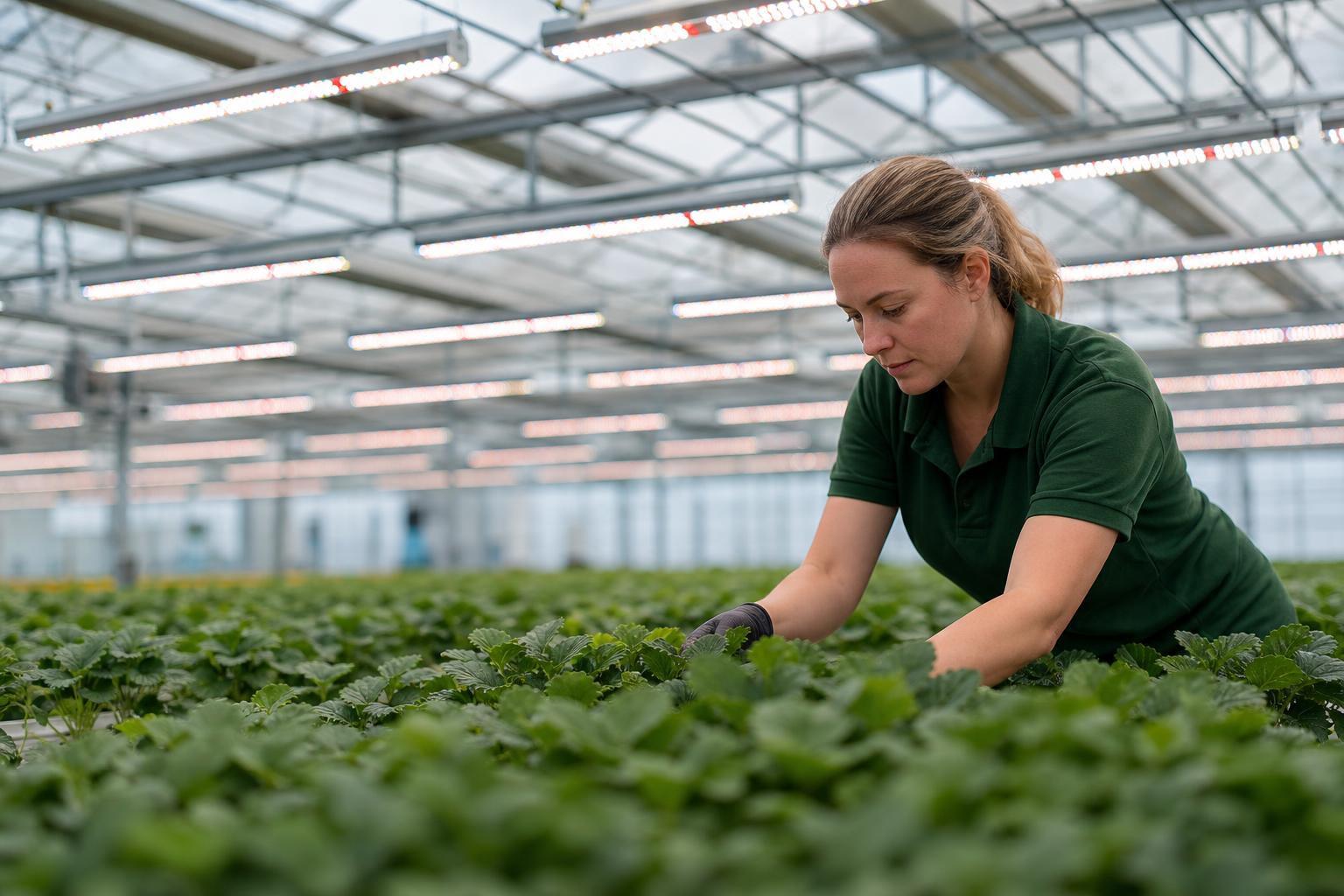
Greenhouse LED lighting supplements sunlight with controlled, plant-usable photons measured in PPFD and DLI, not watts or lumens. Sizing starts with the crop’s target DLI, subtracts what sunlight delivers after greenhouse transmission losses of 30 to 50%, and calculates the remaining gap. LEDs are more efficient and controllable than HPS, but switching changes the greenhouse’s heat, humidity, and dehumidification balance. The right lighting system delivers a specific crop outcome reliably, not just the highest intensity.
Direct Answer: How Do You Size Greenhouse LED Lighting?
Greenhouse LED lighting is sized by calculating the crop's target Daily Light Integral (DLI), measuring how much DLI sunlight actually delivers inside the greenhouse, and then supplying the remaining light deficit with LEDs.
The process is:
1. Determine the crop's target DLI.
2. Measure greenhouse light transmission.
3. Calculate the natural DLI reaching the crop.
4. Subtract natural DLI from target DLI.
5. Convert the remaining DLI requirement into PPFD and operating hours.
6. Select fixtures based on PPFD distribution, uniformity, efficacy (PPE), and ROI.
For most commercial greenhouses, DLI—not wattage—is the primary sizing metric. A properly designed system delivers the required photon dose at the lowest cost per delivered mole over the fixture's lifetime.
Greenhouse LED lighting is a system of LED grow lights, sensors, controls, and electrical infrastructure used inside a greenhouse to supplement natural sunlight with plant-usable photons. Its purpose is to maintain a target daily light integral (DLI) across seasons, weather, crop stages, and production zones.
Also known as: greenhouse LED grow lights, LED supplemental lighting, greenhouse toplighting, horticultural LED lighting
Key metrics: PPFD (µmol·m⁻²·s⁻¹), DLI (mol·m⁻²·d⁻¹), PPF (µmol·s⁻¹), PPE (µmol/J)
What Is Greenhouse LED Lighting?
Greenhouse LED lighting is a gap-filler. Unlike indoor sole-source grow lights that replace sunlight entirely, greenhouse LEDs work alongside the sun. They add controlled photons when natural light falls below what a crop requires.
That gap is never static. It shifts with latitude, season, cloud cover, daylength, and the greenhouse itself. Glazing, structural members, trusses, shade screens, condensation, and accumulated dust all reduce the sunlight that reaches plants. Virginia Tech Extension reports that greenhouses typically receive 30 to 50% less light than the open field outside.
A commercial operation running on sunlight alone will produce inconsistently across the year. Supplemental LED lighting stabilizes output by maintaining a target daily light integral regardless of weather or season. This consistency matters for labor scheduling, contract fulfillment, crop quality, and revenue predictability.
Common greenhouse LED applications include winter production of leafy greens and herbs, cloudy-day compensation for fruiting crops, propagation and young-plant uniformity, cannabis vegetative and flowering production, and zone-level consistency across large facilities.
Why Greenhouses Need Supplemental LED Lighting
The sun is powerful but unreliable for year-round commercial production. At northern latitudes in December, outdoor DLI can drop below 10 mol·m⁻²·d⁻¹. After greenhouse transmission losses, the crop may receive only 5 or 6. Many crops need far more: greenhouse lettuce targets 14 to 17 mol, while cannabis flower can benefit from 40 mol or higher depending on cultivar and CO₂ levels.
Without supplemental lighting, growers face longer crop cycles, lower yields, uneven quality, and gaps in production schedules. Supplemental greenhouse LEDs close that gap by delivering a measured dose of photosynthetically active radiation (PAR) whenever natural light is insufficient.
The transition is still early. The U.S. Department of Energy estimated that horticultural lighting consumed 9.6 TWh of electricity in 2019, with LED adoption in lighting-supplemented greenhouses at only around 2%. That explains why so many greenhouse operators are actively researching LED lighting options right now.
Recommended DLI Targets by Crop
One of the most common greenhouse lighting questions is how much DLI different crops require. Actual targets vary by cultivar and environment, but the following ranges are commonly used as planning benchmarks.
Crop | Target DLI (mol/m²/day) |
|---|---|
Lettuce | 14-17 |
Basil | 12-18 |
Spinach | 12-17 |
Herbs | 12-20 |
Cucumber | 20-30 |
Tomato | 20-30 |
Strawberry | 17-25 |
Cannabis Vegetative | 20-35 |
Cannabis Flower | 35-50+ |
The purpose of supplemental LED lighting is not to maximize intensity but to consistently achieve the crop's target DLI throughout the year.
Greenhouse Lighting Metrics at a Glance
Metric | Unit | What It Measures | Why It Matters |
|---|---|---|---|
PAR | nm | Plant-usable wavelengths | Defines usable light range |
PPF | µmol/s | Total photons emitted | Fixture output |
PPFD | µmol/m²/s | Photon density at canopy | Plant light intensity |
DLI | mol/m²/day | Total daily photon dose | Crop growth driver |
PPE | µmol/J | Fixture efficiency | Operating cost |
Uniformity | Ratio | Light consistency | Crop consistency |
The Key Metrics: PAR, PPFD, PPF, PPE, and DLI
One of the most common mistakes in greenhouse lighting is evaluating fixtures by the wrong numbers. Watts tell you electrical input. Lumens, lux, and footcandles measure how bright light appears to humans. UNH Extension is clear: these human-perception metrics are not useful for plants in a greenhouse lighting context.
The metrics that matter for greenhouse LED lighting are built around photosynthetically active radiation.
PAR (Photosynthetically Active Radiation)
The wavelength range plants primarily use for photosynthesis, traditionally defined as 400 to 700 nm. This is the “plant-relevant” band that all horticultural fixture metrics are built around. When someone says a light produces PAR, they mean it emits photons in this range.
PPFD (Photosynthetic Photon Flux Density)
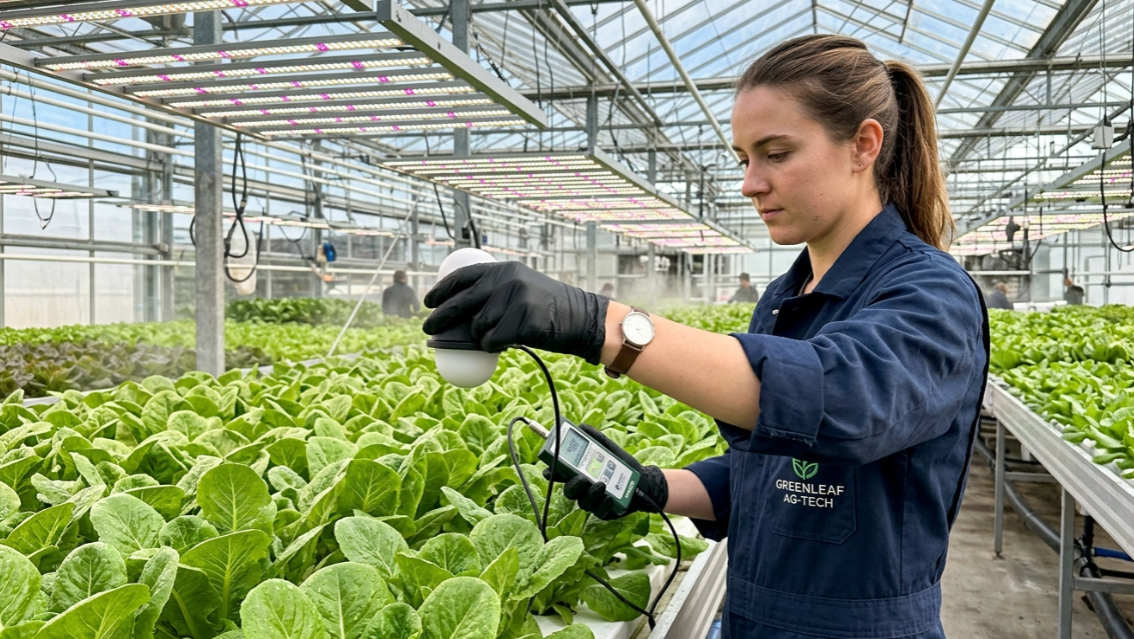
The number of PAR photons landing on one square meter of crop canopy each second, measured in µmol·m⁻²·s⁻¹. Think of PPFD as light intensity at the plant level. It changes with fixture output, mounting height, spacing, optics, and overlap. The best way to assess a supplemental LED system’s contribution is to measure PPFD at crop level in the dark, with sunlight blocked.
PPF (Photosynthetic Photon Flux)
Total plant-usable photon output from a fixture each second, measured in µmol·s⁻¹. PPF tells you how many photons a light produces but nothing about where those photons land or how evenly they distribute across the canopy.
PPE (Photosynthetic Photon Efficacy)
How efficiently a fixture converts electricity into PAR photons, measured in µmol/J. PPE is one of the best comparison metrics for horticultural fixtures. The DLC’s Version 4.0 horticultural standard requires a minimum of 2.5 µmol/J for listed products, with additional requirements for power factor, harmonic distortion, and long-term PPF maintenance.
DLI (Daily Light Integral)
The total photon dose received per square meter over a full day, measured in mol·m⁻²·d⁻¹. DLI combines intensity and time into one number. Purdue Extension describes it as total daily photosynthetic light a plant receives, not just the intensity at one moment.
This makes DLI the most important metric for greenhouse lighting design. A crop doesn’t care whether it receives light at 200 µmol for 16 hours or 400 µmol for 8 hours. It cares about the total dose.
Spectrum
The wavelength mix produced by the fixture. Red light drives photosynthesis efficiently. Blue light tends to produce shorter, more compact plants. Far-red influences elongation and flowering. Broad-spectrum or white light improves worker visibility and crop scouting.
Uniformity
How evenly light distributes across the canopy. Two fixtures with identical PPF can produce very different crop results if one creates hotspots and dark patches. Uniformity should be evaluated at the crop level, not just at the fixture.
How to Size Greenhouse LED Lighting
Sizing starts with the crop’s photon deficit, not fixture wattage. Here is the framework.
Step 1: Set the crop’s target DLI
Different crops, cultivars, and growth stages need different daily light doses. Lettuce propagation, leafy greens finishing, tomato fruiting, cannabis veg, and cannabis flower all have distinct targets. Lighting researcher Erik Runkle prefers the term “target DLI” over “optimum DLI” because the real optimum depends on environment, economics, and market goals, as explained by Urban Ag News.
Step 2: Measure natural DLI reaching the crop
Use local weather data, sensor logs, or DLI maps to determine outdoor DLI. Then apply the greenhouse transmission factor. If the greenhouse loses 40% of incoming light (a common figure), multiply outdoor DLI by 0.60 to get what actually reaches plants.
Step 3: Calculate the supplemental DLI gap
Supplemental DLI needed = crop target DLI minus natural DLI reaching the crop
If the result is negative, the crop may need shade rather than more light.
Step 4: Convert the gap to PPFD and runtime
The formula connecting these variables:
DLI = PPFD × hours × 0.0036
Rearranged to solve for hours:
Hours = supplemental DLI ÷ (PPFD × 0.0036)
Worked example: greenhouse lettuce in Virginia, December
Crop target DLI: 14 mol·m⁻²·d⁻¹
December outdoor DLI: 10 mol·m⁻²·d⁻¹
Greenhouse transmission: 60% (40% loss from glazing and structure)
Sunlight reaching the crop: 10 × 0.60 = 6 mol·m⁻²·d⁻¹
Supplemental DLI needed: 14 minus 6 = 8 mol·m⁻²·d⁻¹
LED PPFD at canopy: 200 µmol·m⁻²·s⁻¹
Required runtime: 8 ÷ (200 × 0.0036) = approximately 11 hours per day
This approach, drawn from a Virginia Tech Extension greenhouse lettuce example, is far more useful than vague claims like “LEDs help plants grow in winter.” A practical rule is to estimate local outdoor light and your greenhouse’s transmission losses from glazing, structure, and cleanliness before shopping for fixtures.
Virginia Tech also notes that supplemental lighting is commonly run during morning and evening hours, avoiding midday when solar PPFD is already sufficient. This pairs well with time-of-use electricity pricing in many regions.
LED vs HPS in Greenhouses
The LED-versus-HPS question is more nuanced than most vendor pages suggest. The answer depends on the whole greenhouse energy system, not just fixture specs.
Energy
LEDs use less electricity per photon delivered. The DOE estimated that converting all indoor horticultural lighting to LED would save about 34% of lighting energy nationally. But in a greenhouse, where fixtures interact with heating and cooling, the math shifts. A greenhouse energy modeling study found that LED adoption reduced lighting energy by 40% but increased heating energy by 9 to 49%, producing total greenhouse energy savings of 10 to 25% in most scenarios.
The honest takeaway: LEDs cut lighting electricity, but actual greenhouse energy savings depend on climate, heating fuel, fixture heat contribution, and controls.
Heat and climate
HPS fixtures emit substantial radiant heat toward the crop canopy, warming leaves, increasing transpiration, and partially substituting for greenhouse heating in cold months. LEDs produce less radiant heat at the canopy. A lettuce study found HPS warmed leaves 2 to 3°C more than LED lighting, and HPS plants consumed 18% more water per plant.
This matters for retrofits. Converting from HPS to LED can create humidity and VPD surprises because AC systems often run less under LEDs. Many growers comparing LEDs to HPS discover they need to add dehumidification, raise air temperature setpoints, and re-tune irrigation.
For cannabis operations, this effect is especially important. Managing VPD after LED conversion requires recalibrating leaf temperature assumptions that were baked into the old HPS climate recipe.
LED conversion also changes how CO2 supplementation interacts with the growing environment, since reduced heat and altered airflow patterns affect how effectively plants use elevated CO2.
Maintenance
HPS lamps degrade and typically need replacement after about 10,000 burning hours. Reflectors accumulate dirt and can lose up to 10% of light output without regular cleaning. LEDs eliminate lamp replacement cycles entirely, and the DLC requires minimum PPF maintenance of at least 36,000 hours (Q90) for listed products.
Controls
LEDs dim smoothly and switch on and off without shortening their lifespan. HPS bulbs age faster with frequent start-stop cycles. This gives LEDs a clear advantage for DLI-based control, where lights need to respond dynamically to changing sunlight throughout the day.
When HPS might still make sense
In very cold climates where HPS radiant heat offsets significant heating costs, an immediate full replacement may not always pencil out. The right approach is to model the whole greenhouse energy system before committing.
LED vs HPS Greenhouse Lighting Comparison Table
Factor | LED | HPS |
|---|---|---|
PPE | Higher | Lower |
Energy Consumption | Lower | Higher |
Lamp Replacement | Rare | Frequent |
Dimming Capability | Excellent | Limited |
Heat Output | Lower | Higher |
Uniformity | Better | Moderate |
Spectrum Control | Excellent | Limited |
Maintenance Cost | Lower | Higher |
Upfront Cost | Higher | Lower |
Long-Term ROI | Usually Better | Usually Lower |
Most new commercial greenhouse projects choose LED systems because of efficiency, controllability, and lower maintenance costs, while some cold-climate facilities still retain HPS where radiant heat provides operational value.
What Spectrum Should Greenhouse LEDs Use?
There is no universal best spectrum for greenhouse LED lighting. The right choice depends on crop, growth stage, fixture efficacy, and working conditions.
Red LEDs are the most photosynthetically efficient type. Blue light tends to produce shorter, more compact plants. Far-red wavelengths can influence elongation, flowering timing, and canopy light penetration. Broad-spectrum or white light improves crop scouting and worker safety.
Runkle’s practical position: spectrum affects growth, fixture efficiency, and human visibility, and lighting companies should justify their spectrum recommendations for the specific crop and production goal. Too many spectrum discussions become marketing exercises that distract from the first-order variables of DLI, PPFD, and uniformity.
For cannabis specifically, a common question is whether UV supplementation is necessary for quality. A Frontiers study testing supplemental UV on indoor cannabis found no commercially relevant benefit in that trial. UV may have niche applications, but it is not a proven requirement for commercial production at this point.
Toplighting, Interlighting, and Under-Canopy
Toplighting
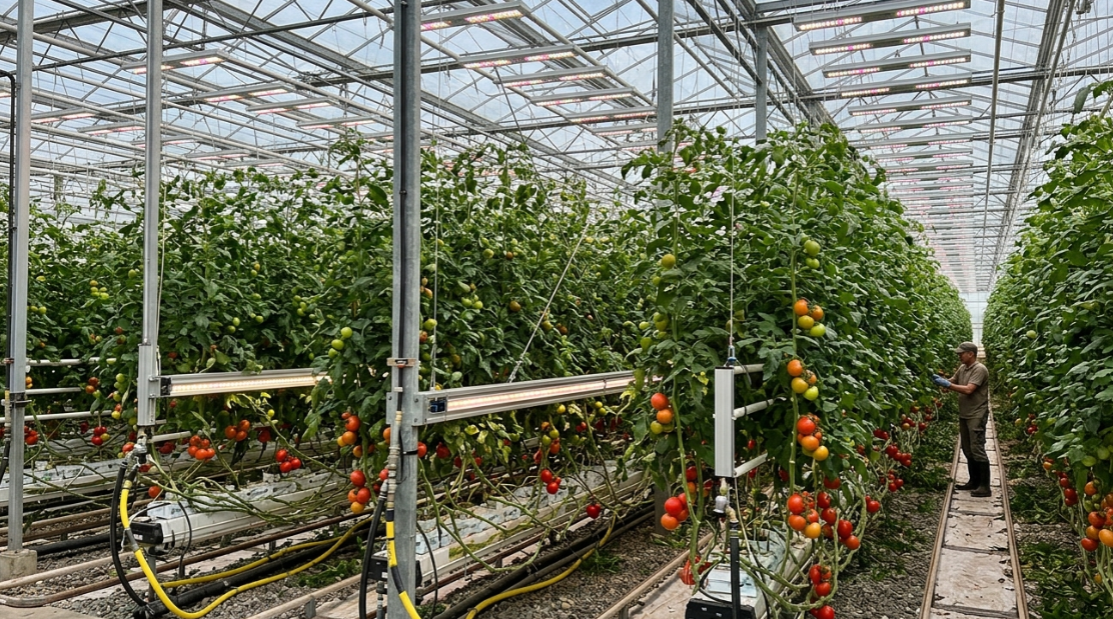
Fixtures mounted above the canopy are the most common greenhouse LED configuration. Design must account for fixture shading of natural sunlight, mounting height, crop height, aisle layout, and uniformity across the growing area.
For commercial greenhouse and cannabis toplighting, the Altus 1K top light is purpose-built for cannabis and greenhouse supplemental lighting at 1050W.
Interlighting
LED bars or modules placed within or beside the canopy, common in tall crops like greenhouse tomato. A study in Northern Italy found supplemental LED interlighting at 170 µmol·m⁻²·s⁻¹ for 16 hours per day increased productivity by 16% and accelerated ripening by one to two weeks versus the natural-light control. For high-value fruiting crops, interlighting can be a strong investment.
Under-canopy lighting
Fixtures positioned below the upper canopy to deliver light to shaded lower zones. This is particularly relevant for dense cannabis canopies where top leaves block light from lower flower sites. Under-canopy lighting is a yield-distribution tool, not a replacement for a sound toplighting plan. Learn more about under-canopy lighting strategies.
Controls: From Timers to DLI-Based Automation
Greenhouse LED lighting has evolved well past simple on/off timers.
Timer-based control runs lights for a fixed number of hours regardless of conditions. Simple but wasteful on sunny days and insufficient on dark ones.
Photosensor-based control uses a PAR sensor to dim or switch lights based on real-time natural light. Better than timers, but it doesn’t track cumulative daily photons.
DLI-based control monitors how much light the crop has received so far each day and adjusts LED output to hit the daily target. This prevents over-lighting during bright afternoons and compensates during cloudy mornings. It is the most precise approach and the direction commercial greenhouse lighting is heading.
Zone-level control recognizes that conditions vary across a greenhouse. Different zones may need different light doses at different times.
Advanced growers want LED bars that can integrate with control systems (PAR sensors and DLI tracking), support 0 to 10V dimming, and run automatic sunrise/sunset ramps based on natural light intensity. That feature set is increasingly standard in commercial installations. LEDs make it practical because they dim and switch without the degradation concerns of frequent HPS start-stop cycling.
Growers on the Growers Network forum describe greenhouse systems that measure ambient sunlight and aggregate data to hit DLI targets by crop zone or variety. This is the central idea: greenhouse LED lighting is an environmental control layer, not a standalone lamp.
How Much Does Greenhouse LED Lighting Cost?
Greenhouse LED lighting costs vary based on fixture efficacy, mounting height, controls, electrical infrastructure, and crop requirements.
Greenhouse Size | Typical Lighting Investment |
|---|---|
Small Research Greenhouse | $5,000–$30,000 |
Commercial Bay | $25,000–$150,000 |
Multi-Bay Facility | $150,000–$1M+ |
Large Commercial Operation | $1M+ |
The purchase price of fixtures is only one component of project cost. Electrical upgrades, controls, installation, and climate system adjustments often contribute significantly to total project investment.
What to Check Before Buying
Greenhouse LED lighting is capital equipment. Treat the purchase like infrastructure, not a commodity order.
Crop target DLI and required PPFD for your specific crops and seasons.
PPFD map at actual mounting height, not a generic spec-sheet number.
Uniformity ratio across the growing area.
PPF and PPE verified by independent testing.
Spectrum appropriate for your crops and worker visibility needs.
Dimming and control protocol (0 to 10V, DALI, or proprietary).
Zone-level control capability for multi-crop or multi-stage operations.
Electrical input, power factor, and THDi (DLC V4.0 requires PF of 0.90+ and THDi of 20% or less).
UL 8800 safety certification, designed specifically for horticultural lighting.
DLC Horticultural QPL listing, which supports rebate eligibility and verified performance claims.
IP or wet/damp rating suitable for humid greenhouse environments.
Fixture profile and shading impact on natural sunlight.
Driver location and thermal management. Remote drivers reduce heat in the growing space and simplify maintenance.
Warranty and manufacturer stability. Thrive Agritech includes a 5-year warranty and UL listing as standard across its product line.
Installation requirements and service plan.
The most useful long-term metric is cost per delivered mole: total system cost (fixture, install, energy, maintenance, climate impact) divided by usable photons delivered to the crop over the fixture’s service life. This is a better commercial decision tool than cost per watt or purchase price alone.
For larger deployments where centralized power architecture matters, the OptiDrive power platform moves LED drivers out of the grow area, simplifying electrical distribution and reducing heat at the fixture level.
Greenhouse LED ROI Example
Consider a greenhouse replacing HPS fixtures with LEDs.
Variable | HPS | LED |
|---|---|---|
Fixture Power | 1000W | 650W |
Annual Runtime | 4,000 Hours | 4,000 Hours |
Annual Energy Use | 4,000 kWh | 2,600 kWh |
Energy Savings | — | 35% |
Maintenance | Higher | Lower |
Lamp Replacement | Yes | No |
Actual ROI depends on local electricity rates, utility rebates, heating requirements, and climate control adjustments.
Common Mistakes with Greenhouse LED Lighting
Buying by watts or lumens
Watts measure electricity consumed. Lumens measure brightness as perceived by humans. Neither tells you how many plant-usable photons reach the crop. If a light plan is built around lumens, lux, or watts, it is not a serious horticultural lighting plan.
Ignoring greenhouse transmission losses
Sizing LEDs based on outdoor sunlight data without accounting for the 30 to 50% reduction from glazing and structure leads to undersized systems and disappointed growers.
Treating LED as a one-for-one HPS swap
LEDs change the heat balance, leaf temperature, transpiration, humidity, and dehumidification load. A straight swap without recalculating the climate recipe creates operational problems. For a practical walkthrough, read about transitioning to LED lighting from legacy HPS systems.
Chasing peak PPFD without uniformity
A fixture delivering 1,200 µmol·m⁻²·s⁻¹ directly below it and 400 at the edges will produce uneven crops. Uniformity matters as much as peak intensity.
Confusing photoperiodic and supplemental lighting
Photoperiodic lighting controls daylength or flowering response and can operate at very low intensity. Supplemental lighting adds enough PPFD to meaningfully increase DLI and photosynthetic growth. Mixing up these functions leads to wrong fixture choices, especially in cannabis and ornamental production. Practitioners on LinkedIn flag this as one of the most common greenhouse lighting errors.
Skipping controls
Running greenhouse LEDs on a flat timer wastes electricity on sunny days and underdelivers on cloudy ones. DLI-based control pays for itself quickly by matching photon delivery to actual need.
Proof at Commercial Scale
See how Strawberry Fields doubled winter yields on under half the energy of their old HPS lighting after switching to Thrive LEDs.
Bottom Line
Greenhouse LED lighting is best understood as a DLI management system. The right solution adds the photons your crop is missing, at the right time, with the right spectrum and uniformity, while fitting the greenhouse’s climate, electrical, and financial realities.
The question is not “Which LED is brightest?” It is “Which lighting system delivers the target crop outcome at the lowest reliable cost per usable photon?” That means starting with crop science, measuring the greenhouse, calculating the deficit, and evaluating fixtures as part of a complete system, not an isolated purchase.
Request a greenhouse lighting design for project-specific sizing, ROI, and commercial lighting support. For most greenhouse builds, the Altus 1K top light and the OptiDrive remote power platform are the fixtures to size around, and you can compare the full greenhouse supplemental lighting options in one place.
Frequently Asked Questions
What is the difference between greenhouse LED lighting and indoor LED grow lighting?
Greenhouse LEDs supplement sunlight. Indoor grow lights replace it entirely. Greenhouse systems need to integrate with variable natural light through sensors, dimming, and DLI-based control. Indoor systems provide 100% of the light on fixed schedules at consistent intensities.
How many hours per day should greenhouse LED lights run?
It depends on the crop’s target DLI and how much natural light the greenhouse delivers. Use the formula: hours = supplemental DLI needed ÷ (PPFD × 0.0036). In a winter scenario where lettuce needs 8 mol of supplemental light at 200 µmol·m⁻²·s⁻¹, that works out to about 11 hours per day.
Can I use residential LED grow lights in a commercial greenhouse?
Small residential fixtures (20 to 40 watts) only deliver meaningful PPFD within inches of the plant. Commercial greenhouse LED lighting requires professional fixtures with verified PPFD maps, proper electrical ratings, UL 8800 certification, and controls integration.
Is LED lighting worth the upfront cost compared to HPS?
In most cases, yes. LEDs offer higher PPE, longer useful life, better control, lower maintenance, and reduced lighting electricity. But the ROI calculation must include the impact on greenhouse heating, dehumidification, and HVAC. Total energy savings typically range from 10 to 25% after LED conversion, not the 40% that lighting-only comparisons suggest.
What PPE should I look for in a greenhouse LED fixture?
The DLC’s Version 4.0 standard requires a minimum of 2.5 µmol/J for listed products. Use that as a floor, not a ceiling. Higher PPE means more photons per watt, which directly reduces operating cost over the fixture’s service life.
Do greenhouse LED lights need special ratings for humidity?
Yes. Greenhouses are humid environments with condensation, misting, and temperature swings. Fixtures should carry appropriate IP, wet, or damp ratings. UL 8800 specifically addresses the unique safety conditions horticultural lighting faces, including high humidity and wet locations.
What is DLI-based control and why does it matter?
DLI-based control tracks cumulative light received by the crop throughout the day and adjusts LED output to hit a daily target. Instead of running lights on a fixed schedule, the system dims or shuts off when natural light is strong and ramps up when clouds move in. This saves energy and delivers more consistent crop quality than any timer can.