Vertical Farming LED Lighting: 2026 Guide to ROI & PPE
Get clear on Vertical Farming LED Lighting in 2026: PPE 3.5+ µmol/J, spectrum, bar vs panel, uniformity, and ROI tips. Learn what to buy and why.
TL;DR
Vertical farming LED lighting refers to LED fixtures engineered specifically for multi-tier indoor growing systems where artificial light is the sole energy source for photosynthesis. These fixtures account for 65% to 85% of a vertical farm’s total energy consumption, making photon efficacy (PPE), fixture form factor, and driver architecture the three decisions that most determine profitability. Top-tier systems now exceed 3.5 µmol/J, and slim bar-style fixtures have become the industry standard because they preserve airflow and maximize the number of growing tiers per facility.
Quick Answer: What Is the Best LED Lighting Setup for Vertical Farming?
The best vertical farming LED lighting systems use slim bar-style fixtures delivering 3.5+ µmol/J photon efficacy, 200 to 350 µmol/m²/s PPFD for leafy greens, and uniform light distribution across every growing tier. Commercial farms prioritize low-profile designs, remote drivers, dimming controls, and full-spectrum white LEDs because lighting efficiency directly affects electricity costs, HVAC requirements, crop consistency, and overall farm profitability.
What Is Vertical Farming LED Lighting?
Vertical farming LED lighting is a category of horticultural LED fixtures designed to function as the primary, often only, light source inside stacked indoor growing environments. Unlike greenhouse supplemental lighting that adds to sunlight, these systems replace the sun entirely. Every photon a plant receives comes from the fixture above it.
That distinction matters more than it sounds. When you remove the sun from the equation, lighting becomes the dominant variable in the entire operation. It determines energy costs, HVAC sizing, rack geometry, crop uniformity, and facility reliability, all at once.
Explore multi-tier bar fixtures built specifically for leafy greens and microgreens production.
The numbers tell the story clearly. Lighting alone accounts for 65% to 85% of total energy consumption in a vertical farm. Those LED arrays run 16 to 24 hours a day. HVAC takes another 15% to 20%, and much of that cooling load exists because the lights generate heat that has to be removed. Electricity can reach up to 40% of total operating expenses.
Why LEDs Won
LEDs convert electrical energy into light through electron movement in semiconductor material. Unlike the high-pressure sodium (HPS) or fluorescent fixtures that preceded them, LEDs emit light in specific wavelength ranges, which means less energy wasted producing wavelengths plants can’t use. They also run cooler per useful photon, dim without losing efficiency, and fit into the compact form factors that multi-tier racks demand.
Modern high-efficacy LED grow lights combine all of these advantages. No other lighting technology comes close for this application, which is why LEDs are now effectively universal in commercial vertical farming.
Key Metrics Every Grower Should Know
Walk into any trade show or read any spec sheet, and you’ll encounter a wall of acronyms. Here’s what each one actually means and why it matters for your operation.
PAR: What the Plant Sees
PAR stands for Photosynthetically Active Radiation, the 400 to 700 nm wavelength range that plants use for photosynthesis. All the other metrics below reference this range. If a fixture is producing light outside PAR, that energy is mostly wasted from a photosynthesis standpoint (with the notable exception of far-red, discussed later).
If you’re unfamiliar with the measurement units, this explanation of what a micromole is provides helpful context.
PPFD: Intensity at the Canopy
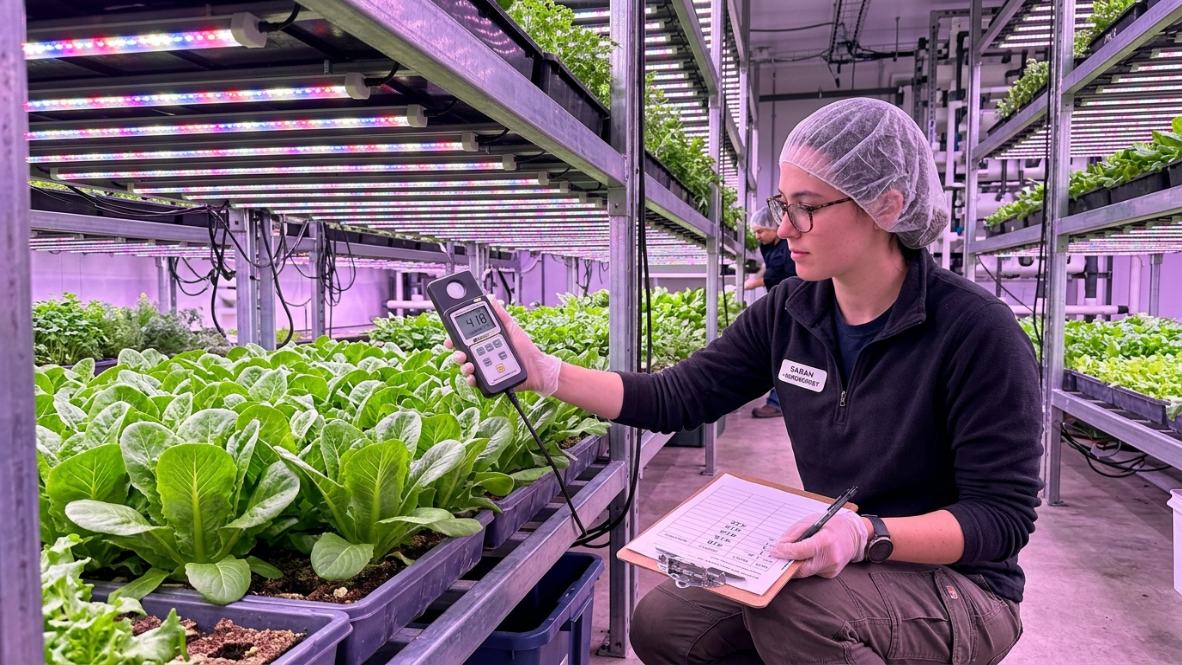
PPFD, or Photosynthetic Photon Flux Density, measures how many photons in the PAR range hit a square meter of canopy per second. It’s expressed as µmol/m²/s.
For leafy greens in multi-tier racks, the practical target band is roughly 200 to 350 µmol/m²/s. Specific crops have more precise needs. According to an expert interview published by Agritecture, basil performs best at 200 to 300 µmol/m²/s with about 16 hours of light, while lettuce benefits from 250 to 300 µmol/m²/s with a red-heavy spectrum.
The critical thing to understand: PPFD is a point measurement. A single reading at the center of a shelf tells you almost nothing about real-world performance. What matters is the PPFD distribution across the entire growing area.
DLI: The Daily Dose
DLI, or Daily Light Integral, is the total number of photosynthetically active photons delivered to a square meter over a full day, expressed as mol/m²/day. Think of PPFD as the “flow rate” and DLI as the “total volume.”
For most leafy greens, target DLI falls between 15 and 25 mol/m²/day. That Agritecture source puts lettuce at 22 to 25 mol/m²/day and basil at 14 to 17 mol/m²/day.
Because vertical farms control photoperiod completely, DLI management is one of the primary tools for balancing crop quality against energy cost. Running at a lower PPFD for more hours can sometimes achieve the same DLI at lower peak electrical demand.
PPE (Photon Efficacy): The Money Metric
Photon efficacy, measured in µmol/J, tells you how efficiently a fixture converts electricity into PAR photons. This is the single most important number for operational cost control.
The benchmark has moved fast. Fixtures installed in first-generation vertical farms (2018 to 2020) typically delivered 2.0 to 2.5 µmol/J. Today’s top-tier commercial fixtures exceed 3.5 µmol/J, with some research-grade systems pushing above 4.0 µmol/J. That represents 40% to 75% more useful light per watt of electricity, and it compounds over thousands of operating hours.
Wattage alone means nothing without PPE. A 50W fixture at 3.5 µmol/J delivers more useful light than a 60W fixture at 2.5 µmol/J, while consuming less power and generating less heat.
Vertical Farming LED Lighting Metrics at a Glance
Metric | What It Measures | Commercial Target | Why It Matters |
|---|---|---|---|
PPE (µmol/J) | Electrical efficiency converting watts into photons | 3.5+ µmol/J | Determines electricity cost |
PPFD (µmol/m²/s) | Light intensity reaching plants | 200-350 for leafy greens | Controls growth rate |
DLI (mol/m²/day) | Total daily photon delivery | 15-25 for leafy greens | Balances yield and energy |
Uniformity CV% | Light distribution consistency | Below 10-15% | Prevents uneven growth |
Driver Efficiency | Electrical conversion efficiency | 90-95%+ | Reduces heat load |
Fixture Height | Distance between LED and canopy | 15-30 cm | Improves photon capture |
Light Uniformity: Why Averages Lie
Average PPFD across a shelf is a convenient number, but it hides the real story. What matters is the spread between the brightest and dimmest zones. When that spread is large, growers end up tuning recipes, irrigation, and harvest timing around the worst tray positions, creating variability, waste, and rework.
Two metrics capture uniformity: the coefficient of variation (CV%), which should stay below 10% to 15%, and the min/avg ratio, which should be as close to 1.0 as possible. Practitioners in vertical farming forums consistently report that hitting 90% or better PPFD uniformity on a rack tier is less about chasing peak intensity and more about reducing the spread. One experienced grower’s advice that shows up repeatedly in practitioner discussions: “Design around your worst tier, usually the one with the tightest clearance, highest humidity, and most difficult air return path. If you can make that tier stable, the rest usually gets easier.”
Vertical Farming LED Lighting Cost and ROI
LED lighting represents one of the largest capital investments in a vertical farm, but it also creates some of the largest long-term operating savings. The ROI depends primarily on fixture efficiency, electricity prices, operating hours, crop value, and HVAC savings.
A small improvement in photon efficacy compounds over thousands of operating hours.
Example Energy Savings From PPE Improvements
Fixture Efficiency | Power Required for Same Light Output | Annual Impact |
|---|---|---|
2.5 µmol/J | Higher electricity consumption | Higher operating costs |
3.0 µmol/J | Approximately 17% fewer watts needed | Moderate savings |
3.5 µmol/J | Approximately 29% fewer watts needed | Significant savings |
4.0 µmol/J | Approximately 38% fewer watts needed | Maximum efficiency |
For facilities operating thousands of fixtures, moving from older 2.0-2.5 µmol/J systems to modern 3.5+ µmol/J fixtures can reduce lighting electricity costs substantially while also lowering cooling requirements.
The highest-return upgrades usually come from:
Higher PPE fixtures
Remote driver architecture
Better light uniformity
Close-canopy placement
Automated dimming controls
LED Fixture Types Used in Vertical Farms
Vertical farming LED lighting fixtures look nothing like the hanging grow lights used in greenhouses or cannabis flower rooms. The constraints are fundamentally different.
In a multi-tier setup, vertical space is money. To maximize the number of tiers, the distance between the light and the plant canopy is compressed to extreme limits, often as close as 6 to 12 inches (15 to 30 cm). Every inch of fixture thickness is an inch that can’t be used for growing or airflow.
Bar and Strip Lights
This is the dominant form factor. Slim aluminum bars spread LEDs across narrow, spaced-apart channels. The result is a fixture that provides uniform light while remaining permeable to airflow.
The airflow point is not trivial. Solid panel-style lights can act as physical baffles, completely blocking the vertical air movement that multi-tier environments depend on for temperature and humidity control. Bar lights solve this by design.
For higher-output vertical farming applications that include flowering crops, universal-power multi-tier fixtures provide the intensity needed without sacrificing the slim profile.
Panel and Quantum Board Lights
Panels pack more LEDs into a smaller footprint and can deliver higher output per unit. But in tight vertical racks, they create problems. Blocked airflow leads to hot spots, uneven humidity, and the need for supplemental fans, which adds complexity and cost. Some operations use panels on top tiers where clearance is less constrained, but the trend has clearly moved toward bars.
Interlighting and Under-Canopy Bars
For taller crops or dense canopies, supplemental bars placed within or below the canopy can deliver light to lower leaves that would otherwise be shaded. This approach has shown documented yield gains in cannabis, and the principle applies to any crop where lower-canopy photosynthesis matters. LED bars for propagation and multi-tier leafy greens also serve double duty in early-stage vertical farming applications.
Spectrum: White Light, Pink Light, and Why It Matters
Walk into a vertical farm and the color of the light tells you a lot about the operation’s vintage and philosophy.
The Pink/Purple Era
Early LED grow lights combined red and blue diodes exclusively, producing the distinctive pink or purple glow. The logic was simple: chlorophyll absorbs red and blue light most efficiently, so why waste energy on other wavelengths?
That logic turned out to be incomplete.
Why White Spectrum Won
Full-spectrum white LEDs, which produce light across the visible range, have become the standard for most vertical farming applications. The reasons go beyond plant science.
Green light (500 to 550 nm) was long dismissed because chlorophyll reflects it. But research has shown that green photons penetrate deeper into the canopy, reaching lower leaves that would otherwise be shaded. For multi-layer leafy greens, that penetration translates directly to more uniform growth.
Beyond plant biology, white spectrum creates a work environment where people can actually see. Crop inspection under pink light is unreliable. Spotting pest damage, nutrient deficiency, or disease early requires accurate color rendering. Growers working 8-hour shifts in a pink-lit facility report eye strain and difficulty identifying problems until they’re severe.
Far-Red Supplementation
The newest development is adding far-red light (700 to 750 nm) to a white or red-dominant base spectrum. Research published in 2025 shows that far-red enhances the efficiency of red light through the Emerson Enhancement Effect. Adding 5% to 10% far-red to a red-dominant spectrum can boost yield by 10% to 15% with minimal additional energy input.
This is a meaningful gain. In an industry where margins are tight, a 10% yield increase with negligible energy penalty is significant.
Best LED Spectrum by Crop Type
Different crops respond differently to light intensity, spectrum, and photoperiod. The ideal vertical farming LED recipe depends on crop architecture and production goals.
Crop | Recommended PPFD | Typical DLI | Spectrum Preference |
|---|---|---|---|
Lettuce | 250-300 µmol/m²/s | 17-25 mol/m²/day | Full-spectrum white + red |
Basil | 200-300 µmol/m²/s | 14-17 mol/m²/day | Red-heavy white spectrum |
Microgreens | 100-250 µmol/m²/s | 8-15 mol/m²/day | Balanced white spectrum |
Strawberries | 250-500 µmol/m²/s | 20-30 mol/m²/day | White + far-red supplementation |
Cannabis | 600-900+ µmol/m²/s | 30-45+ mol/m²/day | High-intensity full spectrum |
Why Vertical Farm Lighting Design Must Include HVAC Planning
LED selection cannot be separated from climate control. Every watt consumed by lighting eventually becomes heat that must be managed by HVAC systems.
A more efficient fixture reduces two costs simultaneously:
Direct lighting electricity
Cooling energy required to remove heat
For example:
Improvement | Lighting Impact | HVAC Impact |
|---|---|---|
Higher PPE | Lower watt consumption | Less heat generation |
Remote drivers | Removes driver heat from grow area | Lower cooling load |
Better uniformity | Fewer overpowered zones | More stable climate |
Dimming controls | Matches energy use to crop needs | Lower peak cooling demand |
Lighting and HVAC should be designed together, not independently.
Heat, Drivers, and the HVAC Connection
Every watt of electricity that enters a vertical farm eventually becomes heat. Even the most efficient LEDs convert only a fraction of input energy into photons that leave the fixture, and the rest becomes thermal energy. The plants then absorb those photons and convert most of that energy into heat through transpiration. Understanding this loop is essential to understanding vertical farming economics.
This is what practitioners call the “lighting heat loop.” Energy enters as electricity, becomes light, becomes heat, and then requires HVAC energy to remove. For a deeper exploration of this relationship, this guide on cooling requirements for LED lights breaks down the math.
The Driver Problem Nobody Talks About
The primary cause of failure in a well-designed LED grow light is not the LED chip. LED chips routinely last 50,000 to 100,000 hours. The weak link is the LED driver, which typically has a lifespan of 30,000 to 50,000 hours. In a vertical farm running lights 16 to 18 hours a day, that’s roughly 5 to 8 years for the driver versus 8 to 17 years for the chips.
Scale this up. A commercial vertical farm might run 5,000 to 10,000 fixtures. With drivers integrated into each fixture, that’s 5,000 to 10,000 potential failure points sitting inside the growing environment, in a warm, humid space that accelerates component degradation. A single driver failure creates a tier-level growth defect that may not show up until harvest day.
For more context on how LED reliability affects operations, this article on LED reliability fundamentals covers what to watch for.
Remote and Centralized Driver Architecture
The solution gaining traction is moving drivers out of the grow space entirely. Centralized power systems that relocate drivers outside the grow space offer advantages across multiple dimensions.
The thermal benefit alone is substantial. Although driver heat may account for only 5% to 15% of total power supplied to the canopy, the absolute numbers add up fast. For a vertical farm using 10,000 30W fixtures, remotely locating 95%-efficient drivers would reduce the canopy’s heat load by 15,000W, or more than 50,000 BTU/hour. That translates directly to HVAC cost savings, smaller chiller sizing, and more stable growing conditions. The guide on remote driver LED systems and HVAC savings quantifies this in more detail.
Remote drivers also simplify maintenance. When a driver needs replacement, a technician accesses it in a mechanical room rather than climbing into a growing rack and disrupting an active crop.
Energy Efficiency and ROI
The economics of vertical farming LED lighting are the economics of the entire farm. No other single variable has as much influence on whether a vertical farm is profitable.
Current Energy Benchmarks
An analysis of published studies on vertical farming energy use shows a current specific energy consumption of 10 to 18 kWh per kilogram of lettuce produced, corresponding to an energy use intensity of 850 to 1,150 kWh per square meter per year. That same analysis suggests a technical benchmark of 3.1 to 7.4 kWh/kg is achievable with expected advances in equipment efficiency and operational control.
Closing that gap, from 10 to 18 down to 3.1 to 7.4, is primarily a lighting efficiency story.
The Efficiency Improvement Trajectory
The pace of improvement is real and measurable. Modern LED grow lights deliver 20% to 30% more photosynthetically active radiation per watt than systems installed just five years ago. And those gains compound: less electricity for lighting means less cooling energy required to remove waste heat.
The long-term outlook is even more encouraging. Haitz’s Law, sometimes called the Moore’s Law of LEDs, projects that cost per lumen falls by 10x per decade while output per package increases 20x. The fixtures available in 2030 will make today’s best look inefficient.
Payback on Upgrades
For facilities still running first-generation LEDs (2.0 to 2.5 µmol/J), upgrading to current fixtures (3.5+ µmol/J) typically pays back in 3 to 5 years. Operations with long photoperiods and high electricity rates see faster returns. For a broader look at operational cost reduction strategies, this article on reducing operating expenses in production facilities provides a useful framework.
Design Considerations for Multi-Tier Environments
Buying the right fixture is necessary but not sufficient. How you deploy vertical farming LED lighting matters as much as which fixture you choose.
Close-Canopy Strategies
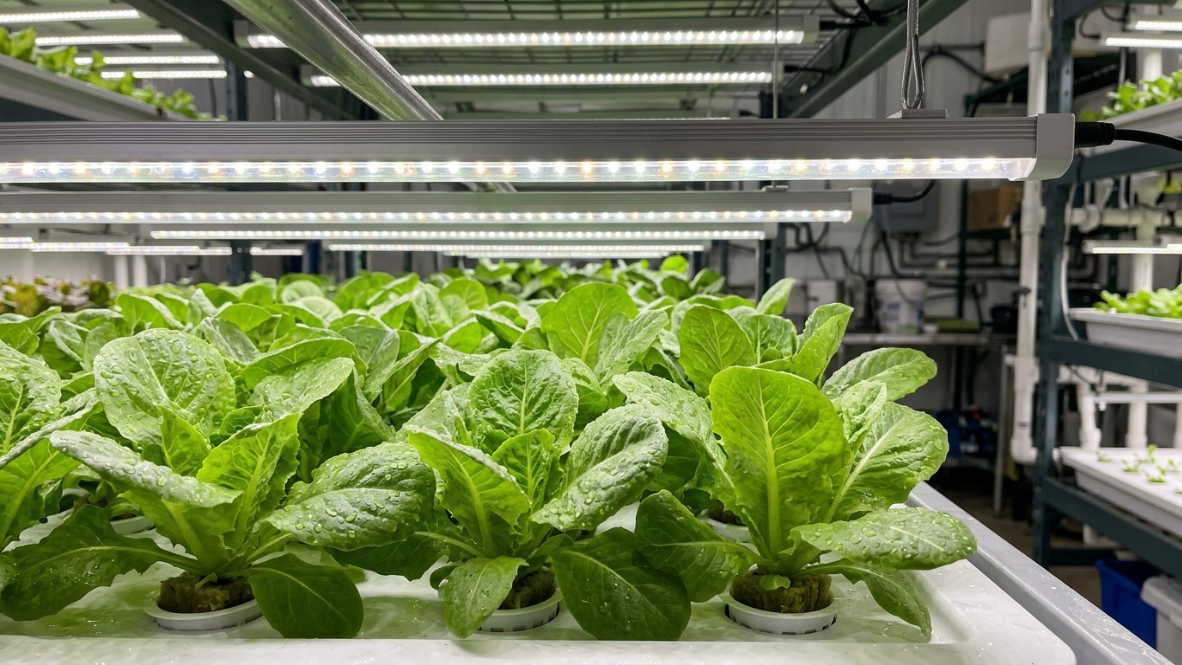
Researchers at Purdue University, led by Sheibani and Mitchell, noticed that in many vertical farms, significant light fell not only on plants but also on walls and walkways. By reducing the distance between the LED system and the leaf canopy, they were able to reduce wasted light and improve what they call “canopy photon capture efficiency.”
Their work demonstrated that targeted close-canopy lighting can achieve the same or better crop outcomes with substantially less total light output. That translates directly to lower energy consumption, no hardware upgrade required.
This is free efficiency. Slim, low-profile bar fixtures mounted close to the canopy maximize capture. Every photon that hits a wall or an aisle floor instead of a leaf is money wasted.
Designing Around the Worst Tier
Experienced vertical farm designers consistently emphasize this point: design your lighting around your most constrained tier, not your average. The tier with the tightest clearance, the highest humidity, and the most difficult air return path is where problems show up first. If you can make that tier stable, the rest usually follows.
This means uniformity should be a commissioning deliverable, not an afterthought. Specify a CV of 10% to 15% or better across the shelf at the design stage. For more guidance on avoiding common mistakes during the build phase, this overview of indoor agriculture pitfalls covers the most frequent ones.
Dimming and Photoperiod Control
Dimming capability is not optional for vertical farming LED lighting. Crops have different light needs at different growth stages. Seedlings need far less intensity than mature plants. Being able to dim from 100% down to 10% or lower, ideally with precise digital control via 0-10V or MODBUS, lets growers match light output to crop demand rather than running at full power continuously.
Photoperiod control, adjusting the number of hours lights run per day, is the other half of DLI management. Running at lower PPFD for more hours can reduce peak electrical demand charges, which in some utility markets makes a meaningful difference to the monthly bill.
What to Look for When Evaluating Vertical Farming LED Lighting
If you’re specifying fixtures for a new build or retrofit, here’s a practical checklist:
Photon Efficacy (PPE): 3.0 µmol/J is the minimum worth considering. Target 3.5+ µmol/J for any new installation.
Form Factor: Slim bar design with open airflow paths between bars. Ask for the fixture’s profile height and verify it fits your planned tier spacing.
Dimming Capability: 0-10V, MODBUS, or equivalent digital control. Avoid fixtures that are on/off only.
Uniformity Specification: Ask for a uniformity map at your planned mounting height and shelf width. Look for CV% below 15% and a min/avg ratio above 0.85.
Driver Strategy: Understand whether drivers are integrated into the fixture or compatible with remote/centralized power systems. For facilities over 1,000 fixtures, this decision has major implications for heat load, maintenance, and long-term reliability.
Certifications: UL, CE, and/or CSA listing. Non-certified fixtures are a liability and safety risk in a commercial facility.
Warranty and Failure Data: A 5-year warranty backed by published failure-rate data is the current standard for commercial-grade equipment. Ask for it.
Spectrum: Full-spectrum white as the base, with the option for far-red supplementation if your crop mix benefits from it.
Talk to a lighting specialist about which configuration fits your crop plan and facility design.
Common Vertical Farming LED Lighting Mistakes
Choosing Fixtures Based Only on Wattage
Wattage does not measure useful plant light. A lower-watt fixture with higher photon efficacy can outperform a higher-watt inefficient system.
Always compare:
µmol/J PPE
PPFD maps
Uniformity measurements
Driver efficiency
Ignoring Light Distribution
A fixture producing high center PPFD but poor edge coverage creates uneven crops. Uniformity matters more than maximum intensity.
Installing Without HVAC Coordination
A lighting upgrade can fail if cooling capacity cannot handle the thermal load.
Overlooking Maintenance Access
Thousands of integrated drivers create thousands of possible failure points. Serviceability should be part of fixture selection.
Using Generic Industrial LEDs
Industrial lighting is designed for human visibility, not photosynthesis. Horticultural LEDs require different spectrum optimization and photon measurements.
Vertical Farming LED Lighting Buying Checklist
Before purchasing commercial LED fixtures, evaluate:
Specification | Recommended Target |
|---|---|
Photon efficacy | 3.5 µmol/J or higher |
Spectrum | Full-spectrum white with optional far-red |
Fixture type | Slim bar or strip design |
PPFD uniformity | CV below 15% |
Mounting distance | 15-30 cm above canopy |
Controls | 0-10V, MODBUS, or digital dimming |
Driver design | Remote preferred for large facilities |
Warranty | 5+ years commercial support |
Certifications | UL, CE, CSA |
Frequently Asked Questions
How much electricity does vertical farming LED lighting use?
Lighting consumes 65% to 85% of a vertical farm’s total energy. For lettuce production specifically, current benchmarks show 10 to 18 kWh per kilogram of output. Improving LED efficacy and deploying close-canopy strategies are the two fastest paths to reducing that number.
What PPFD do leafy greens need in a vertical farm?
Most leafy greens perform well at 200 to 350 µmol/m²/s. Lettuce typically targets 250 to 300 µmol/m²/s with a DLI of 22 to 25 mol/m²/day, while basil does well at 200 to 300 µmol/m²/s with a DLI of 14 to 17 mol/m²/day. These numbers vary by cultivar and growth stage.
What is a good photon efficacy (PPE) for vertical farming fixtures?
Anything below 3.0 µmol/J is outdated for new installations. The current target is 3.5 µmol/J or higher. First-generation vertical farm fixtures from 2018 to 2020 typically delivered 2.0 to 2.5 µmol/J, so upgrading often yields 40% or more energy savings.
Why are bar lights preferred over panel lights in vertical farms?
Bar or strip lights preserve airflow between growing tiers. Panel-style fixtures can block vertical air movement, creating hot spots and humidity problems. Bar fixtures also have a slimmer profile, which means more growing tiers per vertical foot of facility space.
Are pink/purple LED grow lights still used in vertical farms?
Rarely in new installations. Full-spectrum white LEDs have become the standard because they support all growth stages, allow accurate crop inspection, create a more comfortable work environment, and enable green-light canopy penetration that pink fixtures lack. Some operations supplement white with targeted far-red for yield enhancement.
What is the biggest failure point in vertical farming LED systems?
The LED driver, not the LED chip. Drivers typically last 30,000 to 50,000 hours versus 50,000 to 100,000 hours for the chips. In facilities with thousands of fixtures, driver failures are the most common cause of unplanned maintenance and tier-level crop defects.
How close should LED fixtures be mounted to the canopy in a vertical farm?
Most multi-tier setups mount fixtures 15 to 30 cm (6 to 12 inches) above the canopy. Closer mounting improves canopy photon capture efficiency by reducing light lost to walls and walkways, but the fixture must provide adequate uniformity at that distance.
Does far-red light actually improve yields?
Recent research indicates that adding 5% to 10% far-red to a red-dominant spectrum can boost yield by 10% to 15% through the Emerson Enhancement Effect, with minimal additional energy input. This makes far-red supplementation one of the highest-ROI spectral adjustments available.