LED Growth Chamber Lighting: 2026 Spectrum & PPFD Guide
Master growth chamber lighting in 2026—LED spectra, PPFD targets, DLI, photoperiods, and heat management for reproducible results. Get pro tips.
TL;DR
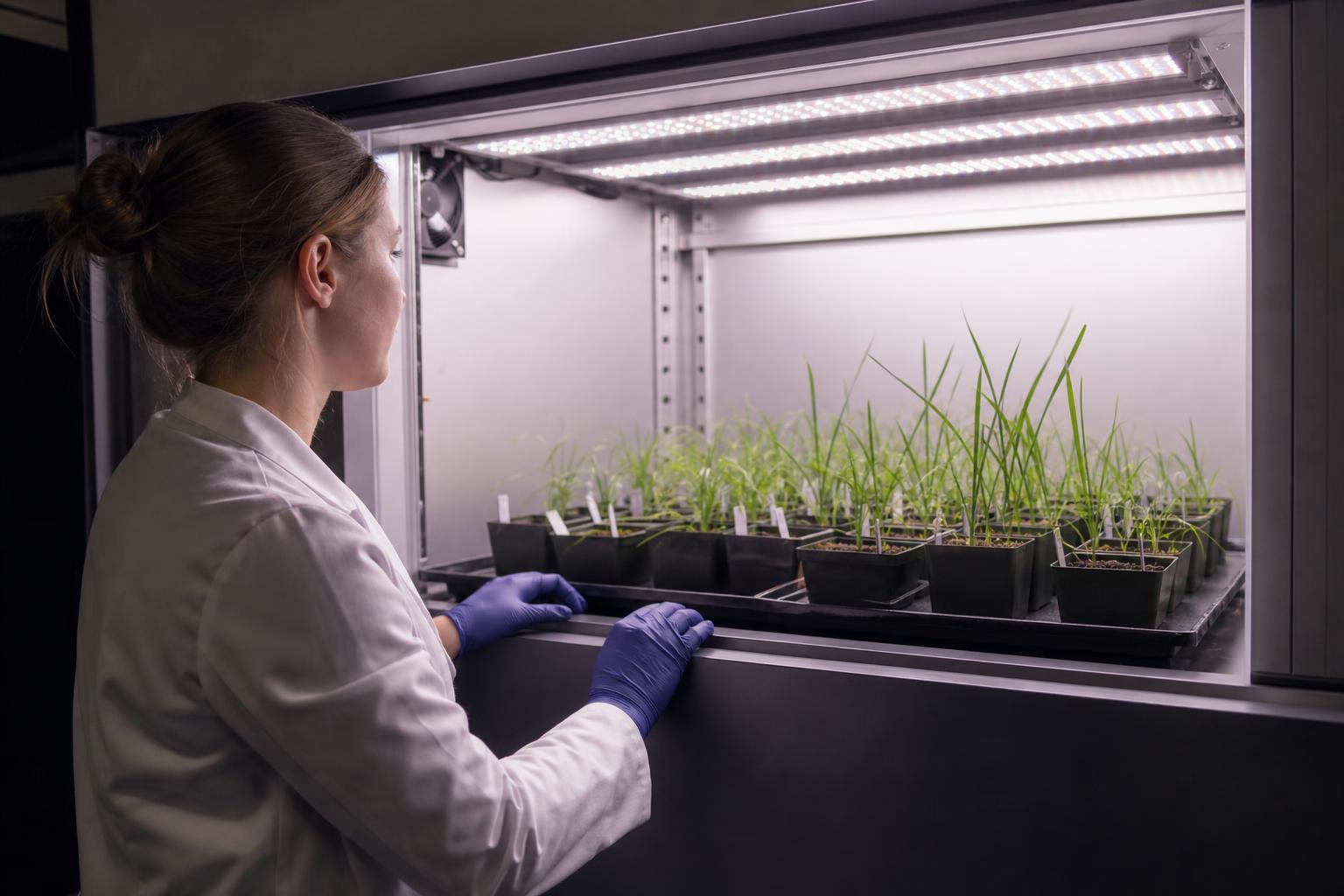
Growth chamber lighting refers to the lighting system inside an enclosed, controlled environment used for plant research and production. It encompasses the technology type, spectrum, intensity (measured as PPFD), photoperiod programming, heat profile, and uniformity of the fixtures. LED technology has replaced fluorescent as the standard, offering superior spectral control, lower heat output, and longer life. The same precision principles that govern growth chamber lighting, including uniformity, spectral stability, and thermal management, directly apply when scaling to commercial vertical farms and greenhouses.
Quick Answer: What Lighting Does a Growth Chamber Need?
Growth chambers typically require LED lighting systems capable of delivering 100–1,000+ µmol/m²/s PPFD, depending on the plant species and growth stage. Most research applications use 150–500 µmol/m²/s PPFD, a controllable spectrum from 400–700 nm, programmable photoperiods, and high uniformity across the growing area. Modern chambers use full-spectrum LEDs because they provide precise control, lower heat output, and better experimental repeatability than fluorescent systems.
Growth Chamber Lighting Requirements Checklist
A research-grade growth chamber lighting system should provide:
Requirement | Recommended Specification |
|---|---|
Light source | Full-spectrum LED |
Spectrum range | 400–700 nm PAR + optional UV/far-red |
PPFD capability | 100–1,000+ µmol/m²/s |
Dimming | 0–100% adjustable |
Photoperiod control | Automated scheduling |
Uniformity | ≥90% canopy consistency preferred |
Thermal management | External drivers or low-heat design |
Control integration | MODBUS, 0–10V, or chamber controller compatibility |
Lifespan | 50,000–100,000 hours |
Efficiency | ≥2.5 µmol/J preferred |
What Is Growth Chamber Lighting?
Growth chamber lighting is the lighting system installed inside an environmentally controlled enclosure designed to simulate and manipulate conditions for plant growth or scientific experiments. It includes the fixture technology, light spectrum, intensity capability, uniformity across the growing area, photoperiod programmability, and heat characteristics of the luminaires.
What separates growth chamber lighting from general “grow lighting” is the emphasis on precision and reproducibility. A growth chamber controls temperature, humidity, CO₂, and light simultaneously, and the lighting system must integrate tightly with all of those variables. Small differences in spectral output between lamps can produce significant effects on plant growth, morphology, biochemistry, and development. In a research context, that kind of variation can invalidate years of work.
Growth chambers come in two main formats. Reach-in chambers are compact enclosures with adjustable shelves, suited for small-scale experiments and educational settings. Walk-in chambers (sometimes called phytotrons) are large rooms designed for high-volume, multi-factorial research. Lighting requirements differ between them, but the core principles stay the same: deliver the right spectrum at the right intensity with the right uniformity, and don’t let the fixtures destabilize the chamber’s thermal environment.
Explore multi-tier LED fixtures built for the precision that growth chamber and vertical farm environments demand.
Why Lighting Is the Most Critical Chamber Variable
Temperature and humidity stabilize relatively quickly inside a sealed enclosure. Light is different. It must be specified across four independent dimensions: intensity, spectrum, photoperiod, and spatial uniformity. Get any one of them wrong and experimental outcomes shift.
Light drives photosynthesis, obviously, but it also drives photomorphogenesis, the process by which light signals shape plant form, flowering behavior, and gene expression. Research has shown that environment can contribute up to 50% of observed plant phenotype. Within that environmental contribution, lighting is the single most influential factor.
A long-standing rule of thumb among commercial growers holds that a 1% increase in sustained PPFD results in a 1% increase in plant growth and yield. That relationship makes lighting the highest-leverage variable in any controlled growing environment, whether it’s a benchtop reach-in chamber or a 50,000 square foot vertical farm.
Key Metrics for Growth Chamber Lighting
LED Growth Chamber Lighting Specifications Explained
When selecting LED lighting for a growth chamber, researchers should evaluate more than wattage or fixture brightness. The important specifications are PPFD output, spectrum control, photon efficiency, uniformity, and thermal performance.
Key Specifications:
Specification | Why It Matters |
|---|---|
PPFD | Determines usable light reaching plants |
Spectrum | Controls photosynthesis and plant morphology |
DLI | Measures total daily light exposure |
Photon efficacy | Determines energy efficiency |
Uniformity | Ensures repeatable experiments |
Thermal output | Prevents temperature fluctuations |
Control compatibility | Enables automated experiments |
PPFD (Photosynthetic Photon Flux Density)
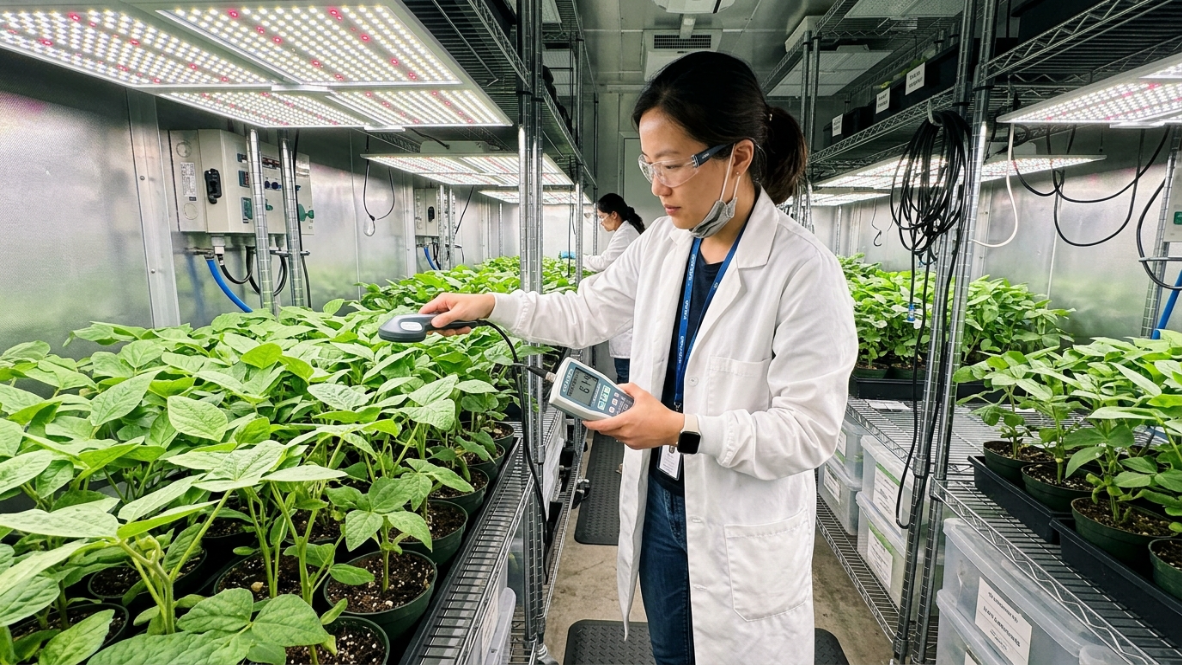
PPFD measures the number of photosynthetically active photons (400 to 700nm) hitting a square meter per second. Units are micromoles per square meter per second (µmol/m²/s). If you’re unfamiliar with the unit, this explanation of micromoles provides a quick primer.
In growth chambers, PPFD should be measured with chamber doors closed, at the height of the uppermost fully expanded leaves. This gives you the reading that actually matters for the plants, not a theoretical number from the fixture spec sheet.
Typical PPFD ranges by application:
Plant / Stage | PPFD Range (µmol/m²/s) |
|---|---|
Arabidopsis and model plants | 100–200 |
Lettuce and leafy greens | 150–300 |
Vegetative stage (general) | 200–400 |
High-light crops (tomato, pepper, cannabis flower) | 500–1,000+ |
These ranges appear consistently across research literature. The Arabidopsis figure, for instance, comes from BioChambers’ widely cited guide, which notes that this model plant is commonly grown at 100 to 200 µmol/m²/s at moderate temperatures of 18 to 23°C.
DLI (Daily Light Integral)
DLI quantifies total light delivered over a full day, expressed in moles per square meter per day (mol/m²/d). It’s the product of PPFD and photoperiod duration. In growth chambers, DLI values between 10 and 30 mol/m²/d are most common. Most plant traits approach saturation beyond a DLI of 20 mol/m²/d, while growth becomes particularly limited below 5. For a deeper guide on calculating and targeting DLI, see this DLI and PPFD planning resource.
Photoperiod
Photoperiod, the number of hours light is delivered per day, matters independently of total DLI. A Purdue University study found that tomatoes grown under a 20-hour photoperiod averaged 45% to 67% more dry mass than those under a 12-hour photoperiod at the same DLI. This means you can’t simply crank intensity and shorten the day to get the same result. Duration and intensity are separate levers with separate biological effects, particularly for flowering responses and circadian regulation. More on photoperiod management strategies is available for growers working with photoperiod-sensitive crops.
Lighting Technologies Used in Growth Chambers
Fluorescent (Legacy)
For decades, T8 and T5 fluorescent tubes were the default in research growth chambers. Often paired with incandescent bulbs (which contributed red and far-red wavelengths the fluorescents lacked), they provided a workable broad spectrum at low cost.
That era is ending. In August 2023, the European Union began phasing out many fluorescent lamps under the RoHS Directive due to mercury content. Key components like T12, T8, and T5 lamps and their ballasts are becoming increasingly difficult to source in North America as well. For any lab running multi-year experiments, this supply risk is not theoretical. Fluorescent tubes also suffer from spectral drift as they age, which quietly degrades reproducibility across long studies.
LED (Current Standard)
LEDs have become the standard for growth chamber lighting, and the reasons are straightforward. They offer approximately 100,000-hour lifespans, dramatically lower heat output, spectral tunability through independent channel control, instant dimming without warm-up, and no mercury. Modern research-grade LED systems provide individually controllable channels (commonly warm white, cool white, red, blue, and far red), each dimmable independently per shelf or per tier.
The efficiency gains are substantial. DLC’s Horticultural Technical Requirements V4.0 now set a minimum photosynthetic photon efficacy of 2.5 µmol/J for listed products. There are over 1,400 DLC-qualified horticultural LED luminaires on the market. For research institutions considering the switch, understanding DLC listing and rebate eligibility can offset a significant portion of upgrade costs.
LED reliability also matters enormously in research settings. A fixture failure mid-experiment can compromise months or years of data. Fixtures with documented sub-1% failure rates over multi-year warranty periods, backed by proven reliability track records, are worth the premium over commodity alternatives.
LED vs Fluorescent Growth Chamber Lighting
Feature | LED | Fluorescent |
|---|---|---|
Spectrum control | Excellent | Limited |
Lifespan | 50,000–100,000 hours | 10,000–20,000 hours |
Heat output | Lower | Higher |
Dimming | Instant | Limited |
Mercury | None | Contains mercury |
Energy efficiency | Higher | Lower |
Research reproducibility | Excellent | Declining with age |
LED systems have become preferred because they provide greater control over experimental variables while reducing maintenance and thermal challenges.
Growth Chamber LED Spectrum Requirements
Spectrum selection determines how plants respond beyond simple photosynthesis. Different wavelengths influence morphology, flowering, pigmentation, and secondary metabolite production.
Spectrum | Wavelength | Primary Effect |
|---|---|---|
Blue | 400–500 nm | Compact growth, stomatal response |
Green | 500–600 nm | Canopy penetration and photosynthesis support |
Red | 600–700 nm | Photosynthetic efficiency and biomass |
Far-red | 700–750 nm | Shade response and flowering regulation |
UV | <400 nm | Secondary metabolites and stress responses |
Modern research chambers increasingly use tunable LED systems because different experiments require different spectral recipes.
Why Full-Spectrum White Light Matters
Early horticultural LEDs combined red and blue diodes, producing the “pink” or “blurple” light that became synonymous with indoor growing. These fixtures drove photosynthesis adequately but created a problem: under pink light, plant leaves appear nearly black, making it extremely difficult to visually identify disease symptoms, nutrient deficiencies, or growth abnormalities.
Full-spectrum white LEDs solve this. They render leaves as green and allow accurate visual plant health assessment, which is critical in research settings where early detection of problems matters. But the benefits go beyond convenience.
Recent research demonstrates that wavelengths previously considered unimportant (green light in particular) have significant physiological influence when present alongside red and blue. A broader spectrum drives a broader range of photomorphogenic responses. Light below 400nm (UV) and above 700nm (far-red) also affects plant chemistry and morphology in ways that narrow-band red/blue fixtures miss entirely.
The trend in growth chamber lighting is clearly moving toward full-spectrum white as the research standard.
Practical Considerations
Heat Management
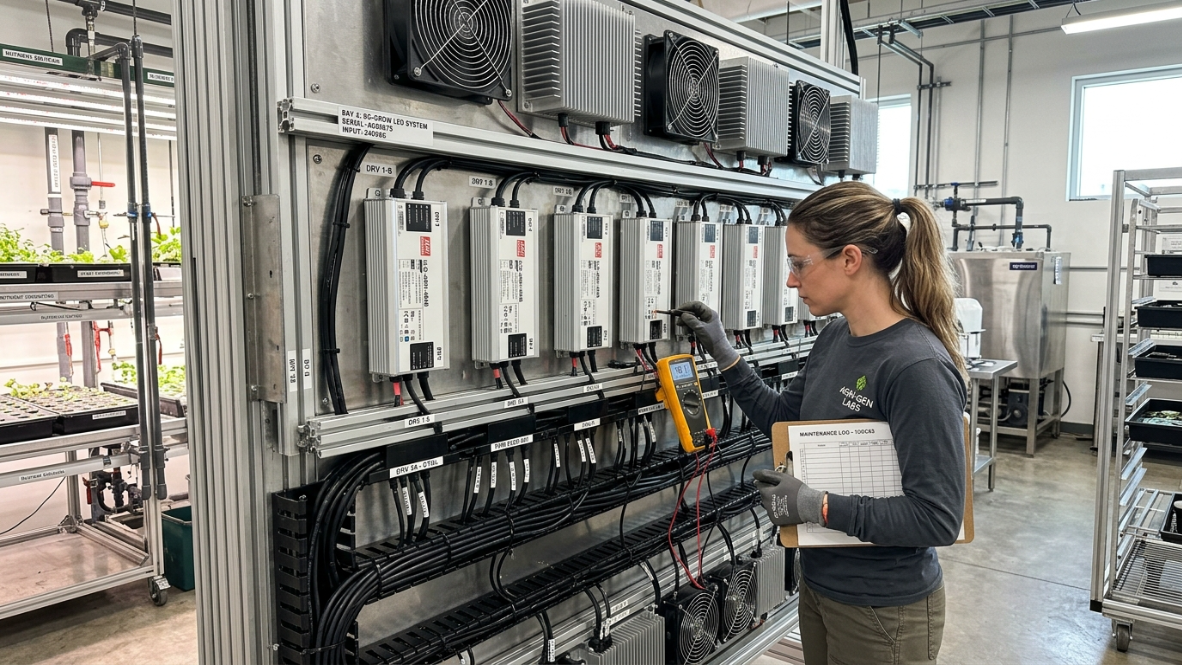
Lighting is the dominant heat source inside a sealed growth chamber. This is the variable that causes the most headaches, because heat from fixtures directly interferes with temperature control, the other critical chamber parameter.
Fluorescent and HID fixtures dump substantial heat into the growing space. Even LEDs generate heat, just less of it and primarily from the driver electronics rather than the diode array. Premium growth chamber manufacturers already address this by mounting lamp banks externally, on the outside of chamber walls, to separate heat generation from the growing space.
This same principle applies at production scale. Centralized remote power systems relocate LED drivers entirely out of the growing environment, reducing heat load above the canopy and cutting HVAC demand. For anyone designing or upgrading a growth chamber or scaling to a commercial facility, understanding how much HVAC cooling LED lights require is essential for accurate environmental control.
Uniformity and Reproducibility
If PPFD varies 20% from one shelf position to another, you don’t have a controlled experiment. You have a gradient study you didn’t intend to run. Uniformity, often expressed as a minimum-to-average PPFD ratio, is what makes growth chamber results transferable between labs and repeatable over time.
Fluorescent tubes emit light in all directions, requiring reflectors and careful positioning to minimize shadows and hotspots. LEDs can be arranged in grid patterns and aimed precisely, making tight uniformity easier to achieve. The best commercial fixtures target ±5% design-to-install PPFD variance, a level of consistency that matters for both research integrity and commercial crop uniformity.
Integration with Chamber Controls
Modern growth chamber lighting connects to the chamber’s environmental controller through standard protocols like MODBUS or 0-10V dimming signals. This allows automated light recipes, synchronized photoperiod transitions, ramping (simulating sunrise and sunset), and data logging. If your lighting can’t integrate with your control system, you lose half the value of running a controlled environment.
How to Choose LED Lighting for a Growth Chamber
Selecting the correct fixture depends on the crop, experiment objective, chamber size, and environmental control requirements.
1. Define Required PPFD
Determine the target PPFD based on species and growth stage.
2. Calculate Required DLI
Use:
DLI = PPFD × Photoperiod Hours × 0.0036
Example:
400 µmol/m²/s × 16 hours × 0.0036 = 23 mol/m²/day
3. Evaluate Uniformity
Avoid fixtures that create:
Hotspots
Edge drop-off
Shelf-to-shelf variation
4. Check Thermal Compatibility
The lighting system must operate without exceeding chamber cooling capacity.
5. Confirm Control Integration
Look for:
Dimming control
Spectrum adjustment
Automated recipes
Data logging
From Research Chamber to Commercial Production
The principles that govern growth chamber lighting, precision spectrum delivery, tight PPFD uniformity, thermal management, and long-term spectral stability, are exactly the same principles that matter in commercial controlled environment agriculture. A 30 square foot reach-in chamber and a 50,000 square foot vertical farm face the same physics. The scale changes; the science doesn’t.
Researchers who understand growth chamber lighting are well positioned to specify commercial systems, because they know what actually matters: not peak intensity claims on a spec sheet, but delivered PPFD at canopy height, uniformity across the growing area, spectral consistency over thousands of hours of operation, and heat behavior in a sealed environment.
The most reliable production fixtures are engineered with research-grade rigor. For operations scaling from chamber research to commercial production, or for research institutions outfitting new facilities, Thrive’s propagation and vegetative fixtures and multi-tier growing solutions are designed around these same principles.
For more technical depth, Thrive’s whitepapers library covers spectrum science, under-canopy lighting data, and facility design considerations.
Schedule a consultation with a lighting expert to discuss growth chamber upgrades or commercial facility lighting design.
Research Considerations for Growth Chamber Lighting
For scientific applications, lighting consistency is as important as light intensity. Researchers should document:
Fixture model and LED spectrum
PPFD measurements
Measurement location
Photoperiod schedule
Fixture age
Calibration dates
Chamber temperature interaction
Maintaining detailed lighting records improves reproducibility between experiments and across research facilities.
Frequently Asked Questions
What is the difference between growth chamber lighting and regular grow lighting?
Growth chamber lighting emphasizes precision, reproducibility, and environmental integration within a sealed enclosure. Regular grow lighting (greenhouse supplemental or open-room fixtures) prioritizes coverage area and raw output. Chamber lighting must also account for its heat contribution to a tightly controlled thermal environment, something open-room fixtures don’t face to the same degree.
What PPFD should I use in my growth chamber?
It depends on the species and growth stage. Arabidopsis is commonly grown at 100 to 200 µmol/m²/s. Lettuce performs well at 150 to 300 µmol/m²/s. High-light crops like tomatoes and cannabis may need 500 to 1,000+ µmol/m²/s. Always measure PPFD at canopy height with the chamber doors closed.
Why are fluorescent lamps being phased out of growth chambers?
Fluorescent lamps contain mercury, which led the EU to begin phasing them out under the RoHS Directive in August 2023. Supply chains for T12, T8, and T5 lamps and ballasts are tightening globally. Labs still running fluorescent chambers face increasing risk of sourcing delays that could compromise ongoing experiments.
How does LED growth chamber lighting affect temperature control?
LEDs produce significantly less heat than fluorescent or HID fixtures, but they still generate some thermal load, primarily from driver electronics. Premium chamber designs and production-scale systems address this by placing drivers or lamp banks outside the growing space, reducing internal heat load and improving temperature stability.
What is DLI and why does it matter for growth chambers?
DLI (Daily Light Integral) measures total photosynthetic light delivered over a 24-hour period, in mol/m²/d. Most growth chamber applications fall between 10 and 30 mol/m²/d. DLI matters because many plant responses (biomass accumulation, flowering, secondary metabolite production) correlate more closely with total daily light than with instantaneous PPFD alone.
Should I use full-spectrum white or red/blue LED lighting in a growth chamber?
Full-spectrum white is increasingly favored for research and production. It allows accurate visual assessment of plant health (leaves appear green instead of black), and emerging research shows that green and other “non-primary” wavelengths play meaningful roles in plant physiology. Red/blue fixtures may still have niche applications, but the trend in growth chamber lighting is firmly toward broad-spectrum white.
Are growth chamber LED upgrades eligible for utility rebates?
Many are, particularly fixtures that meet DLC Horticultural Qualified Products List requirements. DLC V4.0 requires a minimum photosynthetic photon efficacy of 2.5 µmol/J. Research institutions and universities should check with their utility providers, as rebates can offset a substantial portion of retrofit costs.