Best Greenhouse Lighting Company: Top Picks for 2026
Find the best greenhouse lighting company for your crop, scale, and ROI. Compare Thrive, Signify, Fluence, Gavita, and more in our 2026 buyer's guide.
TL;DR
The best greenhouse lighting company for your operation depends on scale, crop type, and infrastructure needs. Thrive Agritech stands out for reliability and centralized power architecture. Signify/Philips dominates global-scale greenhouse projects. Fluence leads in science-driven cannabis cultivation. Gavita offers strong brand recognition for indoor growers. For dynamic spectrum control, Sollum is the specialist. FOHSE targets maximum-output cannabis, Faven owns the under-canopy niche, and California LightWorks serves budget-conscious U.S. buyers.
The horticulture lighting market is expected to hit USD 9.80 billion in 2025, with LED technology commanding over 80% of that share. Greenhouses alone account for 43.2% of revenue, and nearly 59% of all projects are retrofits of existing facilities. These numbers make one thing clear: choosing the right lighting company is now one of the highest-stakes capital decisions a greenhouse operator will make.
Notice the word “company,” not “fixture.” At the top tier, photon output differences between leading brands are minimal. Practitioners on Reddit and grow forums consistently point out that comparing the best LEDs from Gavita, Fluence, or other industry leaders is “like splitting hairs.” The real separators are support quality, reliability track records, install economics, power architecture, and whether a vendor can help you build a credible ROI case for your CFO or board.
This guide evaluates eight companies through that total-project lens. Every profile includes honest tradeoffs, practitioner sentiment, and the operational details that generic market reports skip entirely.
Explore the Altus 1K for greenhouse top-lighting projects.
Which Is the Best Greenhouse Lighting Company?
If you need one recommendation, Thrive Agritech is the best greenhouse lighting company for most commercial greenhouse and cannabis operations because it combines high-efficiency LED fixtures with centralized power architecture, low reported failure rates, and complete lighting design support.
However, the best choice depends on your goals:
If you need... | Best Company |
|---|---|
Best overall commercial solution | Thrive Agritech |
Large produce greenhouse | Signify (Philips GreenPower) |
Cannabis research & premium indoor | Fluence |
Trusted legacy brand | Gavita |
Dynamic spectrum control | Sollum |
Highest-output cannabis lighting | FOHSE |
Under-canopy lighting | Faven |
Budget-friendly U.S. option | California LightWorks |
For most buyers, the decision should come down to project size, crop type, electrical infrastructure, long-term operating costs, and available utility rebates—not just fixture specifications.
How We Evaluated These Companies
Finding the best greenhouse lighting company requires looking beyond spec sheets. We weighted six criteria that reflect how commercial buyers actually make decisions:
Product breadth. Does the company cover top-lighting, under-canopy, and vertical applications, or is it a one-fixture brand? Operations that grow need vendors that grow with them.
Efficacy and spectrum. The baseline for serious commercial LEDs in 2025 is a PPE of 2.5 µmol/J, with the best fixtures exceeding 3.0 µmol/J. Spectrum philosophy matters too. Full-spectrum white light is easier on workers and makes crop inspection straightforward, while red-heavy spectrums may squeeze out marginal flower weight at the cost of workplace comfort.
Power architecture and install economics. This is the factor most guides ignore. Where the LED driver sits (inside the fixture vs. centralized outside the grow space) affects heat load, failure rates, wiring complexity, and total install cost. For a deeper look at how driver location impacts your facility, read about LED fixture reliability.
Reliability and warranty. A fixture failure during a critical growth stage is expensive. We prioritized companies with published failure rates, meaningful warranty terms, and track records verified by repeat orders.
Rebate eligibility. DLC (DesignLights Consortium) listing is often required to qualify for utility rebates that can cover 50–70% of fixture cost. This single factor can change the payback math from years to months.
Grower support and partnership. Lighting design assistance, responsive technical support, and a willingness to stand behind uniformity claims (like ±5% design-to-install PPFD variance) all signal a company that treats the sale as the beginning of the relationship, not the end.
Before You Compare Greenhouse Lighting Companies
Before requesting quotes, answer these questions:
What crop are you growing?
Is this a retrofit or a new greenhouse?
What daily light integral (DLI) must you achieve?
Does your utility offer LED rebates?
Can your current electrical system support new fixtures?
Will you eventually expand the greenhouse?
Do you need under-canopy lighting?
Do you need spectrum control?
Is service available in your region?
Answering these questions first will eliminate companies that are poor matches before you spend time reviewing specifications.
Company Profiles
1. Thrive Agritech
Best for: Long-term reliability and simplified electrical infrastructure in large greenhouse and cannabis deployments
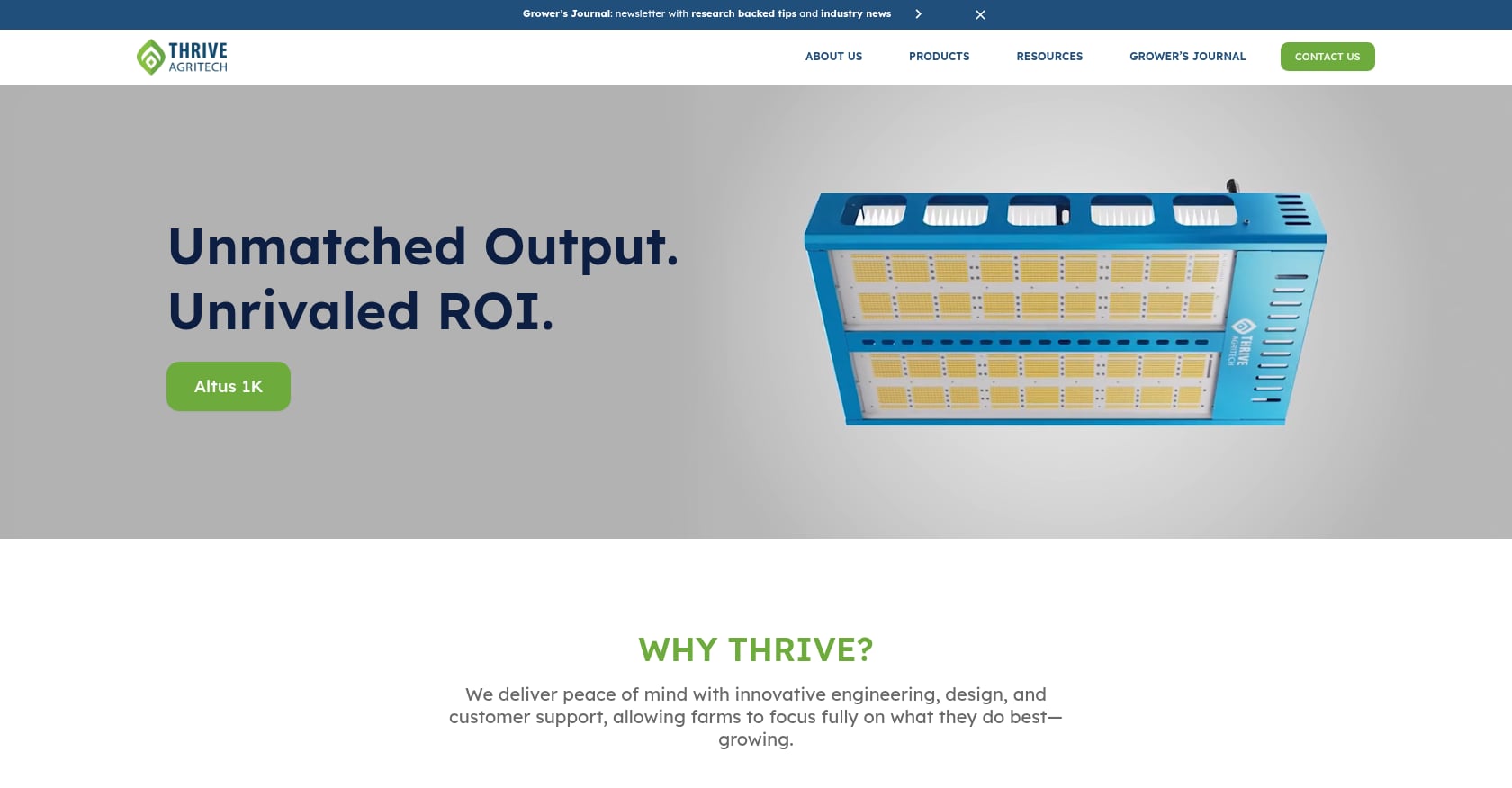
Thrive Agritech designs and manufactures commercial LED grow lights for controlled environment agriculture, with a fixture lineup spanning greenhouse top-lighting, under-canopy systems, and vertical farming bars. What sets Thrive apart from every other company on this list is OptiDrive, a remote and centralized power platform that moves LED drivers out of the grow space entirely.
Key products and specs:
Altus 1K (1050W top light for greenhouse supplemental and cannabis sea-of-green)
Pinnacle Series in three power classes: 300W, 600W, and 840W
Strata HP for multi-tier flower and veg, Strata (30W) for leafy greens
Infinity XE (60W) for propagation and cannabis veg
Boost XE (120W under-canopy bar with patent-pending configuration showing 20–30% yield gains)
What makes OptiDrive different:
OptiDrive DC delivers 12,000 watts per shelf through three 4,000-watt modules at up to 95% efficiency, accepting 208 to 600 volt AC input
OptiDrive DE distributes 3,000 watts per transmitter at greater than 94% efficiency across seven output channels, with low-voltage design that can eliminate conduit and speed installs
Every OptiDrive-ready fixture (Altus 1K, Pinnacle, Boost XE, Strata HP, Strata) works with both models
Learn more about OptiDrive centralized power.
Reliability data:
Sub-1% fixture failure rate over a 5-year warranty period
±5% design-to-install PPFD variance
95% repeat-order rate
Approximately 40,000-hour fixture lifetime
UL, CE, and CSA certified
Named installs: Vertical Harvest (52,000 sq ft), Strawberry Fields (two acres of greenhouse where winter yields doubled in previously unlit areas), Weber Greenhouse, Summit (CO), and Driven Grow. The Strawberry Fields case study documents better canopy uniformity, improved node stacking, and under half the energy consumption of HPS.
Spectrum philosophy: Full-spectrum white light built on patented phosphor chemistry. Thrive positions this as better for both plant growth and worker comfort compared to red/blue “pink” fixtures.
Tradeoffs:
Premium pricing; does not compete on cost with imports
The white-spectrum approach trades the last bit of max flower weight for work-friendliness
Consultative sales cycle is slower than commodity fixture purchases
Quote-based pricing requires engaging with the sales team
Verdict: For commercial growers who prioritize project-level ROI, simplified electrical infrastructure, and long-term reliability over lowest upfront cost, Thrive is the strongest option. The OptiDrive architecture solves a problem no other major competitor addresses at scale.
2. Signify / Philips (GreenPower)
Best for: Multi-acre commercial greenhouse operations needing a global brand with decades of crop-science R&D
Signify (formerly Philips Lighting) leads the global grow light sector with advanced LED horticultural solutions under the Philips GreenPower brand. Their research library, built over hundreds of crop trials, gives them unmatched depth in light recipes for produce and floriculture.
Key products and specs:
GreenPower LED toplighting compact (claims 50% less energy than equivalent HPS)
GreenPower LED production module
GrowWise Control System for centralized management
Efficiency up to 3.6 µmol/J on certain modules
Light recipes: Philips light recipes capture spectrum, intensity, photoperiod, and DLI parameters, refined through hundreds of trials with growers and university researchers. This is genuine intellectual property, not marketing fluff.
Tradeoffs:
Premium enterprise pricing, sold through partner network rather than direct
Less agility for smaller operations or custom requests
Limited public pricing transparency
Forum users note Gavita (a Signify subsidiary) is “good lights but IMO overpriced”
User sentiment: Respected across forums as the “safe corporate choice.” Growers on Reddit and ICMag treat Signify/Philips as the benchmark for produce greenhouse lighting, though some feel the brand premium is steep for what you get in hardware alone.
Verdict: If you operate multi-acre produce or floriculture greenhouses and need vendor credibility that satisfies institutional stakeholders, Signify is the default. The crop-science library is a real competitive moat.
3. Fluence (Osram subsidiary)
Best for: Science-driven cannabis and indoor cultivation with research-backed spectrum technology
Founded in 2012 in Austin, Texas, Fluence has built a reputation as a science-first lighting company. The Osram acquisition added manufacturing scale and credibility. Their PhysioSpec broad-spectrum technology produces white light (not “blurple”), making plant inspection practical while delivering research-validated growth results.
Key products and specs:
VYPR 4 series for greenhouse applications, efficacies up to 3.3 µmol/J, PPF up to 2,660 µmol/s per fixture
SPYDR 3 for vertical and close-proximity applications, Q90 lifetime over 50,000 hours
RAY bars for research and supplemental use
Wide input voltage range (208V to 480V)
5-year limited warranty covering defects in materials, workmanship, and performance
User sentiment: Highly regarded in commercial cannabis circles. One forum user on THCFarmer stated “Fluence is Awesome,” and the Osram backing provides financial credibility. However, some growers report issues with bleaching when fixtures are placed too close to canopy (around 20 inches), so proper light planning is essential.
Tradeoffs:
Premium pricing (forum consensus groups Fluence with Gavita as “much more expensive”)
No centralized driver architecture, so each fixture carries its own driver (more heat in room, more failure points at scale)
Less greenhouse-specific pedigree than Signify
Verdict: The go-to for cannabis operations and research institutions that want peer-reviewed spectrum science behind their lighting. Strong greenhouse retrofit support through the VYPR line.
4. Gavita (Hawthorne/Scotts subsidiary)
Best for: Operations transitioning from HPS that want a trusted name and plug-and-play deployment
Gavita is a Dutch horticultural lighting company with deep roots in commercial greenhouse production. Their fixtures appear in tomato, cucumber, and pepper greenhouses across North America and Europe. The brand carries significant weight, especially among growers who built their operations on Gavita HPS.
Key products and specs:
Pro 1700e LED: 645W, approximately 1,700 µmol/s PAR, retail around $1,199
RS 1900e: 1,900 µmol/s PAR at 3.0 µmol/J
CT 2000e: starting around $1,149
EL2 Master Controller manages up to 80 fixtures from a single control point
User sentiment: One retailer review noted the 1700e “really stands out because of the name GAVITA on the side. Growers know what to expect… there are very few warranty issues and returns.” The brand premium is real but comes with genuine peace of mind for operators who value familiarity.
Tradeoffs:
Brand premium over comparable-spec competitors
EL2 controller only dims to 50%, not 10%
HPS legacy means the LED lineup is relatively younger
No remote driver architecture
Verdict: The safe choice for growers already in the Gavita ecosystem or transitioning from HPS. Strong controller integration, but you pay for the name.
5. Sollum Technologies
Best for: Multi-crop greenhouse operators who switch crops seasonally and want software-driven spectrum optimization
Sollum Technologies, headquartered in Montréal, designed what they call the only 100% dynamic LED lighting solution that modulates the full spectrum of natural sunlight. Their SF-Infinite fixture pairs with the SUN as a Service (SUNaaS) cloud platform for real-time control of spectrum, intensity, timing, and daily light integral.
Key products and specs:
SF-Infinite fixture with fully reprogrammable spectrum
SUNaaS cloud platform for remote management
DLC-certified
Claims up to 40% energy savings vs. HPS, plus an additional 16.8% efficiency gain vs. standard LEDs
Grower feedback: The Chef’s Garden reported that “the Sollum lighting solution has worked out very well for us… we are seeing much better growth in the low light months of winter as compared to the HPS and other LEDs in the market.” An independent Grozine review found the SUNaaS platform “user-friendly” despite its complexity.
Tradeoffs:
Software subscription adds ongoing cost beyond the hardware
Best suited for produce and floriculture greenhouses, with less presence in cannabis
Newer brand with a smaller installed base than Signify or Gavita
Requires buy-in on the dynamic spectrum thesis
Verdict: A strong pick for produce greenhouse operators running multiple crop rotations who want to change light recipes without swapping fixtures. The software layer is both the biggest differentiator and the biggest commitment.
6. FOHSE
Best for: Large-scale indoor cannabis facilities that prioritize maximum output per fixture
FOHSE (Future of Horticultural Science & Engineering) has built a following in cannabis cultivation with high-wattage fixtures that push raw photon output to extremes. Their flagship A3i, at 1500W, claims industry-highest PPF in its class.
Key products and specs:
A3i: 1500W, output remains at 1,613 µmol/s even after 50,000 hours (still exceeding competitor output at that point)
Cobra and O6i for greenhouse truss installation with slim profiles
PRO Series with seven adjustable spectrum channels (UVA, Green, Far Red, Blue, Cool White, Warm White, Red)
Claims most facilities recover investment within 12–18 months
User sentiment: Polarizing. One forum user declared “the Fohse A3i is by far the best out there hands down,” but the brand is primarily associated with indoor cannabis rather than greenhouse supplemental lighting.
Tradeoffs:
Very cannabis-focused with limited greenhouse pedigree
High power draw per fixture demands significant electrical infrastructure
No centralized driver option
Less third-party research data published compared to Fluence or Signify
Verdict: If your single priority is maximum photons per fixture in a high-ceiling indoor cannabis facility, FOHSE delivers. Not the first call for greenhouse supplemental lighting.
7. Faven Lighting
Best for: Cannabis cultivators adding under-canopy lighting to an existing setup
Faven engineers high-output under-canopy LED fixtures purpose-built for commercial cannabis cultivation. They are not a full-lighting-solution company. They do one thing and do it well.
Key products and specs:
R6 (60% red spectrum, designed for HID rooms), R8 (80% red, for LED rooms), and Chroma (tunable spectrum with far-red)
All 120W, 46-inch bars, IP66 rated
Daisy-chain up to 20 fixtures
Compatible with Trolmaster and Vivosun controllers
Available through distributors (Hydrobuilder, GrowersHouse) and Amazon
Results: Over 85% of Faven customers report a one-run ROI, with yield increases of 20–30% or more. The company offers two spectrum options because HID and LED top lights produce fundamentally different light environments, a nuance most under-canopy brands ignore.
Tradeoffs:
Under-canopy only, not a complete lighting solution
Primarily cannabis-focused
Red-heavy spectrum, not full white (less ideal for worker visibility)
No remote driver or power architecture options
Verdict: A specialist play. If you already have top-lighting installed and want to extract more yield from lower canopy sites, Faven is worth evaluating alongside Thrive’s Boost XE. Read more about the under-canopy yield data behind these claims.
8. California LightWorks
Best for: Smaller commercial operators or research labs wanting a U.S.-made option at a more accessible price point
California LightWorks has been producing LED grow lights since 2008, making them one of the longer-tenured U.S. manufacturers. Their product line spans board, strip, and bar form factors across the 400 and 800 series.
Key products and specs:
400 Series and 800 Series (newer models addressing earlier heat management issues)
U.S.-designed and manufactured
Available at retail price points
Tradeoffs:
Smaller commercial footprint than the other companies on this list
Less published research and trial data
Earlier product generations had heat management issues from compact centralized designs
Limited large-scale deployment references
Verdict: A reasonable entry point for smaller greenhouses, research labs, or operations that prioritize buying American at a more accessible price. Not built for the same scale as the top five on this list.
Company Comparison Matrix
Company | Best For | Main Strength | Potential Drawback |
|---|---|---|---|
Thrive Agritech | Large commercial projects | Centralized power architecture | Premium pricing |
Signify | Produce greenhouses | Extensive crop research | Expensive |
Fluence | Cannabis | Proven spectrum science | High upfront cost |
Gavita | HPS replacements | Trusted reputation | Brand premium |
Sollum | Multi-crop operations | Dynamic spectrum | Software subscription |
FOHSE | Maximum output | Very high photon output | Cannabis-focused |
Faven | Under-canopy | Yield improvements | Not full lighting solution |
California LightWorks | Smaller operations | Lower cost | Limited commercial references |
The Factor Most Guides Ignore: Power Architecture
Here is something you will not find in most “best greenhouse lighting company” roundups: the LED driver is the number-one long-term reliability risk in any large lighting deployment.
Practitioners on forums like ICMag, THCFarmer, and Reddit consistently identify driver failure as their biggest concern with LED fixtures at scale. As one experienced grower put it, “The driver is the heart of the system. Brands like Mean Well or Inventronics are the gold standard. A cheap driver will have a poor Power Factor and high Total Harmonic Distortion.”
The problem is structural. In a conventional LED fixture, the driver sits inside or on top of the housing, directly in the grow environment. That means exposure to heat, humidity, and chemical vapors. Multiply this across hundreds or thousands of fixtures in a commercial greenhouse, and you have hundreds or thousands of individual failure points hanging above your crop.
Thrive Agritech’s OptiDrive system addresses this problem by moving drivers entirely outside the grow space. OptiDrive DC centralizes power in a rack (up to 12,000 watts per shelf at 95% efficiency), while OptiDrive DE distributes low-voltage power that can eliminate conduit requirements and speed up installations. The fixtures themselves become lighter, simpler, and cooler, which reduces both HVAC load and maintenance burden.
No other major competitor on this list offers an equivalent centralized power architecture. This matters most at scale: a 1,000-fixture deployment with conventional fixtures means 1,000 in-room drivers. With OptiDrive, the driver count drops dramatically, and the remaining power units live in a controlled utility space where they are easy to access and maintain. For details on how this affects your cooling requirements, see HVAC needs for LED lights.
This architectural difference does not show up on a spec sheet comparison of µmol/J. But it shows up on your P&L over five years.
Under-Canopy Lighting: The ROI Multiplier
Under-canopy lighting has moved from experimental to mainstream. Both Thrive Agritech and Faven cite yield gains of 20–30% from adding light below the canopy, and Faven reports over 800 commercial installations with 85% of customers achieving one-run payback.
The logic is straightforward. Top-lighting, no matter how powerful, creates a gradient: upper canopy sites receive full intensity while lower sites are shaded. Adding targeted under-canopy light addresses this imbalance without proportionally increasing total facility wattage.
The key difference between available options comes down to spectrum. Thrive’s Boost XE uses full-spectrum white light (consistent with their patented phosphor chemistry), which maintains worker visibility and makes crop inspection practical even in the lower canopy. Faven’s approach uses red-heavy spectrums (60% or 80% red depending on the model), optimized for photosynthetic efficiency but creating the pink-hued environment that some operations prefer to avoid.
Both approaches work. The choice depends on your priorities: maximum photosynthetic push from red wavelengths, or a balanced spectrum that also serves the humans working in the space. For the full research behind this strategy, explore the under-canopy lighting guide.
How to Choose: A Decision Framework for Your Operation
The best greenhouse lighting company for a 50,000-square-foot tomato greenhouse in Ontario is not the same as the best for a 10-room cannabis facility in Colorado. Here is how to narrow the field.
New build vs. retrofit. Retrofit projects dominate the market (58.7% of all installations in 2024), and they come with constraints: existing truss capacity, electrical panel limitations, and the need to minimize downtime during the swap. Companies with retrofit experience and flexible power options (like OptiDrive DE’s conduit-free low-voltage design) save real money during installation. If you’re evaluating an HPS-to-LED transition, plan for more than just fixture costs.
Crop type. Produce and floriculture greenhouses tend to favor Signify or Sollum for their crop-science depth and light recipe libraries. Cannabis operations gravitate toward Fluence, Gavita, Thrive, or FOHSE depending on scale and priorities. Multi-crop operations benefit from reprogrammable or broad-spectrum fixtures.
Scale. At 10 fixtures, brand differences matter less than at 1,000. Large deployments amplify every weakness: driver failures, heat generation, install complexity, and controller limitations. This is where power architecture, warranty terms, and vendor support become the deciding factors.
Existing electrical infrastructure. Your panel capacity, available voltage, and conduit routing will constrain or enable certain options. Centralized power systems can dramatically simplify electrical requirements for large facilities.
Rebate eligibility. DLC-listed fixtures can qualify for utility rebates covering 50–70% of fixture cost. This single factor can make a premium fixture cheaper than a budget option after rebates. Always verify DLC status before finalizing your shortlist, and check your available rebate programs.
Common Mistakes When Choosing a Greenhouse Lighting Company
Many greenhouse operators focus only on fixture efficiency while overlooking factors that have a much larger impact on long-term operating costs.
Common mistakes include:
Buying based only on µmol/J ratings
Ignoring electrical infrastructure requirements
Overlooking utility rebate eligibility
Comparing fixtures instead of complete project support
Underestimating maintenance costs
Choosing the lowest upfront price instead of lifetime ownership cost
Not planning for future greenhouse expansion
Ignoring lighting uniformity
Avoiding these mistakes often saves more money than selecting a fixture with slightly higher efficiency.
Ready to Build Your Lighting Plan?
Schedule a free consultation with Thrive Agritech’s lighting team to discuss your greenhouse project, get a custom light plan, and explore rebate eligibility.
Greenhouse Lighting Trends for 2026
Several industry trends are shaping commercial lighting investments:
LEDs Continue Replacing HPS
Nearly all new commercial greenhouse projects now specify LEDs due to lower operating costs and rebate availability.
Smart Lighting Becomes Standard
Cloud-based lighting management platforms allow growers to adjust spectra, schedules, and intensity remotely.
Under-Canopy Lighting Expands
Cannabis producers increasingly supplement top lighting with under-canopy fixtures to improve lower flower development.
Utility Rebates Remain a Major Factor
Many commercial projects now achieve payback within two years because of local energy incentive programs.
Lighting Decisions Focus on Total Cost of Ownership
Commercial buyers increasingly evaluate maintenance costs, reliability, driver architecture, and support rather than fixture output alone.
Greenhouse Lighting Glossary
Term | Meaning |
|---|---|
PPFD | Photosynthetic Photon Flux Density, measuring light reaching the crop canopy |
PPE | Photosynthetic Photon Efficacy, measuring fixture efficiency |
DLI | Daily Light Integral, the total amount of usable light plants receive each day |
HPS | High Pressure Sodium lighting |
LED | Light Emitting Diode |
Supplemental Lighting | Artificial light used alongside sunlight |
Sole Source Lighting | Artificial lighting providing all plant illumination |
DLC | DesignLights Consortium certification used for rebate eligibility |
Frequently Asked Questions
What is the difference between greenhouse supplemental lighting and sole-source lighting?
Supplemental lighting adds to natural sunlight in a greenhouse, filling gaps during cloudy days, short winter photoperiods, or low-DLI seasons. Sole-source lighting provides 100% of the photosynthetically active radiation in windowless environments like indoor grow rooms or vertical farms. Greenhouse operators typically need supplemental fixtures designed for truss mounting and wide coverage patterns, while sole-source applications demand higher intensity and more precise uniformity. For a deeper guide on supplemental strategies, read about greenhouse supplemental lighting.
How much can DLC rebates reduce my greenhouse lighting project cost?
DLC (DesignLights Consortium) rebates from utility companies can cover 50–70% of the fixture cost, depending on your region and utility provider. This means a $1,200 fixture might cost you $360–$600 after rebates. The catch: the fixture must be DLC-listed, and you typically need to apply before purchasing. Some lighting companies, including Thrive Agritech, offer rebate support as part of their project services.
What is PPFD and how much do I need for greenhouse crops?
PPFD (Photosynthetic Photon Flux Density) measures the number of photosynthetically active photons hitting a given area per second, expressed in µmol/m²/s. Greenhouse tomatoes and peppers typically need 400–600 µmol/m²/s of supplemental light during low-light months, while leafy greens can thrive at 200–400 µmol/m²/s. Cannabis flower rooms often target 800–1,200 µmol/m²/s. The right number depends on your crop, natural light levels, and target DLI. For a sizing walkthrough, see the DLI sizing and ROI guide.
How do I calculate greenhouse lighting ROI?
Start with energy savings (LED vs. your current system), then factor in yield improvements, reduced HVAC costs from lower heat output, maintenance savings from fewer fixture failures, and any utility rebates. A solid greenhouse lighting ROI calculation also accounts for installation costs, fixture lifespan, and the cost of downtime during transition. Most commercial LED installations achieve payback within 1–3 years depending on energy rates, rebate availability, and the baseline system being replaced.
What is a centralized or remote driver system and why does it matter?
A centralized driver system moves the power conversion components (LED drivers) out of the grow space and into a utility room or centralized rack. This matters because drivers generate heat, are the most failure-prone component in an LED fixture, and degrade faster in humid, chemically active grow environments. By relocating them, you reduce in-room heat (cutting HVAC load), eliminate hundreds of individual failure points above the canopy, and simplify fixture maintenance. Thrive Agritech’s OptiDrive is currently the only commercial-scale centralized power platform available across a full fixture lineup.
Are LED grow lights actually worth the investment over HPS for greenhouses?
Yes, by a significant margin in most scenarios. LED fixtures save 35–50% on energy costs compared to HPS, produce less radiant heat (reducing cooling costs), last 2–3 times longer, and offer spectrum control that HPS cannot match. Combined with utility rebates that can cover the majority of upfront costs, the financial case for LEDs is straightforward for most commercial greenhouses. The LED horticulture segment is growing at an 18.18% CAGR through 2030, reflecting how decisively the industry has moved.