Is Under-Canopy Lighting Worth It? 2026 ROI, Yield Data
Is Under-Canopy Lighting Worth It? See peer-reviewed 7–30% yield gains, grade upgrades, ROI math, and when UCL pays off. Get the guide.
TL;DR
Under-canopy lighting (UCL) places LED bars beneath or within the plant canopy to illuminate lower bud sites that overhead lights miss. Peer-reviewed research shows yield increases ranging from 7% to 30%, depending on setup and cultivar. For most commercial cannabis operations already running optimized environments, UCL pays for itself within one to three harvest cycles. But it is not a magic fix: it adds heat, increases resource demands, and requires environmental management skills to work properly.
Explore under-canopy applications to see how commercial growers are putting this technology to work.
Is Under-Canopy Lighting Worth It? (Quick Answer)
If your commercial cannabis facility already has optimized irrigation, HVAC, and top lighting, under-canopy lighting is usually worth the investment.
Published research reports yield increases ranging from 7% to nearly 30%, depending on canopy density, cultivar, and whether supplemental photons are added rather than redistributed. Many commercial growers also report improved bud quality, more consistent harvests, and fewer labor hours spent lollipopping lower branches.
However, under-canopy lighting is not a replacement for overhead fixtures and should not be viewed as a solution for poor environmental control. Operations struggling with humidity, airflow, irrigation, or temperature management should solve those issues before investing in supplemental lighting.
Key Takeaways
- Average reported yield improvement: 7–30%
- ROI often achieved within 1–3 harvests
- Works best in dense commercial canopies
- Improves lower bud development
- Can increase premium-grade flower
- Requires additional cooling, airflow, and irrigation management
What Is Under-Canopy Lighting?
Under-canopy lighting refers to LED fixtures placed beneath or within the plant canopy to deliver light upward to lower leaves and bud sites. These are the zones where overhead top lighting simply cannot penetrate, especially in dense commercial cannabis grows with thick upper canopies.
UCL does not replace your top lights. It complements them, creating full coverage from top to bottom.
You will encounter three related terms in the literature, often used interchangeably but with specific meanings:
Subcanopy lighting (SCL): Fixtures placed below the canopy, pointing upward
Inter-canopy lighting (ICL): Fixtures placed horizontally within the canopy, between plant rows or branches
Under-canopy lighting (UCL): The catch-all term covering both approaches
A few technical concepts matter here. PAR (Photosynthetically Active Radiation) is the range of light wavelengths plants use for photosynthesis. PPFD (Photosynthetic Photon Flux Density) measures how many of those useful photons hit a given area per second, expressed in µmol/m²/s. DLI (Daily Light Integral) is the total photon delivery over a full day. These metrics determine whether your under-canopy setup is properly calibrated or just wasting electricity.
The Biological Logic: Why Lower Leaves Need Their Own Light
Every leaf has a light saturation point, the intensity above which additional photons produce no extra photosynthesis. Upper canopy leaves in a commercial cannabis grow often receive 800 to 1,500 µmol/m²/s from top lighting. Many of those upper leaves are already saturated or close to it.
Meanwhile, lower leaves sit in deep shade, sometimes receiving less than 50 µmol/m²/s. These leaves are far below their saturation point. They could be producing significantly more photosynthate if they had access to light.
This is the efficiency argument for UCL, sometimes called the “split approach.” Rather than pumping more photons into already-saturated upper leaves (diminishing returns), you direct those photons to undersaturated lower leaves where each watt of light produces proportionally more photosynthesis. You get more total plant growth per watt consumed.
The practical result: lower bud sites that would otherwise produce small, airy “larf” or “popcorn buds” instead develop into dense, marketable flower.
Why Overhead Lighting Alone Leaves Yield on the Table
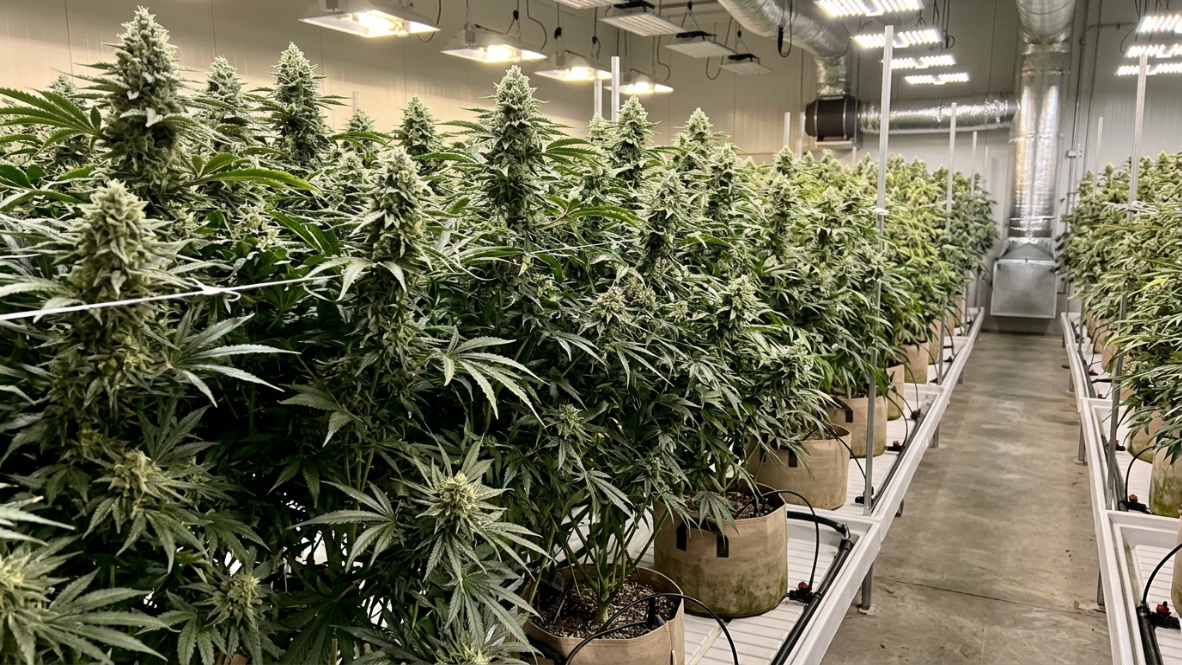
Even high-end LED grow lights lose effectiveness as plant canopies become denser.
Upper leaves intercept most incoming photons before light reaches lower branches. As flowering progresses, this creates a vertical light imbalance where:
Top buds receive excess PPFD
Middle canopy receives moderate light
Lower bud sites become light-limited
Under-canopy lighting restores light distribution by delivering photons directly to shaded leaves, allowing the entire plant to contribute to photosynthesis instead of only the upper canopy.
The Evidence: Does Under-Canopy Lighting Actually Increase Yield?
This is where the question of whether under-canopy lighting is worth it gets concrete. The data range is wide, and understanding why matters more than memorizing a single number.
Peer-Reviewed Research
The most rigorous recent study comes from Garrido et al., published in Plants in 2025. The researchers tested both SCL and ICL configurations against overhead-only controls. The ICL treatment delivered a 29.95% increase in dry inflorescence yield, a 24.4% higher accumulation of THC, and a 12.5% increase in total terpene concentration.
Earlier work by Hawley et al. (2018) in HortScience established the foundational evidence, showing that both red-blue and RGB subcanopy lighting significantly increased yield and THC concentration in lower-canopy bud tissue.
Industry Research
A principal scientist, David Hawley, conducted controlled studies across multiple cultivars and found that subcanopy lighting led to an average yield increase of 7.1% compared to intercanopy lighting. That number is more conservative than many marketing claims, and there is a specific reason.
A multi-cultivar research program revealed a critical distinction that many marketing claims bury: when the same total energy is redistributed between top and subcanopy lighting, total yield generally remains unchanged. Yield gains come from adding light energy to the system, not just moving it around. This is the single most important piece of information for anyone evaluating whether under-canopy lighting is worth the investment. If you are simply dimming your top lights and adding UCL bars to compensate, you should not expect a yield bump. The gains come from additional photons.
Commercial Case Studies
An industry case study at a commercial greenhouse facility in Salinas reported a 29.84% increase in dried, trimmed flower yield above the control group, along with an 11% increase in premium A-grade buds.
A separate industry study reported that supplemental side and bottom lighting with the same total light energy produced a 20% increase in flower yield and a 27% improvement in the premium-to-small bud ratio.
For a real-world example of how supplemental lighting transforms greenhouse production, the Strawberry Fields case study documents doubled winter yields and better canopy uniformity after switching to LED supplemental lighting.
How to Read the Numbers
The honest answer: yield gains from under-canopy lighting range from roughly 7% to 30%. Where you land in that range depends on whether you are adding supplemental light or redistributing existing light, your canopy density, cultivar genetics, and how well optimized your environment already is. The 20 to 30% figures are real in high-density, supplement-light scenarios with deep canopies. The 7% figure represents a more controlled comparison between subcanopy and intercanopy configurations specifically.
Under-Canopy Lighting Research at a Glance
Study | Setup | Yield Increase | Other Benefits |
|---|---|---|---|
Garrido et al. (2025) | Inter-canopy | 29.95% | +24.4% THC, +12.5% terpenes |
Hawley et al. (2018) | Subcanopy LEDs | Significant | Better lower-canopy THC |
Commercial Greenhouse Trial | Under-canopy LEDs | 29.84% | +11% premium flower |
Multi-cultivar Research | Subcanopy vs Intercanopy | ~7% | More consistent production |
Beyond Yield: Quality, Consistency, and Labor Savings
Raw yield is only part of the story. For commercial operations, the quality upgrade may be more financially significant.
Bud Grade Upgrades
Industry research has also found that inter-canopy lighting (ICL) can improve bud grade, with B-grade buds becoming A-grade and C-grade becoming B-grade. For commercial cannabis operators, that shift in flower grading translates directly into higher revenue per harvest. Material that would have been classified as “smalls” or sent to extraction instead becomes top-shelf flower commanding premium prices.
Batch Consistency (The Underappreciated Benefit)
The Garrido 2025 study’s most commercially relevant finding is not just yield, it is consistency. Both SCL and ICL reduced variability in dry flower weight by up to 62%, THC yield variability by over 50%, and terpene content variability by 75%.
For medical cannabis producers and multi-state operators who need batch-to-batch consistency for compliance and branding, this standardization benefit is arguably worth more than the raw yield number. Predictable output simplifies everything from packaging to dosing to quality assurance.
Labor Reduction
Under-canopy lighting reduces the need for aggressive lollipopping (stripping lower branches of growth that would only produce unmarketable buds). When lower bud sites develop properly, growers can skip or reduce this labor-intensive defoliation work. Multiple case studies report lower pruning labor costs because UCL matured lower buds well enough to eliminate de-leafing operations entirely.
The Tradeoffs: What Could Go Wrong
Any honest assessment of whether under-canopy lighting is worth it must address the downsides. This is where practitioner experience diverges sharply from marketing copy.
Heat and Humidity Management
Adding light under the canopy means adding a secondary heat source at substrate level. Without adequate airflow, pockets of heat and moisture build up, creating conditions that invite pathogens and alter transpiration rates.
Practitioners on THCFarmer forums are blunt about this. One experienced grower notes: “It will improve your yield but it will also affect your electric bill and it will raise the temperature in your tent or grow space and your plant will be hungrier. You might need CO2 at this point if you’re not already running it.”
Another grower running UCL in an unheated garage in Southern California described a real tradeoff: the increase in foliage under the canopy made humidity levels harder to control, and he was uncertain whether the yield increase would offset the extra work managing RH.
Understanding and managing VPD becomes even more important when you add heat below the canopy. That said, some growers frame the VPD shift as a net positive: UCL warms the lower microclimate, which means lower buds operate in a VPD environment closer to your room setpoint rather than the cooler, damper conditions near the floor.
Increased Resource Demands
More photosynthesis means more demand for everything else. Plants receiving UCL photosynthesize at higher rates throughout their entire structure, which means they drink more water, consume more nutrients, and can benefit more from supplemental CO2. Light, CO2, water, and nutrients all need to scale together. If you are pushing 1,500 PPFD from the top but underfeeding nutrients or running insufficient CO2, you are wasting light.
The increased transpiration from UCL also affects humidity control throughout the facility, compounding the environmental management challenge.
Cultivar-Dependent Results
Not every strain responds equally. One producer shared first-hand trial experience: “We’ve been running our own trials, and the short answer is: it depends on the cultivar. Cannabis genetics vary wildly, and what works for one cultivar might not work for another.”
This is not a reason to skip UCL, but it is a reason to test before committing to a full facility rollout.
Practical Complexity
Installing and maintaining under-canopy lights takes extra wiring, extra monitoring, and precision about placement and intensity. Too little light and it is a waste of money. Too much and you risk light stress on lower tissue not adapted to high intensity.
A seasoned contributor on THCFarmer captures this well: “These are good options but I wouldn’t advise a new grower to add either of these tools and then stand back and wait for the magic to happen. Both UCL and CO2 change the grow environment to a significant degree.”
When Under-Canopy Lighting IS Worth It
UCL pays off most clearly in these scenarios:
High-density commercial grows with deep canopies. The denser and taller your canopy, the more light your lower sites are missing. Sea-of-green and SCROG setups with thick upper canopies see the largest gains.
Greenhouse winter production. When natural DLI drops in winter months, under-canopy supplemental light helps maintain lower-canopy production that would otherwise collapse. This is especially relevant for greenhouse operations trying to maintain year-round output.
Operations already running optimized environments. If your HVAC, CO2 supplementation, irrigation, and nutrient programs are dialed in, UCL is a natural next step. The 2025 Cannabis Business Times survey found that interest in subcanopy lighting hit 36%, up 12 percentage points from 2024, reflecting growing adoption among serious commercial operators.
Facilities with the electrical and cooling capacity to absorb additional load. UCL works best when your infrastructure has headroom.
When Under-Canopy Lighting Is NOT Worth It
Being honest about when UCL does not make sense builds more trust than overpromising.
Small grows with open canopies. If you are running a few plants with aggressive defoliation and plenty of light penetration, the marginal gains will not justify the cost or complexity.
Growers struggling with environmental instability. If you have not solved basic humidity, temperature, or pest pressure issues, adding a new lighting variable will make things worse. As one forum commenter put it, “under-canopy lighting isn’t a bandaid solution, it’s an optimization strategy for growers looking to refine and elevate already high-performing operations.”
Short plants in sea-of-green or row crops with wide spacing. Research indicates that tall plants benefit more from ICL, while very short plants may benefit more from SCL positioned directly below. Row crops with significant lateral spacing may not benefit meaningfully from either approach.
Budget-constrained operations with other unfixed problems. If the money would be better spent on HVAC, CO2 supplementation, or upgraded top lighting, address those first.
What to Look For in Under-Canopy Fixtures
If you have decided UCL is worth pursuing, fixture selection matters. The sub-canopy environment is harsh: humid, warm, tight, and close to irrigation systems. Here is what to prioritize.
IP rating and UL listing. Fixtures below the canopy get splashed, dripped on, and exposed to high humidity constantly. Look for IP65 or higher water resistance and UL certification for electrical safety. Understanding DLC-listed grow lights also matters if you want to qualify for utility rebates that can offset equipment costs.
Low profile and slim form factor. Space under the canopy is limited. Bulky fixtures block airflow, create shadows, and are difficult to position properly.
Dimmability. Different cultivars and growth stages require different intensities. A fixture you cannot dim is a fixture you cannot optimize.
Full-spectrum white light. Full-spectrum LED output supports healthy plant development and creates a workable visual environment for your cultivation team. It also avoids the spectral compromises of narrowband red/blue fixtures.
Remote driver architecture. This is especially important for under-canopy applications. In-fixture drivers generate heat right at substrate level (the worst possible location), add weight and bulk to bars that need to be slim, and introduce hundreds of failure points in tight, humid spaces. Moving drivers outside the grow environment solves all three problems. The OptiDrive centralized power system takes this approach, relocating the entire power conversion step to a rack outside the grow room.
The Boost XE under-canopy bar was designed specifically for this application at 120W, with OptiDrive compatibility to keep heat and bulk out of the sub-canopy zone.
Getting Started: Implementation Tips
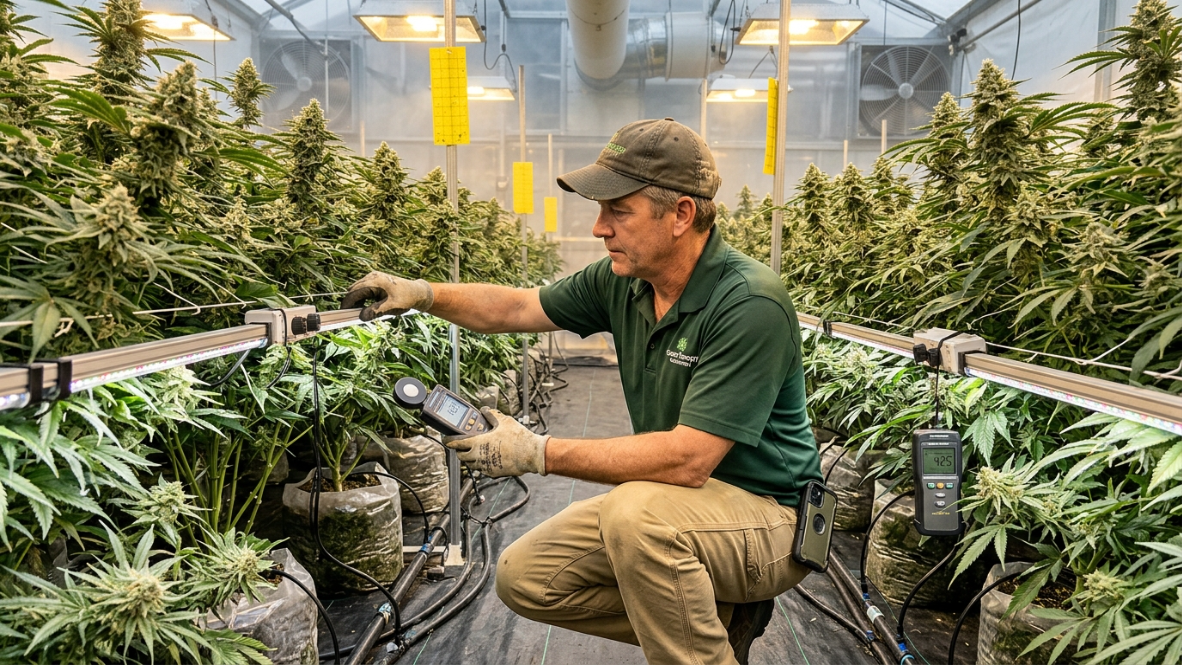
Rolling out under-canopy lighting does not need to be complicated, but it should be deliberate.
Start in early-to-mid flower. Most practitioners recommend turning on UCL around day 14 to 16 of flower, when the upper canopy begins shading lower bud sites. Running UCL during veg is unnecessary for most cultivars since the canopy has not yet developed enough density to block light.
Target the right intensity. Recommended sub-canopy PPFD ranges from 50 to 500 µmol/m²/s depending on application, canopy density, and what your top lighting is already delivering. Starting at the lower end (100 to 200 µmol/m²/s) and scaling up based on plant response is the safest approach.
Add floor-level circulation fans. This is non-negotiable. UCL introduces heat and increases transpiration at the base of the canopy. Without horizontal airflow at that level, you are creating a humidity trap. Position oscillating fans below the canopy to keep air moving around the lower stems and fixtures.
Adjust irrigation and feeding. Plants receiving UCL photosynthesize more aggressively throughout their structure. Your pre-UCL watering schedule may leave them underhydrated, and your nutrient concentrations may need adjustment. Monitor runoff EC and plant response closely during the first cycle.
Run a controlled test batch. Set up one section of your grow with UCL and keep the rest as a control. Weigh and grade the harvest from each section separately. One to two cycles of data will tell you exactly how much UCL is worth in your specific facility, with your cultivars, and at your flower pricing.
Consider the full lighting system. Under-canopy lighting works best as part of an integrated design. Pairing UCL bars with properly specified top lights (like the Pinnacle HP for indoor flower rooms) ensures that the total light environment is balanced rather than patchwork.
Should You Install Under-Canopy Lighting?
Grow Type | Worth It? | Reason |
|---|---|---|
Large Indoor Commercial | ✅ Yes | Highest ROI |
Greenhouse | ✅ Yes | Winter DLI improvement |
Dense SCROG | ✅ Yes | Better lower canopy |
Vertical Farming | ✅ Usually | Improved canopy penetration |
Home Grow (2–6 plants) | ❌ Usually No | Limited economic benefit |
New Grower | ❌ No | Optimize basics first |
The ROI Math
The economics of under-canopy lighting tend to be straightforward. Multiple case studies report that UCL fixtures pay for themselves within one to three harvest cycles at current market pricing for premium flower. One forum contributor on THCFarmer framed it clearly: “UCL is cheaper going in… and Hawley did the work and shows that it’s cost effective for a commercial grower.”
The revenue impact is not just additional weight. It is the grade shift. Converting 10 to 15% of your harvest from smalls to top-shelf flower, at the price differential between those grades, often represents more dollar value than the raw yield increase alone.
For commercial operators running multiple rooms or greenhouses, the compounding effect across dozens of harvests makes the ROI case strong.
Ready to evaluate under-canopy lighting for your facility? Schedule a free lighting consultation with a Thrive lighting expert.
Under-Canopy Lighting Pros and Cons
Pros | Cons |
|---|---|
Higher yield potential | Higher electricity use |
Better lower bud development | Increased heat |
Improved bud consistency | More humidity management |
Better flower grading | Additional installation cost |
Reduced lollipopping labor | Greater irrigation demand |
Faster ROI for commercial grows | More complex environmental control |
Frequently Asked Questions
How much yield increase can I expect from under-canopy lighting?
Published data ranges from 7% to 30%. The variation depends on whether you are adding supplemental light (higher gains) or redistributing existing light (minimal gains), your canopy density, cultivar genetics, and how optimized your environment already is. Peer-reviewed research from Garrido et al. (2025) showed up to 29.95% in an inter-canopy configuration. Multi-cultivar industry studies have shown a more conservative ~7% when comparing subcanopy to intercanopy specifically.
Does under-canopy lighting replace my top lights?
No. UCL is supplemental. It provides light to lower canopy zones that top lighting cannot reach but does not deliver enough intensity or coverage to serve as a primary light source. Think of it as the finishing piece in a complete lighting design, not a replacement.
When should I turn on under-canopy lights during a grow cycle?
Most growers activate UCL in early-to-mid flower, around day 14 to 16, when the upper canopy has developed enough density to meaningfully shade lower bud sites. Running UCL during vegetative growth is typically unnecessary unless you have an unusually dense canopy structure.
What PPFD should I target below the canopy?
Recommended ranges span 50 to 500 µmol/m²/s depending on your setup. For most cannabis applications, starting around 100 to 200 µmol/m²/s and adjusting based on plant response is a practical starting point. Dense canopies with heavy shade can benefit from the higher end of that range.
Will under-canopy lighting increase my electricity costs?
Yes, because you are adding watts to the system. However, the revenue increase from better yield and higher bud grades typically outpaces the added electricity cost within the first few harvests. Forum discussions frequently compare UCL economics to CO2 supplementation as competing upgrade paths, and both are generally considered cost-effective for commercial operations.
Does every cannabis cultivar respond the same way to UCL?
No. Cultivar response varies significantly. Some producers report from their own trials that “what works for one cultivar might not work for another.” This is why running a controlled test batch with your specific genetics is important before committing to a full facility rollout.
What environmental changes should I prepare for when adding UCL?
Plan for increased heat at substrate level, higher humidity from increased transpiration, greater water and nutrient demand, and potentially the need for supplemental CO2 if you are not already running it. Floor-level circulation fans are essential. Monitoring VPD at the lower canopy level becomes more important once UCL is active.
Is under-canopy lighting worth it for small home grows?
Generally not. If you are growing a few plants with open canopies and good light penetration, the marginal gains from UCL probably will not justify the added cost, heat, and complexity. Optimizing your top lighting and plant training methods is usually more cost-effective for small-scale operations.